stump / stumper
15 June 2026
[Edit: 16 June 2026, clarified how the insolvable problem sense developed]
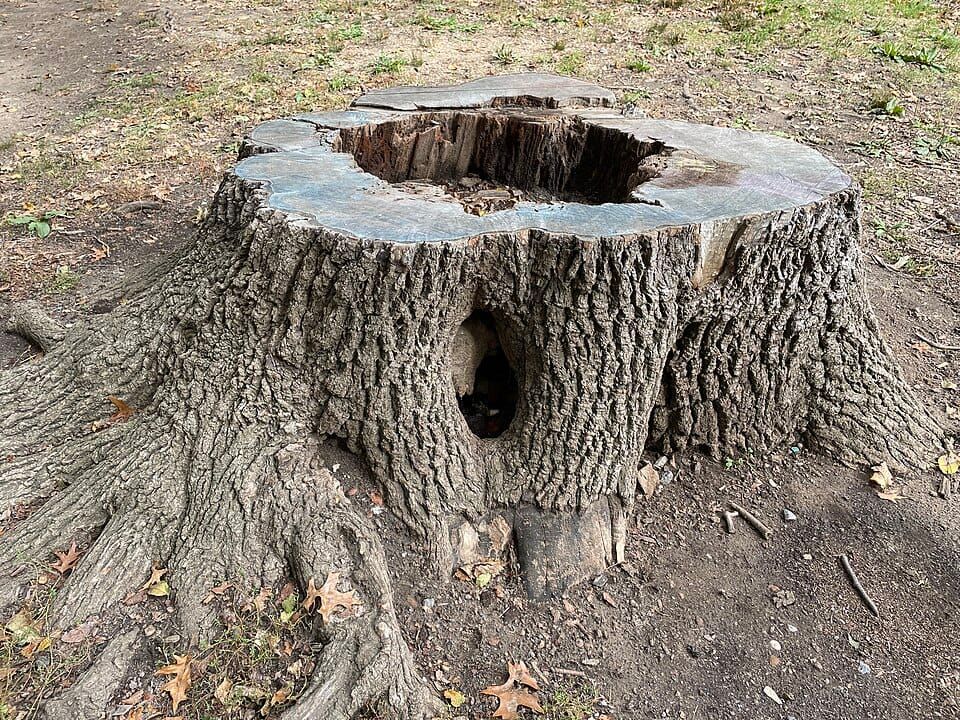
The word stump has a variety of meanings. It can be a noun referring to the what is left after a tree is cut down or a limb—of a tree or a person—is amputated. It can also refer to a place from which a political speech is delivered. And a stumper is an insolvable question or problem. It has been a verb meaning to trip or fall or to walk or tread heavily or to pose an unanswerable question. It has a number of cognates that trace back to the same Germanic root but which likely took different roots into English: stumble, stamp, and stomp.
Stump seems to be a borrowing from the Middle Low German stump or the Dutch stomp. We see it in the written record first as a verb meaning to stumble over a tree stump or obstacle. It appears in the debate poem The Owl and the Nightingale, which was composed in the first half of the thirteenth century:
For flesches lustes hi makeþ slide.
Ne beoþ heo noþt alle forlore
Þat stumpeþ at þe flesches more:
For moni wummon haueþ misdo
Þat arist op of þe slo.
(For fleshly lusts make her fall. But not all is lost if she stumps at the fleshly root: for many women who have sinned have risen up from the mud.)
The verb to stumble probably comes from the same Germanic root but likely entered English via a different route, a borrowing from Old Norse. While we don’t have a record of the sense, the appearance in this poem implies that the noun stump, meaning the remainder of a felled tree, was already in use.
We see this remainder sense about a century later, albeit in the sense of what’s left after a human limb has been amputated, in the poem Joseph of Arimathie. The poem was composed c. 1350 and a c. 1390 manuscript survives. This passage describes Joseph healing a warrior who has lost his arm in a battle:
Þenne com on fro þe fiht þat foule was wemmed,
was striken of þat on Arm and bar hit in þat other.
þen Ioseph asked þe kynges scheld And bad þat mon knele,
þe arm helede a-ȝeyn hol to þe stompe.
(Then [a man] came in from the fight who was badly wounded; one arm was stricken off and he bore it in the other. Then Joseph asked [for] the king’s shield and bade that the man kneel; the arm was healed again, whole to the stump.)
The tree sense is recorded in the Promptorium Parvulorum, an early English-Latin dictionary from the mid fifteenth century:
Stummpe of a tre hewyn done: Surcus, -ci
Surcus is a medieval Latin word referring to what remains after a tree has been cut down or a limb from a tree cut off.
In the Early Modern era, stump started to be used in extended senses referring to the remainder of other stalk- or limb-like things, such as pencils, animal tails, and ships’ masts. The use of stump to refer to the upright posts of a cricket wicket dates to the eighteenth century, as does the use of the verb to mean to knock over a cricket stump or dislodge the bail.
Also from the Early Modern era is the use of to stump meaning to walk heavily, as if with a wooden leg. Again, while it shares the same Germanic root as the semantically similar stamp and stomp, these others came into English via a different path, the Old English stempan.
In the early nineteenth century North America, stump started to be used in the sense of an insolvable question or problem, that is something that might make you trip or fall. We first see it in form of the noun stumper. The satirical magazine Salmagundi, published by Washington Irving, of 20 March 1807 describes (invents?) a debate between an American and an Englishman about the meaning of a line from Shakespeare's Othello:
As ill luck would have it, they happened to run their heads full butt against a new reading. Now this was a stumper, as our friend Paddle would say, for the philadelphians are as inveterate new reading hunters as the cocknies, and for aught I know, as well skilled in finding them out.
Finally, the sense of stump to mean a platform or location from which a political speech is delivered also comes from early nineteenth century North America. The sense comes from the use, either literal or figurative, of tree stumps for such platforms. From the record of a debate in the US House of Representatives about the compensation of its members from 7 March 1816:
The gentleman (Mr. Huger) must pardon me, said Mr. R., if I think his arguments are better calculated for what is called on this of the river stump, than for this Committee, &c.
Sources:
Bosworth, Joseph. In An Anglo-Saxon Dictionary Online, edited by Thomas Northcote Toller, Christ Sean, and Ondřej Tichy. Prague: Faculty of Arts, Charles University, 2014, s.v. stempan, v.
Cartlidge, Neil, ed. The Owl and the Nightingale, corrected edition. Exeter: University of Exeter Press, 2003, lines 1390–94, 34. London, British Library, MS Cotton Caligula A.ix.
“Compensation of Members” (7 March 1816). The Debates and Proceeding of the Congress of the United States, Fourteenth Congress—First Session. Washington, DC: Gales and Seaton, 1854, 1169. HathiTrust Digital Library.
Mayhew, A. L. The Promptorium Parvulorum (1908). Early English Text Society, Extra Series 102. Millwood, New York: Kraus Reprint, 1987, 444. Winchester, Chapter Library (olim Sylkstede). HathiTrust Digital Library.
Middle English Dictionary, 31 January 2026, s.v. stumpe, n.
Oxford English Dictionary Online, 1919, s.v. stump, n.1, stump, v.1, stumper, n., stumble, v.; 1915, stamp, v.; 1986; stomp, v.2.
Skeat, Walter W., ed. Joseph of Arimathie. Early English Text Society. London: N. Trübner, 1871, lines 678–81, 22. Oxford, Bodleian Library, MS Eng. poet. a. 1 (Vernon Manuscript). HathiTrust Digital Library.
Wizard, William (pseudonym for Washington Irving, William Irving, or James Kirke Paulding). “Theatricks.” Salmagundi; or, the Whim-Whams and Opinions of Launcelout Langstaff, Esq. No. 6, 20 March 1807, 121. HathiTrust Digital Archive.
Photo credit: CobbleHill621, 2021. Wikimedia Commons. Licensed under the Creative Commons Attribution-Share Alike 4.0 International license.
