throw one's hat into the ring
10 August 2026
To throw one’s hat into the ring is to enter into a fray or contest, and in particular to announce one’s candidacy for an office. The metaphor has a very literal origin in early nineteenth-century boxing, when challengers would toss their hat into the boxing ring to signal their willingness to fight.
We see a literal use of the phrase in a Times of London article on 30 November 1804:
The champions arrived at Wilsdon Green at eleven o’clock, in two hackney coaches, with their rings, where a ring was formed by the spectators, who greeted the tools of their amusement by loud cheers.—Belcher first threw his hat into the ring over the heads of the spectators, as an act of defiance to his antagonist, who received him in the ring with a welcome smile.
And the phrase would soon start to be used as a metaphor for entering into a dispute or contest. Here is an example from the Blackwood’s Edinburgh Magazine of June 1822 that uses the metaphor, but that still clearly links it to its boxing origins. The quotation here is rather long, but I couldn’t resist the prose and the subject of Byron:
Lord Byron, too, has written something about us—but whether a satire or eulogy seems doubtful. The Noble Lord—great wits having short memories, and sometimes not very long judgments—has told the public and Mr Murray that he has forgotten whether his letter is on or to The Editor of Blackwood’s Magazine. From this we fear his Lordship was in a state of civilation sic when he penned it; and if ever he publishes it, as we scorn to take advantage of any man, we now give his Lordship and the public a solemn pledge, to drink one glass of Sherry, three of Champagne, two of Hock, ditto of Madeira, six of Old Port, and fort-and-twenty of Claret, before we put pen to paper in reply. At the same time, Lord Byron should recollect that we are now an old man—just as Jeremy Bentham is now an old woman; and that he, who has youth on his side, ought not to throw up his hat in the ring, and challenge us for a bellyful. We think we can fit him with the gloves, and that is pretty light play for one at our time of life. But we have still a blow or two left in us; and if a turn-up with the naked mauleys there must be, a hit on the jugular may peradventure do his Lordship’s business.
A couple of years later we see the metaphor being used without direct reference to its boxing roots. The following is from a letter composed by Walter Scott that comments on his continuing personal friendship with Lord Melville, with whom Scott was engaged in a political disagreement over proposals for banking reform. The letters Scott refers to are pamphlets he penned under the pseudonym Malachi Malagrowther in which he took issue with the government’s proposed policies:
I remain of the same opinion respecting the Letters, which have occasioned so much more notice than they would have deserved, had there not been a very general feeling in this country, and among Lord Melville's best friends too, authorizing some public remonstrances of the kind from some one like myself, who had nothing to win or to lose—or rather, who hazarded losing a great deal in the good opinion of friends whom he was accustomed not to value only, but to reverence. As to my friend Croker, an adventurer like myself, I would throw my hat into the ring for love, and give him a bellyful. But I do not feel there is any call on me to do so, as I could not do it without entering into particulars, which I have avoided.
And in an American context, throwing one’s hat into the ring would become a metaphor for candidacy for office. The following headline appeared in Texas’s Austin Statesman of 7 June 1907 regarding Senator Philander Knox’s bid for the Republican nomination for president in 1908:
KNOX’S HAT IN THE RING
Pennsylvania Senator Will Make Race for Nomination by Republican Convention for Presidency
Knox would lose the nomination battle to William Howard Taft.
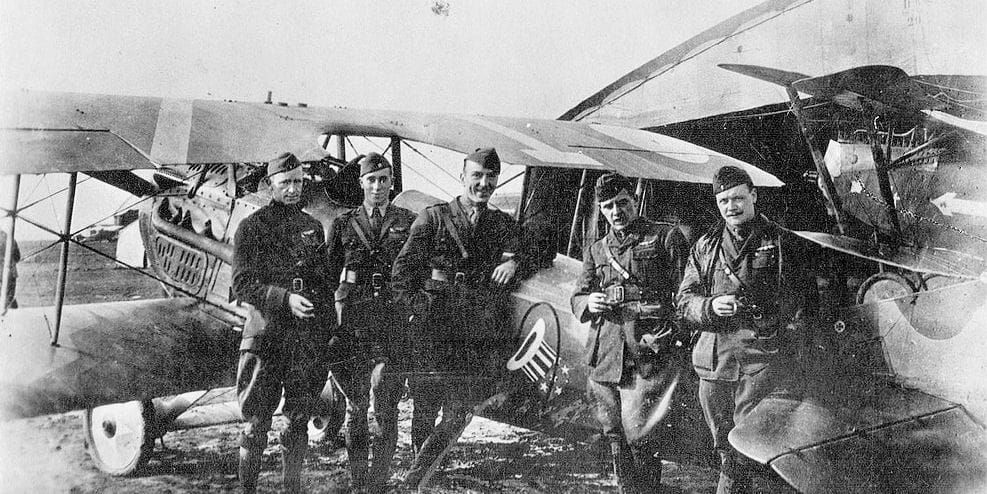
Perhaps the most famous use of the metaphor, only this time in graphic rather than lexical form, was during the First World War. The American 94th Aero Squadron used a squadron insignia of a top hat, decorated with stars and stripes, within a ring. In 1917, the unit was among the first US squadrons to arrive in France, hence the insignia as a metaphor for the United States entering the war. The squadron produced three aces, including Eddie Rickenbacker, the most decorated US pilot of the war, credited with twenty-six aerial victories, and the squadron’s exploits were widely reported in the press. Rickenbacker’s pre-war fame as a racecar driver contributed to the squadron’s notoriety and press coverage. The US Air Force’s 94th fighter squadron uses the hat-in-the-ring insignia to this day.
Sources:
Blackwood, William. “Preface” (20 June 1822) Blackwood’s Edinburgh Magazine, June 1822, vii. HathiTrust Digital Archive. https://babel.hathitrust.org/cgi/pt?id=chi.42691634&seq=268
“Knox’s Hat in the Ring” (headline). Austin Statesman (Texas), 7 June 1907, 1/7. ProQuest Newspapers.
Oxford English Dictionary Online, March 2017, s.v. hat, n.
“Pugilism.” Times (London), 30 November 1804, 3/2. Gale Primary Sources: The Times Digital Archive.
Scott, Walter. Letter to Robert Dundas (1826). John Gibson Lockhart, ed. Memoirs of the Life of Sir Walter Scott, second edition, vol. 8 of 10. Edinburgh: Robert Cadell, 1839,296. HathiTrust Digital Archive.
Photo Credit: US Army photograph, 1918. Wikimedia Commons. Public domain photo.
