gala

12 August 2026
English use of gala is an eighteenth-century borrowing from French, and word originally comes from the Middle and Old French gale, meaning festivity, rejoicing. But the sources disagree about the early path the word took. In a very old entry, the Oxford English Dictionary and more recently the American Heritage Dictionary say the word sojourned in Italian for a while before being borrowed back into French. Merriam-Webster says the stopover was in Spanish. In any case, all this happened before English took the word from French.
That borrowing can be traced to 1625 in a letter by Walter Aston which uses the plural galas to refer to festive clothing:
I understand the French Embassadour by order from the King his Master, hath given account unto this King of the Conclusion of the Match betwixt the Prince his Highnesse, and Madam Christiene his Masters Sister. Whereupon this King, and the whole Court put on Galas: I conceive (howsoever I have not heard any thing thereof by any Letter unto me) that this is ground enough to Congratulate with your Grace this good beginning which I shall affectionately wish may in the successe in all times prove a happiness to his Highnes and a particular blessing to your Grace.
In the seventeenth century gala starts being used to mean festivity in general. Another letter, this time by Mary Wortley Montagu in 1716 uses the word:
They declare, that on such a day the assembly shall be at their house in honour of the feast of the count or countess——such a one. These days are called days of Gala, and all the friends or relations of the lady, whose saint it is, are obliged to appear in their best clothes, and all their jewels.
Toward the end of that century we see gala being used to refer to a specific event. One early use may be in Richard Brinsley Sheridan’s 1780 play The School for Scandal. But it is unclear if Sheridan is using the word to refer to a specific event or to festivity in general:
And yet, I chose with caution a girl bred wholly in the country, who had never known luxury, beyond one silk gown, or dissipation beyond the annual gala of a race ball—Yet now, she plays her part in all the extravagant fopperies of the town, with as good a grace as if she had never see a bush, or a grass plot out of Grosvenor Square.
In any case, by 1799 gala is definitely being used to mean a specific event, as this appearance in the October issue of The Sporting Magazine attests:
Some time ago a certain Lord gave a grand gala to the members of the Volunteer Corps in his neighbourhood, all of whom attended in full uniform.
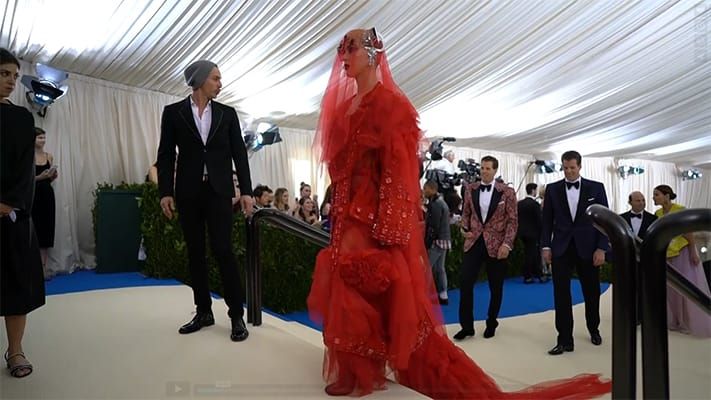
And today, this last sense is perhaps most familiar in reference the annual Met Gala, a fund-raising event for and at the Metropolitan Museum of Art in Manhattan that has been held since 1948.
Sources:
American Heritage Dictionary, fifth edition, 2022, s.v. gala, n.
Aston, Walter. Letter, 10 December 1625. In Cabala, sive, Scrinia Sacra Mysteries of State & Government. London: G. Bedel and T. Collins, 1654, 53–54. ProQuest: Early English Books Online (EEBO).
“Feast of Wit, or Sportsman’s Hall.” The Sporting Magazine, October 1799, 50–52 at 51. HathiTrust Digital Library.
Merriam-Webster.com, 22 April 2026, s.v. gala, n.
Montagu, Mary Wortley. Letter, 1 October 1716. Letters of the Right Honourable Lady M—y W---y M---e. London: M. Cooper, 1775, 32–33. Archive.org.
Oxford English Dictionary Online, 1898, s.v. gala, n.1 and adj.
Sheridan, Richard Brinsley. The School for Scandal. Dublin: 1780, 11. Gale Primary Sources: Eighteenth Century Collections Online.