little green men / little people
12 June 2026
Before there were grays, reptilians, and other species of extraterrestrial beings that have visited earth in science fiction tales and in hallucinations, there were little green men. The phrase appears at the close of the nineteenth century but has its origins in older folklore about little people, a term for elves, fairies, and other mythical beings.
The shift from the supernatural and folkloric to the extraterrestrial and science fiction is a common one. As our understanding of the world changes our culture, the older beliefs are transformed into ones compatible with that understanding. Another example of this happening is demonic incubi and succubi, who allegedly visited people in their sleep, an explanation for hypnagogic hallucinations, transforming into alien visitors.
The phrase little people begins to be applied to fairies and the like in the eighteenth century. For instance, there is this published in the Delphick Oracle of 2 October 1719, although the little people here are humans of small stature whom the writer believes to be the origin of beliefs in fairies:
If then that they be Flesh and Bones, and are subject to Death, the Stories of these Fairies or little People, must proceed from those little People, about a Cubit, or 3 Spans in Height, call’d Pygmies; some of whose small Race are yet to be seen in the Island of Aruclet, one of the Molucca’s, and in the Isle of Cophi.
Poet George Waldron uses both little people and little men to denote the fairies believed by the locals to live on the Isle of Man. From his Description of the Isle of Man, written in 1726 and published posthumously in 1731:
I know not, Idolizers as they are of the Clergy, whether they would not be even refractory to them, were they to preach against the Existence of Fairies, or even against their being commonly seen: for tho’ the Priesthood are a kind of Gods among them, yet still Tradition is a greater God than they; and as they confidently assert that the first Inhabitants of their Island were Fairies, so do they maintain that these little People have still their Residence among them.
And there is this a little further on in the text:
A WOMAN who lived about two Miles distant from Ballasalli, and used to serve my Family with Butter, made me once very merry with a Story she told me of her Daughter, a Girl of about ten Years old, who being sent over the Fields to the Town, for a pennyworth of Tobacco for her Father, was on the top of a Mountain surrounded by a great Number of little Men, who would not suffer her to pass any farther.
A dispute breaks out among the little men as to whether they should abduct her or let her return home, at the end of which they rip her clothes off and beat her bloody. If there is a grain of truth to the story, it would appear to be that of a sexual assault by a gang of local men, hardly something to make one “very merry,” even in the sanitized version depicted by Waldron.
By the mid eighteenth century, such little people begin to be described as being clothed in green, and the phrase little green man starts to make its appearance. From “The Little Green Man of Smokhausen. A Legend of the Rhine,” a story printed in the Cherokee Advocate on 30 March 1853, which depicts a fairy-like, match-making spirit dressed in green:
The baron held out his hand, lifted the little green man down, and having placed a chair, by his request, on the other side of the table, his visitor seated himself on its back.
Another such depiction is F. M. Allen’s 1895 book The Little Green Man, a story about a leprechaun.
The little green people move from being earthly spirits to extraterrestrial beings at the close of the century. Charles Battell Loomis’s children’s story the Green Boy from Harrah tells of the adventures an earth boy named Sandy has with an extraterrestrial visitor, printed in the Atlanta Constitution of 8 October 1899:
“Where’d you come from? asked the little chap.
“From Harrah,” was the reply. He was just about Sandy’s size, but much slenderer, and his head was nearly twice as big. His eyes were yellow and shone like electric lights. His hair was a lighter shad of green than his body and his lipe [sic] were straw colored, uncanny looking, and yet not unhandsome, and decidedly friendly, for he rubbed Sandy’s cheeks with his long slender hands and made a cooing noise that evidently meant “I like you.”
“Where’s Harrah?” asked Sandy, but beyond pointing to the sky the green boy could not explain. Probably he had come from a star and Harrah was what he called it.
And we get the phrase little green men used in reference to ETs in the Sunday Oregonian of 29 July 1906:
And, sure enough, the man who opened the door came back in a minute and said that the president would come down at once and that he was anxious to meet Eddie of New York and then little green men from the moon.
Two years later, Ohio’s Columbus Evening Dispatch of 31 March 1908 printed this joke that shows that the phrase little green man had become widely understood as a reference to extraterrestrial beings:
The Martians were prepared to catch the first message from the earth.
“Let me see,” exclaimed the first little green man, “I wonder if the first communication will be a flash, a tick or a knock.”
“A knock, very likely,” laughed the second little green man. “You know the earth is just full of knockers.”
Which shows how wise the Martians really are.
I’ll conclude by discussing the Oxford English Dictionary’s earliest entry for little green man in a folkloric or science fiction context. It’s from an 1802 poem titled, The Little Green Man. A German Story, the opening stanzas of which read:
THE LITTLE GREEN MAN.
A German Story.
Ye warriors so bold, and ye ladies so gay,
At the Pump-room, at Ty——n’s, at K——g’s, or the play,
Oh never, oh never be seen;
For the Little Green Man will surely be there,
The Little Green Man, who delights to stare
So fierce, through his goggles of green.
The Little Green Man, in the dead of the night,
Fell in love with a maiden, all gaily bedight
In scarlet, in white, and in blue:
“Come, Lady, sweet Lady, with me come away;
Fine clothes you shall have, we will play a fine play;
Come home, I am dying for you!”
“Oh partner! oh partner! and dost thou not hear,
How the Little Green Man whispers low in mine ear
To follow him home from the ball?”
“He is joking, he’s joking—I tell you he is,
’T is only design’d as an innocent quiz,
’T is nothing, ’t is nothing at all.”
But this is not a poem about a fairy or ET. It is a about an ordinary man, whom we today might label as an incel, who accosts a woman at a ball, is subsequently beaten by the other gentlemen at the affair, and who swears revenge upon them. The green here would seem refer to jealousy. Also note the use of an archaic sense of quiz to mean an odd or eccentric person.
Sources:
Allen, F. M. The Little Green Man. London: Downey, 1895. HathiTrust Digital Library.
Delphick Oracle, 2 October 1719, 3. ProQuest Historical Periodicals.
Historical Dictionary of Science Fiction, 17 November 2024, s.v. little green man, n.
“The Little Green Man. A German Story.” The Spirit of the Public Journals, vol. 5. London: James Ridgway, 1802, 348–50. HathiTrust Digital Library.
“The Little Green Man of Smokhausen. A Legend of the Rhine.” Cherokee Advocate (Tahlequah, Oklahoma), 30 March 1853, 1/4. Readex: America’s Historical Newspapers.
Loomis, Charles Battell. “Green Boy from ‘Harrah.’” Atlanta Constitution (Georgia), 8 October 1899, Constitution, Jr. 2/1. ProQuest Historical Newspapers.
Oxford English Dictionary Online, September 2014, little green man, n., little man, n., little people, n.
Palin, G. Herb. “The Little Green Men.” Sunday Oregonian (Portland), 29 July 1906, 47/3. Readex: America’s Historical Newspapers.
“Planet of Hammers.” Columbus Evening Dispatch (Ohio), 31 March 1908, 14/8.
Waldron, George. “A Description of the Isle of Man.” In Compleat Works, in Verse and Prose. Tracts, Political and Historical. London: Widows and Orphans, 1731, 93–191 at 125–26, 131. Gale Primary Sources: Eighteenth Century Collections Online.
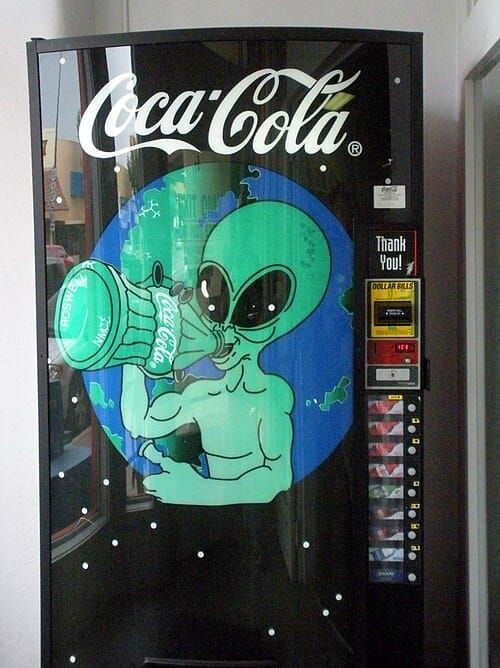
Photo credit: mr_t_77, 2011. Wikimedia Commons. Licensed under the Creative Commons Attribution-Share Alike 2.0 Generic license.
.jpg?ref=wordorigins-org.ghost.io)