incumbent
22 April 2026
Today we usually find the word incumbent in the context of politics, referring to the current holder of a political office. But English use of the word was originally in the sense of the holder of an ecclesiastical office.
Incumbent comes from the medieval Latin incumbere, meaning to settle on, to sit or lie on, but it was also used figuratively to mean to occupy a religious office or benefice. The earliest use of the word in English that I’m aware of is in one particular manuscript of Geoffrey Chaucer’s Canterbury Tales, London, British Library, Harley MS 7334, copied c. 1410. It appears near the beginning of the Wife of Bath’s Tale, where Chaucer is likening the mendicant friars of his day to the elves and fairies who supposedly used to wander the land:
For þer as wont was to walken an elf
Ther walkith noon . but þe lymytour himself
In vndermeles and in morwenynges
And saith his matyns and his holy þinges
As he goþ in his lymytacioun
wommen may saufly vp and doun
In euery bussch or vnder euery tre
Þer is non oþer incumbent but he
And ne wol but doon hem dishonour
(For where an elf was wont to walk
There walks no one but the mendicant friar himself
In late mornings and in early mornings,
And says his morning prayers and holy things
As he goes in his assigned district.
Women may go safely up and down.
In every bush and under every tree
There is no other incumbent but he
And he will do them no harm but dishonor.)
Most manuscripts of the Tales, including the Ellesmere and Hengist manuscripts which are considered the most authoritative, do not have this reading. Those manuscripts have incubus where this one has incumbent. And given the passage’s allusions to elves and fairies, incubus would indeed seem to be Chaucer’s original, but this manuscript does provide evidence of the use of incumbent.
We see the usual use of incumbent, referring to the holder of an ecclesiastical office, in a letter, written in 1424 or earlier, by John Hurlegh to Thomas Stoner:
I am enfourmed þat Osebarn and Cassy have pursued a new writ of quare impedit aȝeyns J. Golafre. J. Warfeld, and þe incumbent.
A writ of quare impedit (literally, why does he hinder) was an English a common law action requesting the court resolve a disputed benefice, typically brought against a bishop who has appointed someone else to the post.
And by the latter half of the seventeenth century we see incumbent used to refer to secular political offices. Here is an example from Andrew Marvell’s 1672 The Rehearsal Transpros’d, in which he refers to kings as incumbent stewards of their kingdoms:
For these Kings, Mr. Bayes, how negligent soever or ignorant you take'm to be, have, I doubt, a shrewd understanding with them. ’Tis a Trade, that God be thanked, neither you nor I are of, and therefore we are not so competent Judges of their Actions. I my self have oftentimes seen them, some of them, do strange things, and unreasonable in my opinion, and yet a little while, or sometimes many years after, I have sound that all the men in the world could not have contrived any thing better. ’Tis not with them as with you. You have but one Cure of Souls, or perhaps two, as being a Noblemans Chaplain, to look after: And if you make Conscience of discharging them as you ought, you would find you had work sufficient, without writing your Ecclesiastical Policies. But they are the Incumbents of whole Kingdoms, and the Rectorship of the Common people, the Nobility, and even of the Clergy, whom you are prone to affirm when possest with principles that incline to rebellion and disloyal parctices, to be of all Rebels the most dangerous, p. 49, the care I say of all these, rests upon them.
From there it is an easy jump to democratically elected political office and the sense we know today.
Sources:
Chaucer, Geoffrey. “The Wife of Bath’s Tale.” In The Harleian MS 7334 of Chaucer’s Canterbury Tales. Frederick J. Furnivall, ed. The Chaucer Society. London: N. Trübner, 1885, lines 3:873–81, 219. London, British Library, Harley MS 7334, fol. 97v. HathiTrust Digital Archive.
Dictionary of Medieval Latin from British Sources, Oxford UP, 2013, s.v. incumbere, v. Brepols: Database of Latin Dictionaries.
Hurlegh, John. “Letter to Thomas Stoner” (28 September 1424, or earlier). The Stoner Letters and Papers, 1290–1483, vol. 1. Charles Lethbridge Kingsford, ed. London: Royal Historical Society, 1919, 35. HathiTrust Digital Library.
Marvell, Andrew. The Rehearsal Transpros’d, second edition. London: A.B., 1672, 134. ProQuest: Early English Books Online (EEBO).
Middle English Dictionary, 31 January 2026, s.v. incumbent, n.
Oxford English Dictionary Online, 1900, s.v. incumbent, n., incumbent, adj.
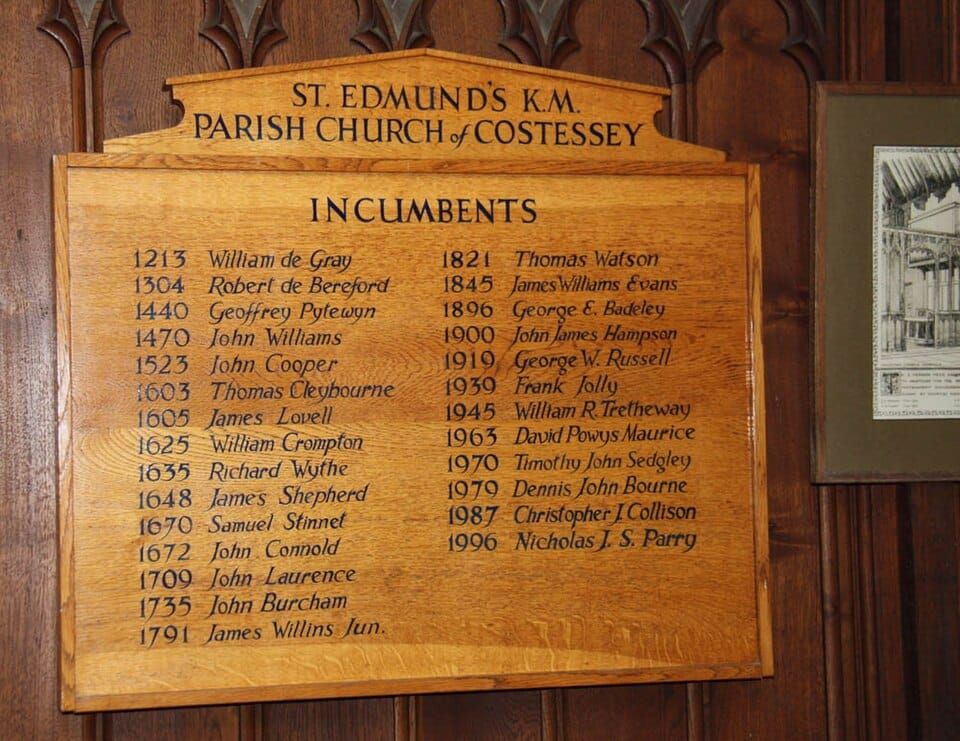
Photo credit: John Salmon, 2011. Wikimedia Commons. Licensed under the Creative Commons Attribution Share-alike license 2.0.
.jpg?ref=wordorigins-org.ghost.io)