on/off the hook
20 May 2026
The phrases on the hook and off the hook have had various meanings over the centuries. Of course, there are many literal uses of the phrases, but the figurative ones extend from on the hook metaphorically meaning to be ensnared or entrapped, like a fish on an angler’s line, to off the hook meaning to be wild and out of control. The use of hook as a metaphor for entrapment or being under control underlies all the figurative senses.
The metaphorical use of on the hook dates to the seventeenth century when Robert Naughton uses it in his 1642 Fragmenta regalia. The following passage is about Queen Elizabeth I’s spymaster, Francis Walsingham, who, starting in 1580, had used information about William Parry, a Roman Catholic, to compel him to spy on others of his faith, but Parry was a double agent and plotted to assassinate Elizabeth. Parry was caught and executed in 1585.
They note him to have had certain curiosities, and secret wayes of intelligence above the rest, but I must confesse I am to seek wherefore he suffered Parry to play so long on the hook, before he hoysed him up; and I have been a little curious in the search thereof, though I have not to do with the Arcana Imperii [i.e., secrets of the empire].
And in that same era we see off the hooks to mean being flustered or in a bad temper. From Robert Davenport’s 1639 play A New Trick to Cheat the Divell:
Rog[er]. I doe not like this shufling.
Gef[frey]. What Roger, al amort, me thinkes th’art off o’th’hookes?
Rog. Yes faith, and Henges too, I’me almost desperate,
And care not how I am.
And by the nineteenth century, off the hooks in the ill-tempered sense had developed into being crazy or eccentric. We see the sense in Walter Scott’s 1824 novel St Ronan’s Well:
So saying, he exhibited a very handsome, highly-finished, and richly mounted pair of pistols.
“Catch me without my tools,” said he, significantly buttoning his coat over the arms, which were concealed in a side-pocket, ingeniously contrived for that purpose. “I see you do not know what to make of me,” he continued, in a familiar and confidential tone; “but, to tell you the truth, everybody that has meddled in this St Ronan’s business is a little off the hooks—something of a tête exaltée, in plain words, a little crazy, or so; and I do not affect to be much wiser than other people.
By the middle of the twentieth century, we see off the hook in American slang, meaning to be freed from an obligation, debt, or unfortunate situation. From Jim Thompson’s 1953 novel The Criminal:
Maybe that Federal judgeship will come through soon enough to take me off the hook.
And by the end of that century, off the hook was being used in teen and Black slang to refer positively to situations that were crazy or out of control. The college slang project at California State Polytechnic University (Cal Poly), Pomona defined off the hook as “happening; incredibly cool and hip.”
Sources:
Davenport, Robert. A New Trick to Cheat the Divell. London: John Okes for Humphrey Blunden, 1639, Act 1.1, B2r. ProQuest: Early English Books Online (EEBO).
Green’s Dictionary of Slang, accessed 26 April 2026, s.v. hook, n.1.
Naunton, Robert. Fragmenta regalia, or Observations on the Late Queen Elizabeth, Her Times and Favourites. London: 1642, 19. HathiTrust Digital Library.
Oxford English Dictionary Online, 2024, s.v. hook, n.1.
Scott, Walter. St Ronan’s Well, vol. 3 of 3. Edinburgh: Archibald Constable, 1824, 95–96. HathiTrust Digital Library.
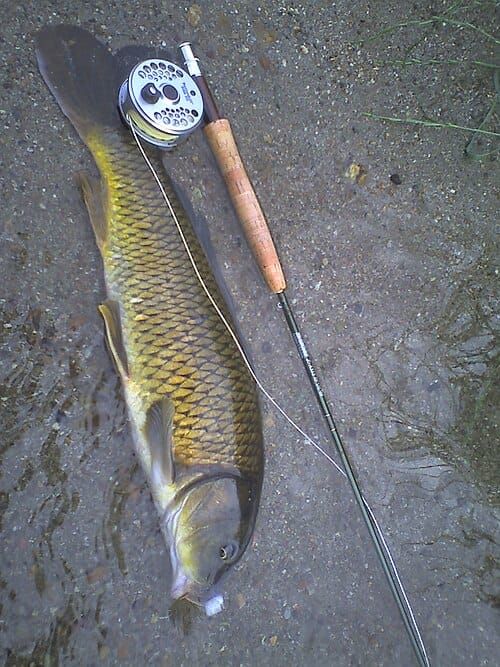
Photo credit: Fishfeeder, 2009. Wikimedia Commons. Licensed under a Creative Commons Attribution-Share Alike 3.0 Unported license.
