hush puppy
29 June 2026
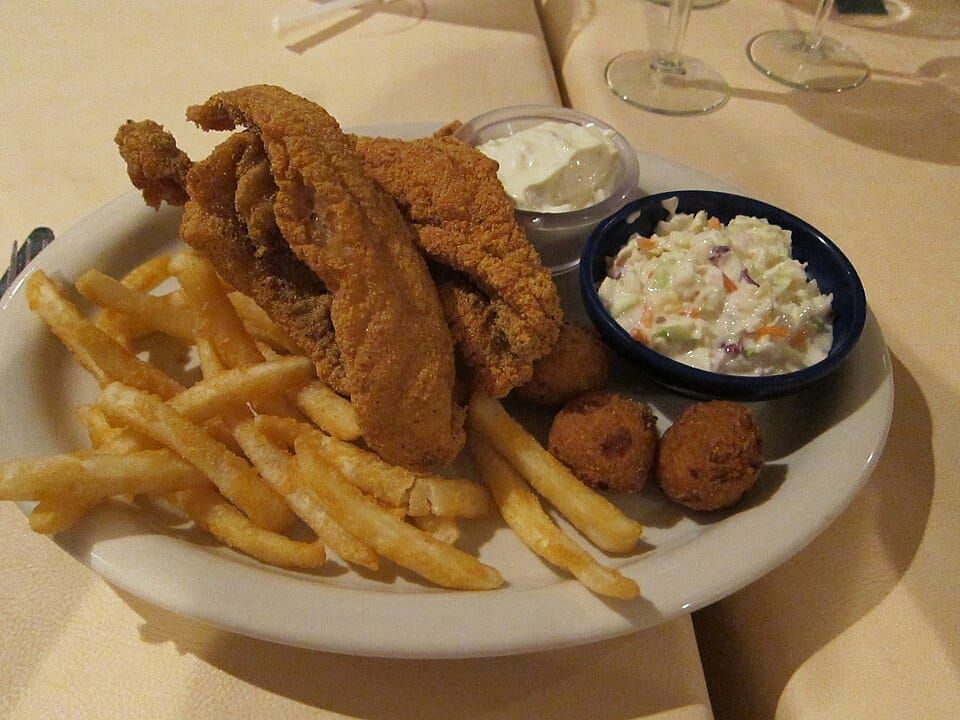
Hush puppy has a number of meanings ranging from types of food to a brand of casual shoes, but its most common meaning is that of a small, fried ball of corn meal. The dish is a common throughout the American South and is often served alongside fish. The name probably comes from the idea that hush puppies can be fed to a dog to keep it quiet.
The use in reference to the balls of fried corn meal is attested to in the early twentieth century, but we see hush puppy gravy being used to refer to white or cream gravy from several decades earlier. The following is a passage from an article in the 23 October 1879 issue of Louisville, Kentucky’s Courier-Journal that describes the aftermath of a deadly skirmish with Native Americans that had occurred on 9 January 1876:
Jim Gillet, of Lampasas Springs, who took one of the scalps, covered his revolver holster with it, but afterward, in bending over a frying pan at breakfast, he trailed the long hair into the “hush puppy” gravy, whereupon Lieut. N. O. Reynolds applied a torch to the greasy locks, and in an instant nothing was left but the bald skin. “Wah!” said a wooly ranger as he sniffed the burnt hair, “you have spoilt my appetite.”
We see the term used in reference to some unspecified type of food in Kirk Monroe’s 1899 novel of the Spanish-American war. This is the earliest citation in the Oxford English Dictionary. The scene is that of an army camp in San Antonio, Texas:
Had breakfast hours ago, you know, and a prime one it was. Scouse, slumgullion, hushpuppy, dope without milk, and all sorts of things.
Hushpuppy here may refer to the balls of corn meal, but since scouse and slumgullion are a type of stew, and since, as we shall see, hush puppy can also refer to a stew, it may be reference to the latter. And indeed, there is this from Alabama’s Montgomery Advertiser of 10 October 1907 that uses hush-puppy as the name for a stew:
The Voice of the People—we heard much of it even in these days when there is scant enough belief in any god to stand sponsor as joint owner. Yet is it not but today’s well-cooked hash of the scraps from yesterday’s feast of words? A camp stew? What streetwise cooks call a Hush-puppy or a Duke’s Mixture?
We finally get a clear use of hush puppy to refer to the balls of corn meal in the New York Tribune of 8 September 1912:
I’m tellin’ you all this in excuse for Frosty bein’ a cook. Seems like he was just fitted for that callin’ and no other. He could cook frijoles and hush-puppy, and make sinkers, or moss agates, or death balls, or whatever you call biscuits, as good as the best.
And hush puppy is given as the name for a type of soup in the Arkansas Gazette of 14 August 1917. Whether or not this soup is more of a stew cannot be determined from the context:
If you want good soup that’s good and made in wash post and made in “hush puppy” style, visit this little country city and ask for the same. We are the originals of “hush puppy” soup.—Spring Hill Correspondent of the Hope Gazette.
And there is a solid description of corn meal hush puppies in the Atlanta Journal of 21 December 1919:
They had no fancy bill-of-fare and only old Bill for a cook, but how they did feast out there beneath those big trees. They would awaken in the morning from a refreshing sleep in the open air to a breakfast that is enough to make any man envious in these days of high prices. There was hominy and butter, venison, friend [sic] fish and coffee, the real article, “slap-jacks” and “hush-puppies” with syrup and wild honey. For the benefit of the novice I had better state that “slap-jacks” are thin cakes of corn bread friend [sic] where the venison was cooked and “hush-puppies” are small pones of corn bread cooked in the grease in which the fish had been fried.
The idea that the name comes from a food fed to a dog in order to keep it quiet has some evidentiary support. There is this from Oklahoma’s Henryetta Free-Lance of 25 September 1914. Here the term is used to refer to a pork barrel appropriation enacted by politicians to silence critics and appease voters:
Those Republicans who engineered the successful filibuster in Congres [sic] against the fifty-three million dollar “hush-puppy” appropriations deserve the thanks of the entire public.
And there is this casually racist use of the stew sense of hush puppy that opines on the origin in Jackson, Mississippi’s The Issue of 13 May 1915:
“Pot-licker” or “hush-puppy,” a concoction of utilitarian value so comprehensive as to be employed both in silencing the growls of “houn’ dawgs” and keeping colored babies from becoming bow-legged, was celebrated in speech and story yesterday afternoon at the Mississippi dedication exercises.
[…]
Known as “Hush Puppy.”
State Senator H. H. Casteel of Mississippi said that “pot-liquor” in his section was known as “hush-puppy,” because it kept the “houn’ dawgs” from growling.
So that is probably how the foodstuffs got their name.
As for the brand of shoes, they went on the market in 1958 and feature a basset hound as the brand’s mascot. According to the company’s website, the name comes from the idea that the shoes are “solutions for sore feet, aka ‘barking dogs.’”
Sources:
“About Us.” Hushpuppies.com, accessed 6 June 2026.
“All Over Arkansas.” Arkansas Gazette (Little Rock), 14 August 1917, 6/8. Readex: America’s Historical Newspapers.
Bealer, Alex W. “Hunting Trip Down on Pin Hook River.” Atlanta Journal (Georgia), 21 December 1919, SM 2/3. Readex: America’s Historical Newspapers.
“Bow, Shield, Quiver and Arrows.” Courier-Journal (Louisville, Kentucky), 23 October 1879, 3/6. ProQuest Newspapers.
Dictionary of American Regional English (DARE), vol. 2, 1991, s.v., hush puppy, n.
Henryetta Free-Lance (Oklahoma), 25 September 1914, 2/2. Newspapers.com.
Munroe, Kirk. Forward, March: A Tale of the Spanish-American War. New York: Harper & Brothers, 1899, 28. HathiTrust Digital Library.
Oxford English Dictionary Online, 1976, s.v. hush puppy, n.
Popik, Barry. “Hush Puppies,” 17 August 2006. Barrypopik.com.
“Pot Liquor” The Dedication Pass Word.” The Issue (Jackson, Mississippi), 13 May 1915, 4/1. Newspapers.com.
Speed, Ida. “The Double Cross Outfit.” New York Tribune, 8 September 1912, SM 13/1. ProQuest Newspapers.
“What the Crowd Had to Say Enroute to the Wild West.” Montgomery Advertiser (Alabama), 10 October 1907, 7/4. ProQuest Newspapers.
Photo credit: Jay Cross, 2009. Wikimedia Commons. Flicker.com. Licensed under the Creative Commons Attribution 2.0 Generic license.
