Hail Mary play / prayer shot
10 July 2026
Hail Mary as part of a prayer or devotional recitation dates to late fourteenth century, but it appears a few decades earlier as a translation of the angelic greeting to Mary in Luke 1:28. It is a calque of the Latin Ave Maria.
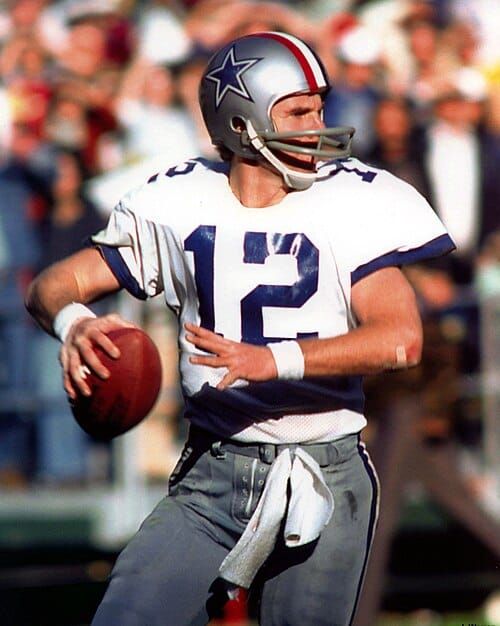
It is, however, also used in sporting contexts as a label for a pass or shot made in desperation, in a last-minute attempt to win the game; the idea is that one makes the shot and then prays that it works. It is perhaps most strongly associated with a fifty-yard, game-winning, touchdown pass thrown with 24 seconds left on the clock by Dallas Cowboys quarterback Roger Staubach to wide receiver Drew Pearson to win an NFC playoff game against the Minnesota Vikings on 28 December 1975. After the game, Staubach, a devout Catholic, was quoted in the New York Times:
“It was a play you hit one in a hundred times if you’re lucky,” Staubach said. “I guess it’s a Hail Mary pass. You throw it up and pray he catches it.”
But this was far from the first time Hail Mary was used in sports. That dates to half a century earlier, and the nondenominational phrase prayer shot is even older.
We see prayer shot in a basketball context from 26 December 1916. From the Scranton Republican of that date:
Scranton was first to score in the nightcap, a foul goal by Long making the totals 11 to 10. Muller followed with a prayer shot for a deuce that sent Nanticoke ahead but Berger came through with a two pointer that again changed the leadership.
And there is an account of Hail Mary being used during a 1922 Notre Dame football game in Ohio’s Portsmouth Sunday Times of 10 January 1932:
Gus Welch retained the “Brown Derby” at the annual banquet of the American Football Coaches’ association, but Jim (Sleepy) Crowley, one of the Four Horsemen of Notre Dame and now coach at Michigan State, brought down the hall with this one:
“In 1922 Notre Dame had nine sophomores on the team that to Atlanta to play George [sic] Tech,” Crowley related. “In the firist [sic] half Tech got a field goal and things looked pretty dark for us. In the third period, Layden punted to Red Barron, who muffed. We recovered on the 20-yard line and tried three plays in vain. It was fourth down.
“It so happened that we had a Presbyterian on the team. He stopped play and said to us, ‘Boys let’s have a Hail Mary.’ Well we prayed, and Layden soon went over for a touchdown.
“Believe it or not, the formula was repeated. Again Layden kicked, again Barron fumbled, again we tried three plays in vain. ‘Let’s have another Hail Mary,’ said the Presbyterian. Well, again Layden went over for a touchdown.
“After the game I discussed the strange series of events with our Presbyterian. ‘Say, that Hail Mary is the best play we’ve got,’ he exclaimed.”
Generally, Presbyterians don’t go around saying Hail Marys, but if you attend Notre Dame, when in Rome…
Sources:
“‘Hail Mary’ Play Wins Football Game” (9 January 1932). Portsmouth Sunday Times (Ohio), 10 January 1932, 12/2. NewspaperArchive.com.
Middle English Dictionary, 17 June 2026, s.v. heil Mari(e, phr. & n.
O’Toole, Garson. “Hail Mary pass/play/shot.” ADS-L, 17 January 2018.
Oxford English Dictionary Online, 1898, additional sense 2005, s.v. Hail Mary, phr. & n.; 1885, s.v. Ave Maria, n.
Popik, Barry. “‘Hail Mary’ (1922, 1972, 1974, 1975).” ADS-L, 1 January 2007.
“Local Quints Divide Honors.” Scranton Republican (Pennsylvania), 26 December 1916, 10/6. Newspapers.com. (Metadata lists the paper as The Tribune.)
Wallace, William N. “Bengals’ Rally Falls Short in 31–28 Loss: Cowboys Upset Vikings by 17–14” (28 December 1975). New York Times, 29 December 1975, 22/3–4. ProQuest Historical Newspapers.
Photo credit: Unknown photographer, 1976. Wikimedia Commons. Public domain photo.
