desi
27 May 2026
Desi is an adjective that refers to things of South Asian origin, and in recent decades has also come into use as a noun referring to people of South Asian descent outside of the region. The word comes from the Hindi desi (deysi in Urdu), meaning local, indigenous, and ultimately from the Sanskrit desiya (desh [country] + -iya [suffix forming adjectives]). The adjective often carries a negative connotation of rustic or unsophisticated.
In appears in Anglo-Indian vocabulary, that is Indian words used in English and English words with distinctive senses in India, in the late nineteenth century. I found an 1880 use of desi in an article on Hindi etymology in Journal of the Asiatic Society of Bengal:
The commentary correctly explains it […] according to some it is a desí word meaning “blundering.”
And it can be found in two Anglo-Indian dictionaries of that decade. George Whitworth’s 1885 Anglo-Indian Dictionary has this entry, spelling it deshi:
Deshi. (Hindi deśi, from the Sanskrit deśa, country.) Native, belonging to the country, local. Often used in contradistinction to Viláyati.
Yule and Burnell’s 1886 Hobson-Jobson doesn’t have an entry for desi, but it has this in its entry for the word country:
The term, as well as the Hindustani desī, of which country is a translation, is also especially used for things grown or made in India as substitutes for certain foreign articles.
Rudyard Kipling uses desi in this sense in 1893 short story “The Finest Story in the World” in reference to Indian food:
And you’ll eat desi food, and like it all, from the smell of the courtyard to the mustard oil over you.
And there is this use in the April 1895 Calcutta Review in the context of textiles:
The Madhyama Kul and the Uttara Kul Tantuvás still adhere to weaving cotton-cloth, but their condition, on the whole, is not prosperous, as the demand for desi, or country-made, cloth is much diminishing.
In addition to referring generally to things of South Asian origin, desi is also used specifically to refer to folk and popular South Asian styles of music. There is this from the July 1888 issue of Calcutta Review:
Little is known, and much less is understood, of what is called Márga-desí or Harmonic Music, which was, no doubt cultivated at one time in this country. According to the author, Márga literally means offspring of search, enquiry, investigation &c. and Desí means local, indigenous, popular, and the compound word signifies a system of music, founded upon facts and principles determined empirically and æsthetically, as well as upon those ascertained by scientific investigations. But beyond the etymology, we have very little useful or reliable information on the subject.
In addition to the adjectival uses, by the late twentieth century desi could be used to refer to a South Asian person who is rustic or uncultured. Here is an example from John Masters’s 1972 novel The Ravi Lancers, set during the First World War:
But yesterday, Brigadier-General “Rainbow” Rogers, the senior office on board, had seen Lieutenant Mahadeo, the ex-rissaldar, eating rice with his hand, and had told Colonel Hanbury to get his officers house-trained without delay. They were taking it very well, thanks mainly to Krishna Ram’s attitude—all except Flaherty, the Anglo-Indian, who was staring with a surly mien at the empty plate before him, his head bowed.
“…Take up knife and fork, like this…Not like a dagger, Ishar Lall, more like a pencil…Try it, Flaherty.”
“I’m not a desi, sir,” the big man said sullenly. “I know how to use knives and forks.”
While this use of desi carries a negative connotation when applied to those living in South Asia, when applied to those of South Asian descent in diaspora it lacks the idea of rustic or unsophisticated, simply referring to their ethnicity. This sense appears in the closing decades of the twentieth century. From an article on slang in the 30 September 1988 issue of India Today:
In Bombay, an HMT is again no reference to a watch but to a “Hindi-medium type.” ABCD is more than a nursery lesson; it refers to “American-born confused desis” (a growing tribe).
And there is this from the Indian news website ap7am.com on 30 December 2023 with the title, “Beyond Rishi and Leo: The Political Desi’s Unstoppable Rise Around the World”:
In September this year, Singapore President Tharman Shanmugaratnam joined the growing list of Indian-origin leaders dominating the world politics, just as Rishi Sunak scripted history by becoming Britain's first desi premier in 2022.
And the article's subhead reads, “The Political Desi in the US, UK, Canada.”
Sources:
“Bengal: Its Castes and Curses. Calcutta Review, April 1895, 297. Gale Primary Sources: Nineteenth Century UK Periodicals.
“Beyond Rishi and Leo: The Political Desi’s Unstoppable Rise Around the World.” Ap7am.com, 30 December 2023.
Green’s Dictionary of Slang, accessed 1 May 2026, s.v. desi (boy), n.
Hoernle, A. F. Rudolf. “A Collection of Hindi Roots, with Remarks on Their Derivation and Classification. Journal of the Asiatic Society of Bengal, 11, 1880. 66. Gale Primary Sources: Nineteenth Century UK Periodicals.
“Hindu Music, Part I.” Calcutta Review, July 1888, xxi. Gale Primary Sources: Nineteenth Century UK Periodicals.
Kipling, Rudyard. “The Finest Story in the World.” Many Inventions. New York: D. Appleton, 1893, 106–150 at 135. HathiTrust Digital Library.
Masters, John. The Ravi Lancers. London: Book Club Associates, 1972, 80. Archive.org.
Oxford English Dictionary Online, September 2004, s.v. desi, adj. & n.
Tripathi, Salil and David Devadas. “Campus Slang: Elite Students Coin an Increasingly Outlandish Vocabulary." India Today, 30 September 1988.
Whitworth, George Clifford. An Anglo-Indian Dictionary. London: Kegan Paul, Trench, 1885, s.v. Deshi, 82. HathiTrust Digital Library.
Yule, Henry and Arthur Coke Burnell. Hobson-Jobson: Being a Glossary of Anglo-Indian Colloquial Words and Phrases. London: John Murray, 1886, 206. HathiTrust Digital Library.
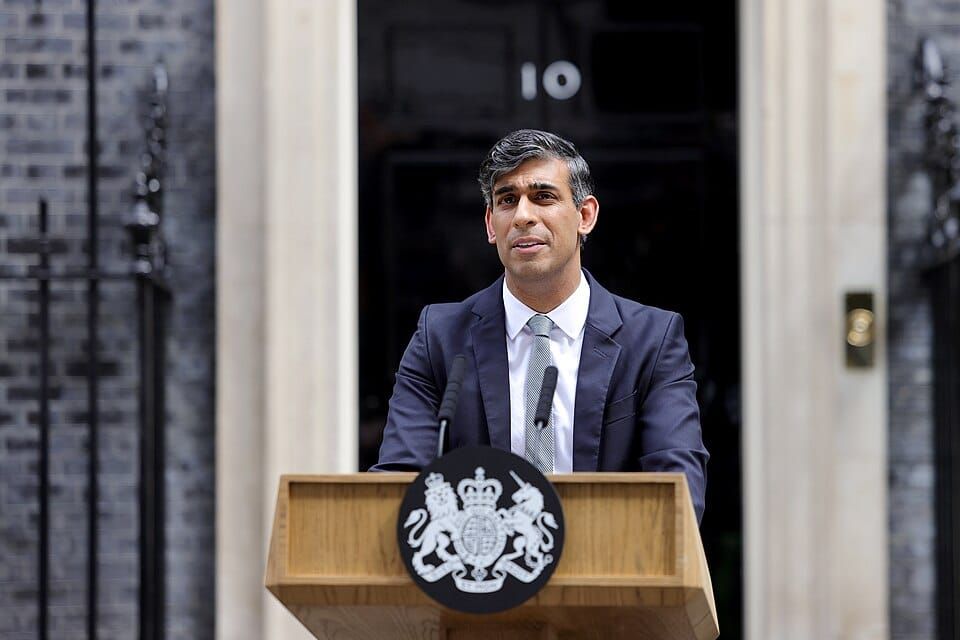
Photo credit: Kristy O’Connor/No 10 Downing Street, 2024. Wikimedia Commons. Flickr. Licensed under the Creative Commons Attribution-NonCommercial-NoDerivs 2.0 Generic License.
.jpg?ref=wordorigins-org.ghost.io)