chips / crisps / Saratoga potatoes
3 June 2026
One of the differences between North American and British English is the use of chip and crisp. Thin slices of potato fried until hard and brittle are chips in North America and crisps in Britain and the rest of the Commonwealth. And French-fried potatoes are chips in Britain and fries in North America. About the only place one will see this sense of chip in North America is in the phrase fish and chips, a usage and dish imported to America relatively recently from Britain.
But this difference was not always the case. For instance, the potato sense of crisp got its start in North America and didn’t make its way across the Atlantic to Britain until the twentieth century.
Crisp has a straightforward origin. The noun comes from the adjective, which in turn descends from the Old English cirps or crisp. But instead of a Germanic root, the Old English word was borrowed from the Latin crispus, meaning curled. In early use, the English word also had the sense of curled or curly. But in the sixteenth century it acquired the additional sense of brittle or stiff.
The origin of chip is more murky. The noun chip, meaning a small piece or shard of a larger object, probably comes from the verb meaning to cut or break into pieces, although the noun is attested about a century earlier. The noun appears in the mid fourteenth century and the verb in the mid fifteenth. There is an Old English word that is likely related, for-cippod, which appears four times in the extant corpus glossing the Latin praecisus, meaning to cut off or cut short. For-cippod is the past participle of the otherwise unattested verb *for-cippian, which hints that the verb *cippian also existed. There is also the Old English noun cipp which probably comes from the same root but which means rod, stick, or beam. These Old English words hint strongly that the word ultimately comes from a Germanic root.
The use of chip to refer to a French-fried potato dates to the mid nineteenth century. We see it in an article in the Mississippi Free Trader and Natchez Daily Gazette of 29 December 1841:
“They welcomed us to every thing, and we set off with our pockets filled with biscuit, jerked venisen [sic] and potatoe chips [sic], a sort of chrystalized [sic] preserve, steeped in syrup and then dried in the sun.
A little over a decade later, this sense of chip pops up in Britain. From Robert Smith Surtees’s 1854 novel Handley Cross:
By dint of playing a good knife and fork, our friend cleared his plate just as the second course made its appearance. This consisted of a brace of partridges guarding a diminutive snipe at the top, and three links of black pudding at the bottom—stewed celery, potato chips, puffs, and tartlets forming the side-dishes.
Crisp, on the other hand, isn’t attested until the end of the nineteenth century. We see it in this advertisement for a grocer in the Windsor, Ontario Evening Record of 6 January 1896:
Something Nice
Fresh Potato Crisps
In packages At
30 CENTS
Headquarters For
PURE FOOD PRODUCTS
J. A. DOUGALL
Your Grocer
And there is banquet menu printed in Benton Harbor, Michigan’s Daily Palladium of 25 April 1896:
Bouillon
[???]ished Tongue Cold Ham
Potato Crisps
[???]Fruited Jelly Pickles
In case there is any doubt as to what crisp refers to, the following appeared the next day in a grocer’s ad in Evansville, Indiana’s Sunday Courier:
Potato crisp [sic] in one-half pound and pound packages. These are exceedingly delicate chips. Try them.
Crisps made their way down under the following year. From the Molong Express in New South Wales on 6 November 1897:
POTATO CRISPS—Skin and scrape four large, mealy raw potatoes. Mix with a little salt, a well beaten egg, and a little milk to moisten if needed. Fry a tablespoon in lard over a brisk fire, browning on both sides until crisp. Serve very hot. A little chopped onion improves the taste.
But we don’t see crisps in England until 1917. Another advertisement, this one from Middlesborough’s North-Eastern Daily Gazette of 3 April of that year:
Try Nuts (all varieties, shelled) Nut Meals, Nut Butters, Nut Margarine, Cooking Nutter, Nutter Suet, Vegetable Lard, Nut and Vegetable Soups, Potato Crisps, Fruitarian Cakes, Proteid [?] Foods, Breakfast Foods, Special Biscuits, Chocolate, etc. Obtainable at the
SUFFRAGE HEALTH FOOD STORES
This advertisement for a potato crisp factory that was for sale appeared in London’s Daily Telegraph on 11 May 1922:
THE CENTRAL AGENCY, 179, EUSTON-RD., offer: POTATO CRISP FAC. Rent £160. Loc. 30 mis. Ldn., Profit £1,000 p.a. Books. Price £5,000.
And the Telegraph ran this help-wanted ad on 23 October 1922:
REQUIRED, MAN, capable of working potato crisp machine and frying. State experience and wages required.
There is another term for crisps or chips that you don’t hear much anymore, but which was enormously popular in the nineteenth century America, that is Saratoga crisp/chip/potato. It comes from the name of the resort town of Saratoga Springs, New York, which evidently had a reputation for serving crisps/chips in its restaurants.
A description of restaurant fare at the resort town of Richfield Springs, New York (about 75 miles / 120 km from Saratoga Springs) printed in Rhode Island’s Newport Mercury on 22 August 1868 reads:
When summoned, you are refreshed [with]
Broiled Otsego Bass with Cream,
Chicken Partridges,
Woodcock,
Saratoga Potatoes,
Frogs’ Legs and Potatoes a L[???]
Tea, Coffee, Rolls and fresh [???]
A banquet bill of fare printed in Kingston, Ontario’s Daily British Whig of 7 December 1870 lists “Saratoga chips” as one of the items served. And we see “Saratoga chips” on a banquet menu in the Brooklyn Daily Union of 12 October 1871:
Appearances of Saratoga potatoes/chips/crisps fall off markedly after the nineteenth century, although one can still occasionally see it.
But I cannot leave without including this recipe for Saratoga potatoes that drips with purple prose like oil from chips fresh out of the deep fryer. From Lexington’s Kentucky Gazette of 22 July 1874:
Saratoga potatoes, the poetry of common life, and costly charm of Delmonico’s and Parker’s, can be made in perfection in any kitchen, by the use of a very simple apparatus consisting of a sharp blade set slanting into a wooden trough with a narrow slit in the bottom, two wire screens or sieves and a common spider. Select eight large potatoes, pare them and slice very thin with the cutting machine, soak them in cold water for two hours, and stir common table salt into the water, one teaspoonful to a quart, and allow them to remain in the brine half an hour longer. Pour them upon the screen to drain, and put on spider with a pound of clear lard over a brisk fire. Wipe the sliced potatoes dry on a towel, wait until the lard is smoking hot, and pour a large plateful into the spider. The result is like a small sea in a white squall, and now the cook shows the artistic soul, which every votary of that noblest of the arts must possess to be worthy of the name. Patient and calm, with steady and incessant motion of the skimmer she prevents adhesion of any too affectionate slices and watches carefully for the tender blush of brownness to appear. Slowly it creeps and deepens until it rivals the hue of the fragrant Havana. Hast then takes the place of caution, lest any martyrs burn for the perfection of others; and they must be quickly spread upon another sieve to drain until dry and greaseless enough for the fairest fingers, then served hot, to melt like a kiss on sweet lips, with a dying crackle like the falling leaves of autumn.
Sources:
“[???]ssoli’s Third Annual [R]eception and Banquet at the Hotel Benton.” Daily Palladium (Benton Harbor, Michigan), 25 April 1896, 2/1. Newspapers.com.
“Businesses, Sales by Tender” (classified ad). Daily Telegraph (London), 11 May 1922, 16/7. Gale Primary Sources: Telegraph Historical Archive.
Classified ad. Evening Record (Windsor, Ontario), 6 January 1896, 8/1. Newspapers.com.
Dictionary of Old English: A to Le, 2024, s.v. for-cippod, past. part.; cirps, crisp, adj.
“Food Economy and Better Health” (advertisement). North-Eastern Daily Gazette (Middlesborough, England), 3 April 1917, 2/1. Newspapers.com.
“H. A. Cook & Son, Grocers” (advertisement). Sunday Courier (Evansville, Indiana), 26 April 1896, 8/7. Newspapers.com.
“Home Again.” Brooklyn Daily Union, 12 October 1871, 4/4. Newspapers.com.
“The Household. Recipes.” Molong Express and Western Districts Advertiser (New South Wales), 6 November 1897, 11/2. NewspaperArchive.com.
Middle English Dictionary, 31 January 2026, s.v. chippen, v., chippe, n., chip-ax, n., crisp, adj.
Mississippi Free Trader and Natchez Daily Gazette, 29 December 1841, 2/2. Newspapers.com.
Oxford English Dictionary Online, December 2021, s.v. chip, n.2, chip, v.1, Saratoga, n.; December 2006, s.v. potato chip, n.; 1893, s.v. crisp, n., crisp, adj.
“Richfield Springs.” Newport Mercury (Rhode Island), 22 August 1868. 28. Readex: America’s Historical Newspapers.
“St. Andrew’s Anniversary at Baltimore.” Daily British Whig (Kingston, Ontario), 7 December 1870, 2/5. Newspapers.com.
“Saratoga Fried Potato Secret.” Kentucky Gazette (Lexington), 22 July 1874, 2/1. Newspapers.com.
“Situations Vacant” (classified ad). Daily Telegraph (London), 23 October 1922, 19/2. Gale Primary Sources: Telegraph Historical Archive.
Surtees, Robert Smith. Handley Cross; or, Mr. Jorrocks’s Hunt. London: Bradbury, Agnew, 1854, 317. HathiTrust Digital Archive.
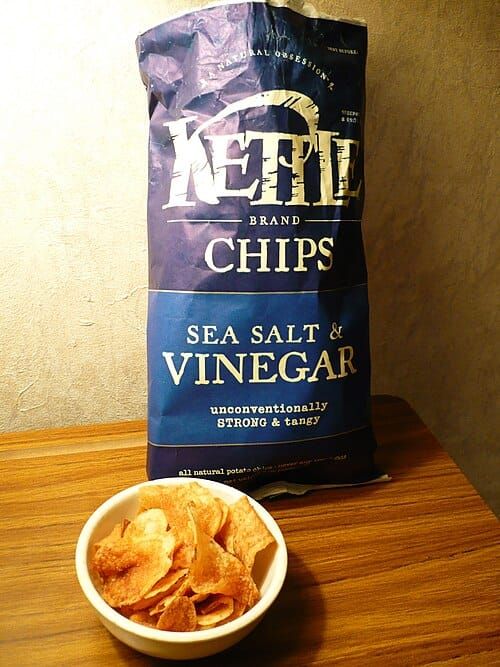
Image credit: Badagnani, 2008. Wikimedia Commons. Licensed under the Creative Commons Attribution 3.0 Unported license.
