black hole
5 June 2026
In the world of astronomy, a black hole is a cosmological object formed by the gravitational collapse of a star that is larger than about twenty solar masses. (Other mechanisms for black hole formation may exist.) The star, or remnants of the star after a supernova explosion, collapse into nothingness. Despite this collapse, the black hole retains the mass of the star, and therefore its gravity. And any matter or energy that gets close enough, that is crosses the event horizon, cannot escape its gravitational pull and will fall into it with no chance of escape.
Black holes were predicted as a consequence of Einstein’s general theory of relativity, and the modern understanding of black holes was pioneered by J. Robert Oppenheimer and Hartland Snyder in 1939. The term black hole, however, would not appear for another quarter century.
In the early 1960s, the term black hole was being batted about among physicists and astronomers and was first put into print in Science News-Letter on 18 January 1964:
Degenerate stars are not Hollywood types with low morals. They are dying stars, or white dwarfs, and make up about 10% of all stars in the sky.
[…]
Because a degenerate star is so dense, its gravitational field is very strong. According to Einstein’s general theory of relativity, as mass is added to a degenerate star a sudden collapse will take place and the intense gravitational field of the star will close in on itself.
Such a star then forms a “black hole” in the universe.
A few days later, the term was brought to the attention of the general public in an article in Life magazine on 24 January 1964:
Now Einstein’s theory predicts that if the gravitational collapse of a star did occur, the collapse would go on and the gravitational field would become stronger and stronger until it grew so powerful that it would close in upon itself; ultimately, the escape velocity would equal the speed of light, which is the speed limit of the universe. In that case nothing could get out of the star, not even light waves. Thus, instead of an intensely radiating object, sending out lavish quantities of light and radio energy, gravitational collapse would result in an invisible “black hole” in the universe. (To attain this “black hole” status, the matter comprising the earth would have to be compressed to a sphere slightly less than one inch in diameter.)
Theoretical physicist John Archibald Wheeler is often credited with coining the term black hole, but that is incorrect. He helped popularize the term, but there is no evidence that he invented it.
The phrase black hole is also used figuratively to refer to something from which there is no escape or return. While today this is often understand as metaphor for the cosmological object, the figurative use predates the astronomical use of the term. This figurative use appears in a science fiction story by P. Schuyler Miller in the February 1941 issue of Astounding Science Fiction:
To east and south and north—the road ahead was clear. There lay the great sky-reaching crags of the Mountains of the Night, blanketed in everlasting clouds, cleft by bottomless chasms, drenched by the endless rains that were slishing into the mire in which he lay, rattling on the forest roof above him. There, somewhere, was the mysterious Black Hole that had sucked a score of ether ships into oblivion since men first found this God-forsaken planet.
Instead of arising from the astronomical use, the opposite may be the case, with figurative use of black hole having played a role in astrophysicists naming the cosmological objects black holes.
And there is an even older astronomical use of black hole, referring to region of space, particularly in the Milky Way, that is seemingly devoid of stars. Edmund Beckett in the 1874 edition of his Astronomy without Mathematics uses the term:
Not only is the Milky Way composed of innumerable multitudes of stars, both large and small, but it has twice as many bright stars as are due to its space according to the average of the whole heavens. On the other hand, there are patches like black holes in it which contain no stars or scarcely any.
Such regions in the Milky Way are now understood to be dust clouds that obscure our view of the stars behind them. And seemingly starless regions outside the plane of the Milky Way have been shown, by modern telescopes and in particular the Hubble Deep Field experiment, to be filled with distant galaxies that are too faint to be seen with the unaided eye.
And there is an even older use of black hole to refer to a dungeon or prison. We see this use in a 1707 report in the Daily Courant about the actions of Richard Blondevil, the marshal of Dublin:
Resolved, That it is the Opinion of this Committee that the said Blondevil, upon very small Provocations hath Beaten, Bolted and put into a Place called the Black Hole, and kept there for several Hours, several of the said Prisoners.
While Blondevil was an Englishman imprisoning Irishmen, in the most famous use of the dungeon black hole it was the English who were thrown into the dungeon. That is the Black Hole of Calcutta, in which troops of Siraj-ud-Daulah, the nawab of Bengal, held British prisoners of war during the night of 20 June 1756. The conditions were so horrific that of the sixty-four British and Anglo-Indian soldiers and Indian civilians imprisoned that night, only some 21 survived. The phrase Black Hole of Calcutta appears in the Public Advertiser of 28 April 1761:
It appears by a Letter from Gustrow, that in the End of February the Prussians confined 2500 of the Mecklenburgers in the Cathedral of that City, where their Sufferings could be compared only to those of the English Gentlemen who were shut up in the Black-Hole of Calcutta in 1756.
As horrible as it was, at least some prisoners emerged from the Black Hole of Calcutta. That would not be the case with a stellar black hole, from which there is no escape.
Sources:
Beckett, Edmund. Astronomy without Mathematics, fifth edition. London: Society for Promoting Christian Knowledge, 1874, 315. HathiTrust Digital Library.
Daily Courant, 26 August 1707, 1/2. Gale Primary Sources: Seventeenth and Eighteenth Century Burney Newspapers Collection.
Ewing, Ann. “‘Black Holes’ in Space.” Science News-Letter, 85.3, 18 January 1964, 39/1. JSTOR.
Miller, P. Schuyler. “Trouble on Tantalus.” Astounding Science Fiction, 26.6, February 1941, 48–66 at 48. Archive.org.
Oppenheimer, J. R. and H. Snyder. “On Continued Gravitational Contraction.” Physical Review, 56, 1 September 1939, 455–59. DOI: 10.1103/PhysRev.56.455.
Oxford English Dictionary Online, September 2011, s.v. black hole, n.
Public Advertiser (London), 28 April 1761, 2/2. Gale Primary Sources: Seventeenth and Eighteenth Century Burney Newspapers Collection.
Rosenfeld, Albert. “Heavens’ New Enigma.” Life, 24 January 1964, 11/4–12/2. Life Magazine Archive.
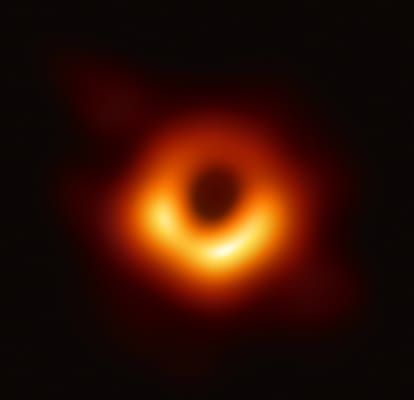
Image credit: Event Horizon Telescope (EHT)/European Southern Observatory, 2017. Wikimedia Commons. European Southern Observatory. Licensed under the Creative Commons Attribution 4.0 International license.
