biscuit / cookie
24 June 2026
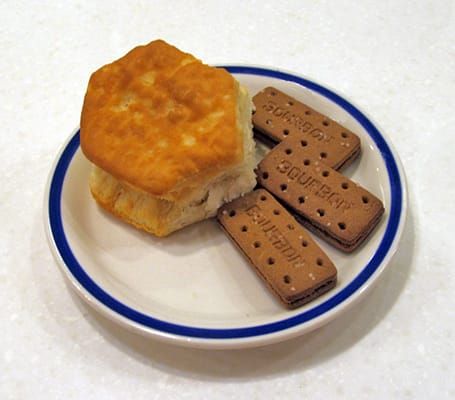
One distinction between the British and North American lexicons is the usage of biscuit and cookie. What North Americans call a cookie, the British call a biscuit. And what Americans call a biscuit has no exact counterpart in British cuisine. American biscuits are savory and resemble a scone in some respects, but a scone is denser and less salty.
The word biscuit comes from the Anglo-Norman bescuit, bis/bes- (twice) + cuit (cooked). It is attested in that language in the late twelfth century in the sense of dry, unleavened bread. We also see the Anglo-Latin panis biscoctus (twice-baked bread), attested in the early thirteenth century, which would probably make the Latin a borrowing from the French, a reversal of the usual direction.
Cookie, on the other hand is from the Dutch koekje (little cake). It was borrowed independently into both Scots and American English.
An early use of biscuit in Middle English can be found Robert Mannyng’s Chronicle, which is a translation of an Anglo-Norman work by Peter Langtoft. Mannyng’s translation was composed sometime before 1338. The passage in question is about the sinking of ship that was resupplying the Muslim army besieging the Crusader-held city of Acre during the Third Crusade:
þe schip þat was so grete, it dronkled in þe flode.
þei teld fiueten hundred Sarazins, þat drenkled were,
Fourti & sex wer sundred, & alle þo were saued þere.
þe summe couth no man telle of gold þat was þer in
& oþer riches to selle, bot alle mot þei not wyn.
þe venom alle þei hent, in þe se cast it away,
þe folk it mot haf schent, þat about Acres lay.
Armour þei had plente, & god besquite to mete,
It sanke son in þe se, half myght þei not gete.
(The ship was so large that it drowned in the flood. It held fifteen hundred Saracens that were drowned; forty-six were separated [from the others], and all those were saved. The amount of gold and other riches it held for the taking, no one could say, but all was not good. All the deadly things it held, they cast into the sea, the army that besieged Acre it might have ruined. Armor it had plenty and good biscuit for food; it soon sank in the sea; they could not get half of it.)
The sweet biscuit, the counterpart to the North American cookie, comes along some two centuries later. We see it in a 1566 poem titled The Banquett of Dainties:
As Marchpaine, Chéese & Ginger gréene,
with sucket pleasaunt swéete,
Blauncht Almondes, as in court is séene,
for princely Ladyes, méete.
Stewde Proynes, conserue of Cherries red,
Peares, Biskets, Suger fine,
With nectar dulce, since I am wedde,
by voyce of Muses nine,
And the North American style of biscuit is recorded in the early nineteenth century. From John Palmer’s 1818 Journal of Travels in the United States of North America, and in Lower Canada:
Our living consisted almost invariably of coffee, hot short cakes, called biscuits, corn-bread, cucumbers, honey, eggs, bacon, and chicken.
Cookie, on the other hand, appears in Scotland by the beginning of the eighteenth century. But in Scottish usage, a cookie was an unsweetened, plain bun. Here is an example from the household accounts of John Foulis. The entry is from 3 December 1701:
for seck and a cuckie wt ye tuo alexr Gibsones 0 14 6
Here seck is sack, the fortified white wine.
And the North American style of cookie is attested by the close of that century, in Amelia Simmons’s 1796 cookbook American Cookery:
Cookies.
One pound sugar boiled slowly in half pint water, scum well and cool, add two teaspoons pearl ash dissolved in milk, then two and half pounds flour, rub in 4 ounces butter, and two large spoons of finely powdered coriander seed, wet with above; make rolls half an inch thick and cut to the shape you please; bake fifteen or twenty minutes in a slack oven—good three weeks.
Another Christmas Cookey.
To three pound flour, sprinkle a tea cup of fine powdered coriander seed, rub in one pound butter, and one and half pound sugar, dissolve three tea spoonfuls of pearl ash in a tea cup of milk, knead all together well, roll three quarters of an inch thick, and cut or stamp into shape and size you please, bake slowly fifteen or twenty minutes; tho’ hard and dry at first, if put into an earthern [sic] pot, and dry cellar, or damp room, they will be finer, softer and better when six months old.
Sources:
Anglo-Norman Dictionary, AND2 Phase 1, 2000–06, s.v. biscuit, n.
The Banquett of Dainties. London: Thomas Hacket, 1566, sig. A.6.v. ProQuest: Early English Books Online.
Dictionary of Medieval Latin from British Sources, 2013, s.v. biscoctus, n. Brepols: Database of Latin Dictionaries.
Hallen, A. W. Cornelius, ed. The Account Book of Sir John Foulis of Ravelston. Edinburgh, Edinburgh UP, 1894, 299. HathiTrust Digital Library.
Hearne, Thomas, ed. Mannying’s Chronicle (before 1338). Peter Langtoft’s Chronicle in The Works of Thomas Hearne, vol. 3. London: 1725, 170–71. Corpus of Middle English Prose and Verse.
Middle English Dictionary, 31 January 2026, s.v. bisquit(e, n.
Oxford English Dictionary Online, September 2020, s.v. biscuit, n. & adj., cookie, n.
Palmer, John. Journal of Travels in the United States of North America, and in Lower Canada. London: Sherwood, Neely, and Jones, 1818, 125. HathiTrust Digital Library.
Scottish National Dictionary, 2005, s.v. cookie, n. Dictionary of the Scots Language | Dictionars o the Scots Leid.
Simmons, Amelia. American Cookery. Hartford, Connecticut: Hudson & Goodwin, 1796, 35. Archive.org.
Photo credit: Lou Sander, 2009. Wikimedia Commons. Public domain image.
