x-dimensional chess
25 May 2026
Chess is considered by some to be the ultimate test of human intelligence, and multi-dimensional chess—three-, four-, five-, and even higher-dimensional versions—is a metaphor for even more complex tasks and strategies.
Three-dimensional chess started out as an actual variant on the game, or rather variants, as there are different versions of the game. It was invented in the early twentieth century, but within a few decades of its introduction, it had become a metaphor. And by the 1960s, notional higher-dimensional variants had entered the lexicon.
The earliest citation of three-dimensional chess in the Oxford English Dictionary is a literal one, found in H. J. R. Murray’s 1913 A History of Chess:
The latest derivative game of chess is Schachraumspiel, or Three dimensional chess (see Dr. Ferd. Maach, Das Schachraumspiel, 1908).
The German is literally chess-room-game or translated more idiomatically, spatial chess game.
But it wasn’t long before higher dimensions entered the picture. A. Merritt’s 1920 science fiction short story The Metal Monster uses fourth-dimensional chess to describe a complex, alien control panel:
The rods were movable; they formed a keyboard unimaginably complex; a keyboard whose infinite combinations were like a Fourth Dimensional chess game. I saw that only the swarms of tentacles that were the Keeper’s hands and these only could be masters of its incredible intricacies.
But the notion of three-dimensional chess really took off in the 1930s when it was erroneously associated with Albert Einstein. The idea of the famed physicist operating on a higher level undoubtedly fed the later figurative use of the term. The earliest reference to the game in connection to Einstein that I’m aware of is in Portland’s Sunday Oregonian of 26 January 1936:
When Colonel Lindbergh and his entourage left New Jersey they passed, so to speak, the door of Albert Einstein, who ponders mighty matters and plays three-dimensional chess with his colleagues for relaxation. Dr. Einstein must have deemed it curious indeed to see the colonel so hurriedly leaving a place where he, the doctor, had but recently so hurriedly arrived. It is a strange world, with some folk escaping to places which others are escaping from.
But Einstein did not actually play chess in any dimensions, as this 28 March 1936 article in New Jersey’s Asbury Park Press attests:
In answer to Smith’s questions, Prof. Einstein said yesterday he avoids playing bridge “because it affords too little relaxation.”
The scientist said also that his knowledge of three-dimensional chess, reputedly his favorite pastime, was limited to what he had read in the newspapers.
[…]
He disclosed that his chief form of diversion is walking. He is often seen taking strolls thru the country.
But the idea of Einstein playing three-dimensional chess was so compelling that the truth didn’t matter. Stories of him playing the game abound in the 1930s.
And, undoubtedly fueled by association with the physicist, figurative uses of three-dimensional chess as a metaphor for complex strategies appear in the wartime 1940s. The 28 June 1942 issue of the Miami Herald depicts complex billeting arrangements as a form of the game:
Last week was moving week for 653 TSS. Bright and early Monday morning, the whilom billetees of the Gale and Richmond hotels repaired to the Sea Isle, a 12-story barracks on the seaward side of Collins ave. at 31st st. The morning was featured by the three-dimensional chess game played by 653’s new top-kick, Sgt. George C. Barefield and Sgt. Clinton G. Gewirtz, in elevating squadron members to rooms on the top six floors.
The game is a simile for wartime logistics in Rhode Island’s Providence Journal of 11 June 1943:
The fact is that the oil transportation problem is much like a three-dimensional chess game. On the one hand, we have the crude oil-producing wells; on the other, we have the refineries; and above and below, we have the consumers—military, industrial and civilian. You can readily understand that this is on the complex side.
And the game is a metaphor for the strategy of island hopping in the Pacific theater in Alfred Vagt’s 1946 book Landing Operations:
By the beginning of December “a halt in the mud”—real, not metaphorical—had come about on Leyte. The tri-dimensional chess game of island warfare seemed to approach stalemate.
By the 1960s, three dimensions weren’t complex enough, and higher dimensions were necessary to describe the complexities of the modern age. We have avant-garde music likened to five-dimensional chess in the Buffalo Evening News of 1 May 1967:
Involving a good deal of special talent to perform, it was something like watching some young, erudite physicists play five-dimensional chess—interesting and esoteric, but largely a matter for the performers themselves.
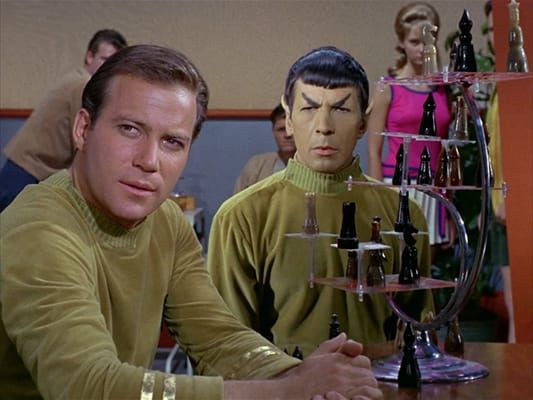
One wonders whether the appearance of a version of three-dimensional chess in the televsion series Star Trek, which premiered in 1966, further contributed to the popularity of the metaphor.
And by the twenty-first century, the number of dimensions was upped to six. From an article about Texas politics in the Houston Chronicle of 18 May 2014:
Back in San Antonio, the 10-member City Council would appoint a mayor until the May 2015 election.
“The process is not ideal. It’s a six-dimensional chess game with several variables,” said Councilman Rey Saldaña, who wouldn’t say yet whether he’ll seek the appointment.
Sources:
Baugh, Josh and Brian Chasnoff. “Castro Turned Down Past Obama Offer.” Houston Chronicle (Texas), 18 May 2014, A25/2. Readex: America’s Historical Newspapers.
“Dr. Einstein to Colonel Lindbergh.” Sunday Oregonian (Portland), 26 January 1936, 10/2. Readex: America’s Historical Newspapers.
Dwyer, John. “The Gallery: Color Film, Jazz Trio, Noise Are Latest Far-out Mixture.” Buffalo Evening News (New York), 1 May 1967, 13/1.Readex: America’s Historical Newspapers.
“East’s Oil Supply Called at Limit.” Providence Journal (Rhode Island), 11 June 1943, 2/2. Readex: America’s Historical Newspapers.
“Interviews Einstein.” Asbury Park Press (New Jersey), 28 March 1936, 5/2. ProQuest Newspapers.
Merritt, A. “The Metal Monster.” Argosy-Allstory Weekly, 125.2, 11 September 1920, 277. HathiTrust Digital Library.
Murray, H. J. R. A History of Chess. Oxford: Clarendon Press, 1913, 860. Archive.org.
Oxford English Dictionary Online, 2024, s.v. three-dimensional chess, n.
“653 TSS. Is Moved to Sea Isle Hotel.” Miami Herald, 28 June 1942, D-7/6. Readex: America’s Historical Newspapers.
Vagt, Alfred. Landing Operations: Strategy, Psychology, Tactics, Politics, from Antiquity to 1945. Harrisburg, Pennsylvania: Military Service Publishing Company, 1946, 792. HathiTrust Digital Library.
Photo credit: DesiLu Productions, 1966. Memory-Alpha.Fandom.com. Fair use of copyrighted image to illustrate the topic under discussion.
