influence / influencer
3 August 2026
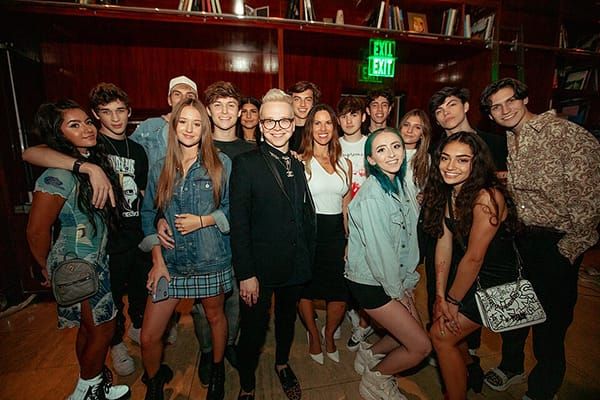
Social media has given rise to the influencer, a person who uses their celebrity on social media to endorse and promote products and messages. But the word influencer, and it’s root influence, long predate the advent of the internet.
The English noun influence is borrowed from the French influence, originally meaning an emanation from the stars or an inflow of water, which in turn is from the Latin influere, to flow in (cf. influenza/flu). English use begins in the fourteenth century and is first used in the sense of divine power and inspiration. Here is an example from John Trevisa’s translation of Bartholomæus Anglicus’s De proprietatibus rerum, translated sometime toward the end of that century:
And þe influe(n)s of blisse is þe more worthi, in as moche as þe aungel ioyneþ hym by his owne wille þe more parfitlich to þe soþnes þat may not be chaungid, as Gregorye seiþ.
(And the influence of bliss is the more worthy, in as much as the angel joins him by his own will the more perfectly to the truth that may not be changed, according to Gregory.)
We also see it in the first book printed in English, William Caxton’s 1473 translation of Raoul Lefèvre’s Recuyell of the Historyes of Troye:
Thou hast lasse knowleche now / than thou haddest in thy paryllous yougth and fro whens cometh this deffaulte / is this by the heuenly Influence / yf hit be thus / where is rayson where is equyte
(You have less knowledge now than you had in your perilous youth. And where does this deficiency come from? Is it from heavenly influence? If it be thus, where is reason? Where is equity?)
And in the fifteenth century influence began to be applied to mundane, worldly forces.
The verb, to influence, is in place by the mid seventeenth century. Here is an example from a speech by Oliver Cromwell to parliament on 25 January 1658:
He [the Pope] doth, as always he hath done. He influenced all the powers, all the Princes in Europe to this very thing, and no man like this present man.
Influencer also appears in the seventeenth century. From George Sikes’s 1662 The Life and Death of Sir Henry Vane:
If men do peep out of this bruitish strain of Life, (the prevailing dispensation of the devil in England, at present) through some awakenings of Conscience, and begin to look after a little moral righteousness in their personal operations, the old serpent can apply himself to them, as their Tutor, Influencer, and Instructor herein; has diet at his board, that will fit their palate.
And in the twentieth century, the field of marketing adopted influencer to refer to those who effect purchasing decisions. Here’s an example from the February 1968 issue of the Journal of Marketing Research:
The role of the child as an influencer of consumer decisions was investigated by studying the interaction between mother and child. Purchase behavior by the mother of a child's preferred packaged cereals was related to the child's assertiveness and the mother's child-centeredness.
Finally, the marketing use of the word led us to influencers on social media and the internet. From Advertising Age, 26 July 2004:
Fan sites and influencer message boards list complaints from park-goers that include broken rides, unkempt parks, lax security and additional charges for high-profile rides. Park executives said premium fees are an industry standard and that emphasis has been put this year on upgrading guest services and rehabbing restaurants and restrooms.
Sources:
Bartholomæus Anglicus. On the Properties of Things: John Trevisa’s Translation of Bartholmæus Anglicus De proprietatibus rerum (before 1398), vol. 1 of 3. M. C. Seymour, ed. Oxford: Clarendon Press, 1975, book 2, chapter 21, 61.
Berey, Lewis A. and Richard W. Pollay. “The Influencing Role of the Child in Family Decision Making.” Journal of Marketing Research, 5.1, February 1968, 70–72 at 70. JSTOR.
Cromwell, Oliver. “My Lord Protectors’s Speech” (25 January 1658). Diary of Thomas Burton, Esq, vol. 2 of 4. John Towill Rutt, ed. London: Henry Colburn, 1828, 358. HathiTrust Digital Library.
Lefèvre, Raoul. Recuyell of the Historyes of Troye. William Caxton, trans. Bruges: William Caxton (and Colard Mansion?), 1473. Unnumbered page. ProQuest. Early English Books Online.
Middle English Dictionary, 17 June 2026, s.v. influence, n.
Oxford English Dictionary Online, 2022, s.v. influencer, n.; 1900, s.v. influence, n., influence, v.
Sikes, George. The Life and Death of Sir Henry Vane, Kt. London: 1662, 80. ProQuest. Early English Books Online.
Stanley, T. L. and Kate MacArthur. “Does Six Sell?” Advertising Age, 75.30, 26 July 2004. ProQuest.
Photo credit: Juice Crate, 2019. Wikimedia Commons. Flickr.com. Licensed under the Creative Commons Attribution 2.0 Generic license.
