hokum

1 May 2026
Hokum is a slang term with two main senses. One is something that is overly sentimental or melodramatic; the other is nonsense, something that is false. Like most slang terms, its origin is a bit mysterious, but the most likely explanation is that it is a blend of hocus pocus and bunkum.
Hokum arises in American theater slang in the opening years of the twentieth century. We see the sentimental sense in the pages of New York’s Evening World of 3 March 1906:
No, I ain’t going out in a musical show. Musical shows are dead cards and you have to carry too many people. I’ve been studying plays that make hits and I’m going to write one myself that won’t be nothing but sure-fire hokum from start to finish.
And we see the false sense of hokum a couple of years later. From Kenneth McGaffey’s 1908 The Sorrows of a Show Girl:
Honest, to hear him spring that sure-fire hokum you would have thought he believed it. I know he passed the same line of dope out to me, and I fell for it.
Since the appearances in print are so close to one another and that the term was undoubtedly in oral use for some time before this, we can’t say which sense came first. They probably arose in tandem, as overly sentimental and nonsense aren’t all that much different from one another.
The adjective hokey and the term hokey-pokey, which has a plethora of meanings, probably influenced the development and use of hokum, but an exploration of those terms will be explored in a forthcoming entry. Hokey is too much work to take on all at once.
Sources:
Green’s Dictionary of Slang, accessed 13 April 2026, s.v. hokum, n., hokum, adj., hokey, adj.
McCardell, Roy L. “The Chorus Girl.” Evening World (New York), 3 March 1906, 9/4. Library of Congress: Chronicling America.
McGaffey, Kenneth. The Sorrows of a Show Girl. Chicago: J. I. Austen, 1908, 214. Archive.org.
Oxford English Dictionary Online, 1933, s.v. hokum, n.; 1976, s.v. hokey, adj.
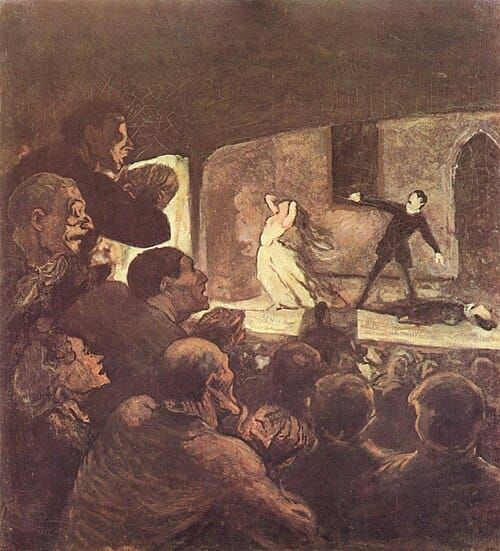
Image credit: Honoré Daumier, c. 1858. Wikimedia Commons. Public domain image.
