zero gravity / zero-g / microgravity
7 January 2026
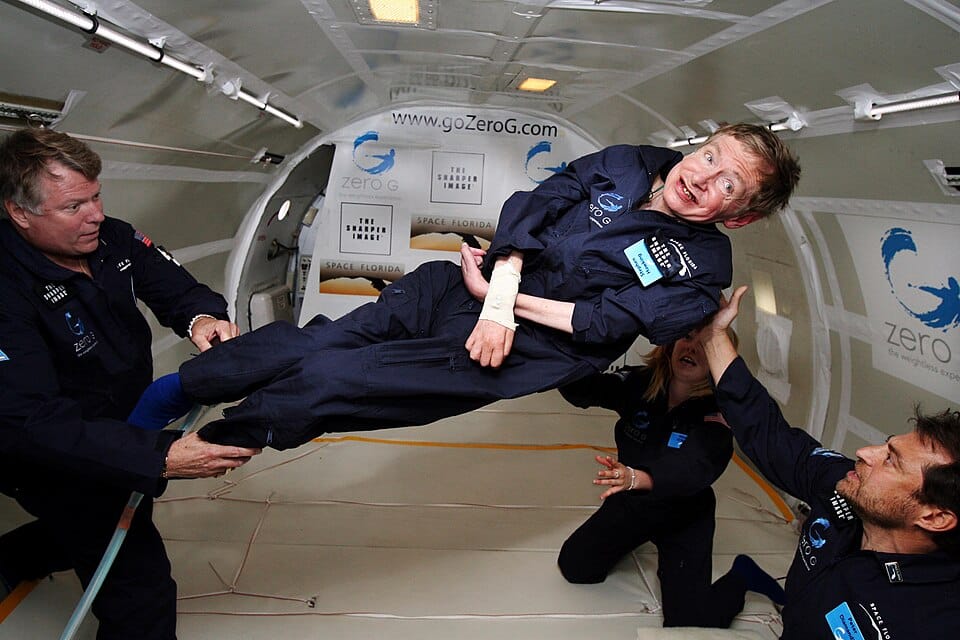
Zero gravity, also called zero g or microgravity, is the state of weightlessness experienced in outer space (and, as we shall see, at the center of the earth).
The term is much older than you might expect. It first appears back in February 1915 in the journal Science:
First, the instrument commonly taken as the fundamental means of measuring mass—namely, the beam-balance—is essentially a gravitational instrument, depending for its operation on the (established or assumed) equality of the gravitational fields of force at the two ends of the beam; whereas the instrument for measuring forces, at least in a readily idealized form, is a universal instrument, not in any way dependent on locality. For example, if a man should be placed, in imagination, at the “point of zero gravity” between the earth and the moon, it is not at all obvious how he would proceed to measure a given mass with a beam-balance; whereas, if he had a spring balance, in the form, for example, of a grip-testing machine, he could measure the strength of the muscles of his hand, or the attraction between two bodies, just as well under those circumstances as if he were on the surface of the earth.
Zero gravity made its way from science to science fiction by 1938, when the term is used in a story by Jack Binder, “If Science Reached Earth’s Core,” in the October issue of Thrilling Wonder Stories:
Space travel is solved. Starting at the zero-gravity of earth’s core, accumulative acceleration is easily built up in a four-thousand-mile tube. The ships reach the earth’s surface where gravitation is strongest with an appreciable velocity that makes the take-off a simple process of continuation!
Since gravity is the attraction between two masses, if we could go to the center of the earth, we would feel no pull from the earth’s mass. The planet’s mass would surround us, and the pulls in all different directions would cancel each other out—we would be at zero-gravity. Binder's solution for escaping earth's gravity well is quite imaginative, although getting to the earth’s center has proven far, far more difficult than simply launching a rocket into space from the earth’s surface.
For spacecraft in orbit the mechanism is different, but the effect is the same. In earth orbit, the planet’s gravity is still tugging at a spacecraft, but the craft is traveling fast enough that it “falls around” the earth. The craft’s forward motion cancels out the effect of the earth’s gravity and things, including people, float.
We see zero gravity used in reference to actual space flight by December 1952, when it is used in a photo caption in Science News Letter to describe the effects a monkey experienced when launched into space on a rocket:
HISTORIC ZERO-GRAVITY FLIGHT—One of the monkeys which was rocketed nearly 40 miles into space. Results showed that man may be able to stand the gravity-free state for brief periods.
The shorter zero-g is older, dating to an article about Navy dive-bomber pilots that appeared in the 9 June 1940 issue of the Detroit Free Press:
“Recovery,” he said, “occurred in a few seconds following or during a return to zero G (the level) and beyond a brief period of apparent bewilderment, no other effects were noted.”
But here the term is used in a different sense. The article is discussing the effects of high acceleration on pilots, and G here is measuring acceleration, not gravity. Zero-G in this context is the normal acceleration a pilot feels once they have pulled out of a dive and are flying straight and level.
Zero-g is used to mean an absence of gravity in Arthur C. Clarke’s 1952 novel Islands in the Sky:
She was wearing a rather worried smile, and it was quite obvious that she found the absence of gravity very confusing. Remembering my own early struggles, I sympathized with her. She was escorted by an elderly woman who seemed quite at home under zero g and gave Linda a helpful push when she showed signs of being stuck.
The abbreviation G or g is standard physics notation for the force of gravity and has been in use since at least 1726.
Today, space scientists tend to use the term microgravity to describe most real-world zero-gravity situations. In orbit, the effects of earth’s gravity are not completely cancelled out, and other astronomical bodies, notably the moon and the sun, will exert some, albeit very weak, gravitational influence. These minute gravitational forces are not technically “zero,” so the term microgravity is substituted. Use of microgravity dates to the Skylab missions of the mid 1970s, if not earlier. From the 14 February 1975 issue of Science:
The experiments finally chosen to fly on the various Skylab missions are best characterized as a mixed bag of studies designed to observe the effect of microgravity on a variety of phenomena ranging from solidification of molten semiconductors to joining metals by brazing.
Sources:
Binder, Jack. “If Science Reached Earth’s Core.” Thrilling Wonder Stories, 12.2, October 1938, 98–99 at 99. Archive.org.
Clarke, Arthur C. Islands in the Sky. Philadelphia: John C. Winston, 1952, 82. Archive.org.
Huntington, Edward V. “Discussion and Correspondence: The Fundamental Equation of Mechanics.” Science, 41.1049, 5 February 1915, 207–209 at 208–209. Biodiversity Heritage Library.
“1952 Science Review.” Science News Letter, 20 December 1952, 389. JSTOR.
Oxford English Dictionary Online, June 2018, s.v. zero gravity, n. & adj., zero-G, adj. & n., G, n.; December 2001, s.v. microgravity, n.
Prevost, Clifford A. “U.S. Developed Dive-Bombing.” Detroit Free Press, 9 June 1940, Magazine page 6/1. ProQuest Historical Newspapers.
Robinson, Arthur L. “Crystal-Growing in Space: Significance Still Up in the Air.” Science, New Series, 187.4176, 14 February 1975, 527–28 at 527/1. JSTOR.
Sheidlower, Jesse. Historical Dictionary of Science Fiction, 27 January 2021, s.v. zero-gravity, n.; 16 December 2020, s.v. zero-g, n.
Photo credit: Jim Campbell, 2007. Wikimedia Commons. Licensed under the Creative Commons Attribution 3.0 Unported license.
