uncanny valley

17 August 2026
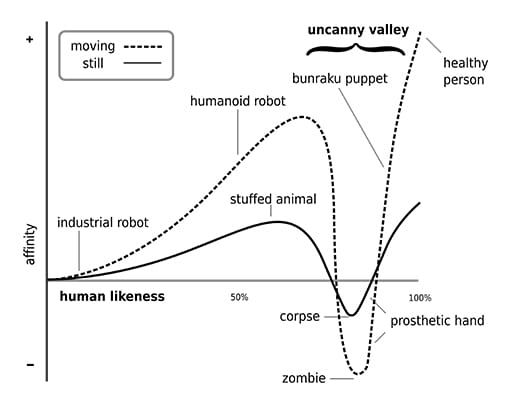
The phrase uncanny valley is a calque of the Japanese phrase bukimi no tani (bukimi (uncanniness + no (possessive particle) + tani (valley)). The Japanese phrase was coined by Masahiro Mori in a 1970 article in which he observed people’s emotional affinity toward robots rising as they appeared more humanlike but then suddenly dropping as their appearance approached verisimilitude. A 2005 English translation of Mori’s 1970 article reads, in part:
Climbing a mountain is an example of a function that does not increase continuously: a person's altitude y does not always increase as the distance from the summit decreases owing to the intervening hills and valleys. I have noticed that, as robots appear more humanlike, our sense of their familiarity increases until we come to a valley. I call this relation the “uncanny valley.”
The root of the words canny and uncanny trace back to the Old English verb cunnan, meaning to know, to understand. And the use of uncanny in the particular psychological sense of something familiar suddenly revealed to be strange or unsettling dates to the translation of the title of a 1919 essay on the subject by Sigmund Freud, The Uncanny, or in the original German, Das Unheimliche. Freud, of course, was not thinking about robots or computer-generated graphics.
The earliest documented appearance of uncanny valley in English is in Jasia Reichardt’s 1978 book Robots: Fact, Fiction, and Prediction. In that book, one of the section headers reads:
Human reactions to imitation humans, or Masahiro Mori’s Uncanny Valley.
And in the text:
One of the robots at the 1970 Osaka World’s Fair incorporated twenty-nine facial muscles so that a range of expressions could be programmed, the idea being to make the robot smile. According to the engineer who made it, a smile is a sequence of facial distortions performed at a certain speed. If the speed is decreased by half, the robot’s smile, far from being charming, would become a frightening and uncanny grin. This is another example of the strange effect caused by something unexpected. If anything at all goes wrong, either with an artificial hand, or a doll, or a smiling robot, those witnessing the event shudder, and the particular devices immediately drop into the uncanny valley.
It took a while for the term uncanny valley to catch on. There are a handful of uses prior to 2001, usually referencing Mori’s work. The following appearance of uncanny valley in the Los Angeles Times of 8 May 2001 was prompted by the film Final Fantasy: The Spirits Within. The film was entirely CGI and, unlike prior all-CGI films such as those by Pixar, aimed for verisimilitude in its human characters:
Moreover, people generally relate better to animated figures that are distinctly outlandish than those that begin to approach the ideal. This is a phenomenon known to robotics researchers as “the uncanny valley”—the point where a robot is so close to lifelike yet still so short of ideal that people become focused on its imperfections.
Sources:
Hiltzik, Michael A. and Alex Pham. “Synthetic Actors Guild.” Los Angeles Times, 8 May 2001, A22/2. ProQuest Newspapers.
Mori, Masahiro. “The Uncanny Valley” (1970). Karl F. MacDorman and Takashi Minato, trans. Androidscience.com, 19 September 2005. Archive.org.
Oxford English Dictionary Online, June 2015, s.v. uncanny valley, n.
Reichardt, Jasia. Robots: Fact, Fiction, and Prediction. Harmondsworth, England: Penguin, 1978, 26. Archive.org.
Image Credit: Karl MacDormand, 2005, based on an image by Masahiro Mori. Wikimedia Commons. Licensed under the Creative Commons Attribution-Share Alike 3.0 Unported license.
