tweezers
23 October 2026
Tweezers are a pair small pincers, often used for plucking hairs or picking up small objects. The form tweezers, invariably spelled with an ‹s›, is a variation on an older, now obsolete noun tweeze, sometimes rendered as pair of tweezes. That word, in turn, is a variation on etui, a case for holding needles, pins, or small tools. Etui was borrowed into English from French by 1611.
The case became the object it holds through the process of metonomy, where a term comes to refer to something closely associated with what the term originally represented, as in White House coming to refer to the presidency or the crown to refer to the monarch.
We see tweeses as early as 1619, but in this instance exactly what the word refers to, the pincers or the case, is unclear. It’s in a letter written from Paris by Welsh writer and historian James Howell
I have sent you by Vacandary the Post, the French Bever and Tweeses you writ for: Bever-hats are grown dearer of late, because the Iesuits have got the Monopoly of them from the King.
Twizes, distinctly meaning pincers, appears in a 1623 translation of Mateo Alemán’s The Rogue:
Asking such a Gentlewoman, whether shee would buy a very fine paire of Twizes; which but a little before, we had cut from another Gentlewomans girdle, and hauing new ground and whet them, and made them very neat and cleane, and fitted them with a new cace, and a new ribond, we sold them afterwards away for new ware
And we see the form tweezers in a 1654 commentary on Cervantes’s Don Quixote by Edmund Gayton:
When Sancho perceived that the Book was lost, his visage waxed as pale and wanne as a deadman, &c.] Sancho not capable of his Book, doth fearefull execution upon himselfe, and in an instant, unthatches his reverend chin, that Mr Barber with his Razor or his Tweezers, could not be so expeditious.
Sources:
Alemán, Mateo. The Rogue: or the Life of Guzman de Alfarache. London: Eliot’s Court Press and George Eld for Edward Blount, 1623, 130. ProQuest: Early English Books Online (EEBO).
Gayton, Edmund. Pleasant Notes upon Don Quixot. London: William Hunt, 1654, 156. ProQuest: Early English Books Online (EEBO).
Howell, James. Letter to Richard Altham (1619). Epistolæ Ho-elianæ Familiar Letters Domestic and Forren. London: Humphrey Mosely, 1650, 28. ProQuest: Early English Books Online (EEBO).
Oxford English Dictionary Online, 1916, s.v. tweezers, n., tweeze, n.; March 2014, s.v. etui, n.
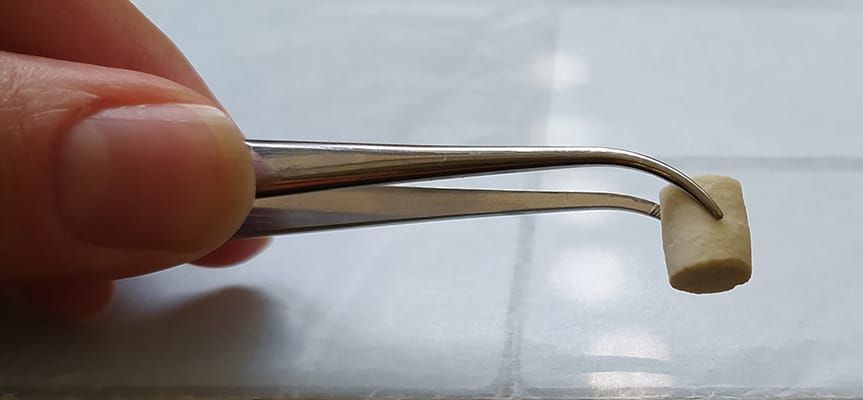
Photo credit: Giovanna Canu, CNR-ICMATE, 2021. Wikimedia Commons. Licensed under the Creative Commons Attribution 4.0 International license.
