terrific
1 April 2026
From its meaning alone you would never guess where terrific comes from, but if you look at the word, the origin is rather obvious. The form, or morphology, of the word gives it away. Terrific is from the Latin terrificus, meaning frightening, causing terror. Despite it coming from classical Latin, terrific doesn’t enter English use until the early modern era.
The earliest use of the word that I’m aware of is in a 1599 edition of a poem about the Wars of the Roses, “The Civill Wars of England,” by Samuel Daniel (earlier editions of the poem do not have terrific):
Red fiery dragons in the aire doe flie,
And burning Meteors, poynted-streaming lights,
Bright starres in midst of day appeare in skie,
Prodigious monsters, gastly fearefull sights:
Straunge Ghosts, and apparitions terrific,
The wofull mother her owne birth affrights,
Seeing a wrong deformed infant borne
Grieues in her paines, deceiu'd in shame doth morn.
Daniel was no slouch of a poet, but terrific got a big boost when John Milton used it in his 1667 Paradise Lost. Milton uses it in the sense of frightening as he describes the creation and lists many of the animals that God has created:
The Serpent suttl’st Beast of all the field,
Of huge extent somtimes, with brazen Eyes
And hairie Main terrific, though to thee
Not noxious, but obedient at thy call.
A serpent with a hairy mane? One would think that Milton wasn’t a very good zoologist, but this hairie Main is probably an allusion to Virgil and the Aeneid, the epic poem about the founding of Rome, which describes the two serpents which devour the priest Laocoön and his two sons as having iubaeque sanguineae superant undas (and blood-red crests that top the waves, 2.206–07). We don’t see this “frightening” sense of terrific much anymore; the modern sense has scared it away.
In the mid-eighteenth century the word began to be used to mean large or excessive. In a 1743 translation of Horace’s odes, Matthew Tower described the giant Porphryion as “of terrific size,” which could be interpreted as meaning terrifying and awe-inspiring and also as of great size. And in his 1798 satirical poem The Literary Census, Thomas Dutton could mean only of great size when he writes of pamphleteer William Cobbett, “I am struck with admiration at the terrific sublimity of his genius.”
By the latter half of the nineteenth century, this sense of great size had come to mean simply great or excellent. An 1871 advertisement for a book in the Athenaeum magazine could say:
The last lines of the first ballad are simply terrific,—something entirely different to what any English author would dream of, much less put on paper.
And by the next century Denis Mackail’s 1930 novel The Young Livingstones could contain this exchange:
“Thanks awfully,” said Rex. “That’ll be ripping.”
“Fine!” said Derek Yardley. “Great! Terrific!”
In the space of three-hundred years, terrific had moved from a Latinate description of awe-inspiring terror with allusions to Virgil to become a rippingly informal word.
Sources:
Advertisement. Athenaeum, 21 October 1871, 540/1. HathiTrust Digital Library.
Danyel, Samuel. “The Civill Wars of England.” The Poeticall Essayes of Sam. Danyel. London: P. Short for Simon Waterston, 1599, stanza 1:115, 17r. ProQuest: Early English Books Online (EEBO). (Note: the pagination in this copy is off; the pages appear to be from two different print runs bound together; the stanza number seems accurate.)
Dutton, Thomas. The Literary Census. London: 1798, 60n. Gale Primary Sources: Eighteenth Century Collections Online (ECCO).
Horace. “Ode 18.” In Matthew Tower, ed. and trans. The Lyric Pieces of Horace, vol. 2. Dublin, A. Reilly, 1743, 325. Gale Primary Sources: Eighteenth Century Collections Online (ECCO).
Milton, John. Paradise Lost. A Poem Written in Ten Books. London: Peter Parker, et al., 1667, 7.495–98. ProQuest: Early English Books Online (EEBO).
Oxford English Dictionary Online, September 2011, terrific, adj. and n.
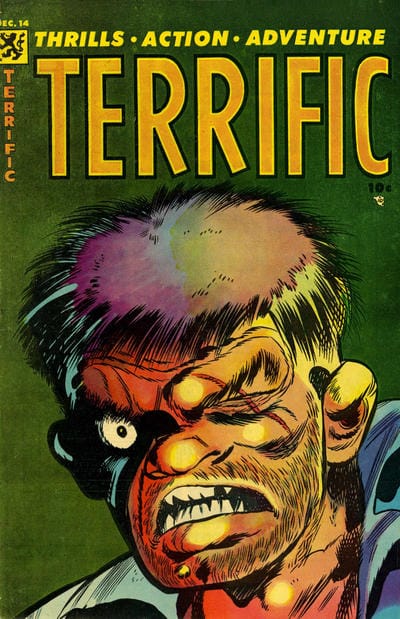
Image credit: Unknown artist, 1954. Wikimedia Commons. Public domain image.
