tell that to the marines
9 February 2026
The origin of the phrase tell that to the marines is exactly what you might think it to be, an expression originally used by sailors that implies their shipmates in the marines are gullible. The earliest example of the phrase that I’m aware of is in John Davis’s 1806 novel The Post-Captain: or, The Wooden Walls Well Manned. Here it is used in an exchange between a sailor and an officer about a young woman who has just been brought aboard ship:
“Is not Flora, sir, a French name?”
“Yes it is; it is Creole French.”
“But the lady, sir, is English. Her husband at least said so.”
“He may tell that to the marines, but the sailors will not believe him.”
At first glance, this use might be just a simple collocation of the words rather than a set phrase. But the phrase appears three other times in the novel, each one followed by some variation saying that sailors are not so gullible.
By December 1820 we see the phrase being used outside a naval context. The article itself, which appears in the New Monthly Magazine and Universal Register, has nothing particular to do with the sea, although the writer connects the phrase to life aboard ship. The introduction of the phrase with nostrum illud solenne (our usual) indicates that it is a catchphrase:
So also the able-bodied seamen, who think a certain part of their crew mere fruges consumere nati on board a ship, regularly consign all exaggerated narratives and incredible propositions to their “willing ears,” according to nostrum illud solenne, “You may tell that to the marines.”
Fruges consumere nati = exist to eat (lit., born to consume crops)
And by 1821 we have an example of the phrase that makes no nautical reference at all. Irish novelist Sydney Morgan (1778–1859) uses it a piece that savages a reviewer or her travelogue of Italy:
“In page 3,” adds this Captain O’Blunder of the Edinburgh,—“in page 3, Conquest is said to be consolidated by Usurpation; but I beg to inform Miladi, that Conquest consolidates Usurpation!"
Oh, my Chronomastix, you may “tell that to the Marines,” but the Cæsars and Napoleons would never have believed you! They were Conquerors first—Emperors afterwards; and they consolidated the conquests, which gave them an influence over the opinions of their fellow citizens, by usurpations, which gave them power over their rights.
I think there are many authors who would like to respond to critics in a similar tone and fashion.
Sources:
Davis, John. The Post-Captain: or, The Wooden Walls Well Manned. London: G. Hazard for Thomas Tegg, 1806, 28–29. Gale Primary Sources: Nineteenth Century Collections Online.
Morgan, Sydney. “Letter to the Reviewers of ‘Italy.’ Edinburgh Magazine, July 1821.” New Monthly Magazine and Literary Journal (London), vol. 2, 1821, 6–26 at 9–10. HathiTrust Digital Archive.
“The New Adventurer.—No. III.” New Monthly Magazine and Universal Register (London), December 1820, 605–608 at 608/1. ProQuest Historical Periodical.
Oxford English Dictionary Online, September 2015, s.v. tell, v.
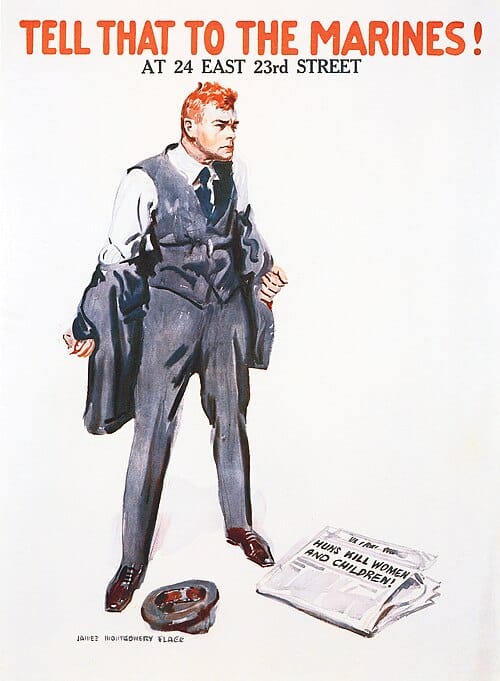
Image credit: James Montgomery Flagg, 1917. Wikimedia Commons. Public domain image.
