tawdry
11 March 2026
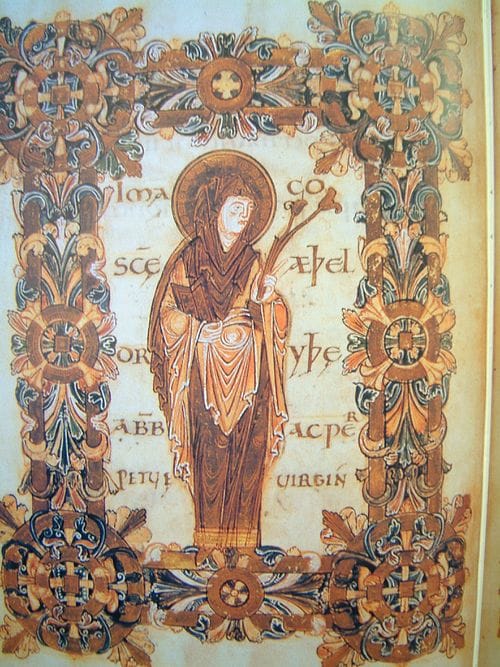
Something that is tawdry is cheap and gaudy. The word comes from the story of Æþelðryþ (Æthelthryth), also known as Audrey, the daughter of Anna, a seventh-century king of East Anglia. Æthelthryth’s tale is recounted by Bede in his eighth-century Ecclesiastical History and by Ælfric in his late tenth-century Lives of Saints. It is said that Æthelthryth took a vow of perpetual virginity and managed to get through two marriages without sleeping with either husband. Her first husband died before he could get her into the marital bed, and the second marriage was eventually annulled, much to the relief of the very frustrated young man, who had gone so far as attempting to bribe the local bishop to release her from her vow and who, when she fled his advances, had chased after her across England. After the annulment, Æthelthryth took holy orders and went on to found an abbey in the town of Ely in East Anglia. Æthelthryth died of a large tumor on her neck, which she attributed to punishment for having worn many expensive jeweled necklaces in her younger years.
In the sixteenth century, it became fashionable for medieval English women to wear silk scarves around their necks in tribute to her. Such scarves, and other articles, were sold at the fair held each year on her feast day. The merchandise at this fair was the type of stuff that you would find at any tourist trap, cheap and gaudy, hence the fashion eventually became associated with finery of inferior quality.
John Palsgrave includes Seynt Audries lace in a glossary in his 1530 Lesclarcissement de la langue Francoyse, thought to be the first French grammar written in English. (Despite the French title, the text is in English.) Palsgrave translates the phrase with the French cordon, meaning tie. And we get tawdry lace by 1548, when we see it in a list of objectionable (i.e., Roman Catholic) religious practices in William Patten’s The Expedicion into Scotlande:
setting vp candels too saincts in euery corner, & knak kynge of beadstones in euery pewe, tollyng of belles against tempestes, Scala coeli Masses, Pardon Beades, Tanthonie belles, Tauthrie laces, Rosaries, Collets, charmes for euery diseas, and Suffrain suffrages for euery sore
(setting up candles to saints in every corner, & knacking of beads in every pew, tolling of bells against tempests, Scala coeli [ladder of heaven] Masses, Pardon Beads, Tantony [St. Anthony] bells, Tawdry laces, Rosaries, Collets, charms for every disease, and Suffering suffrages for every sore)
And we see tawdry lace, without any opprobrium, in Edmund Spenser’s 1579 Shepheardes Calender:
Ye shepheards daughters, that dwell on the greene,
hye you there apace:
Let none come there, but that Virgins bene,
to adorne her grace.
And when you come, whereas shee is in place,
See, that your rudenesse doe not you disgrace:
Binde your fillets faste,
And gird in your waste,
For more f[i]nesse, with a tawdrie lace.
But a century later, after the wearing of tawdry lace had fallen out of fashion, we see the adjective tawdry being used to mean cheap and gaudy. This usage appears in Nehemiah Grew’s 1672 Anatomy of Vegetables:
So that a Flower without its Empalement, would hang as uncouth and taudry as a Lady without her Bodies.
That’s how the name of an early medieval English saint came to mean something cheap and in poor taste.
Sources:
Grew, Nehimiah. The Anatomy of Vegetables. London: for Spencer Hickman, 1672, 131. ProQuest: Early English Books Online (EEBO).
Oxford English Dictionary Online, 1910, s.v. tawdry, n. & adj., tawdry lace, n.
Palsgrave, John. Lesclarcissement de la langue Francoyse. London: Richard Pynson and John Hawkins, 1530, fol. 63r/2. ProQuest: Early English Books Online (EEBO).
Patten, William. The Expedicion into Scotlande, London: Richard Grafton, 1548, sig. c4v. ProQuest: Early English Books Online (EEBO).
Spenser, Edmund. The Shepheardes Calender. London: Hugh Singleton: 1579, fol. 13v. ProQuest: Early English Books Online (EEBO).
Image credit: Unknown tenth-century artist. London, British Library, Add MS 49598. Wikimedia Commons. Public domain image.
