take me to your leader
6 February 2026
The phrase take me to your leader is a science fiction cliché, so much so that in the 2007 “Voyage of the Damned” Christmas episode of Doctor Who the time-traveling, title character said, “Take me to your leader! I’ve always wanted to say that!” (Another phrase in that episode that the good doctor always wanted to say was “Allons-y Alonso!”)
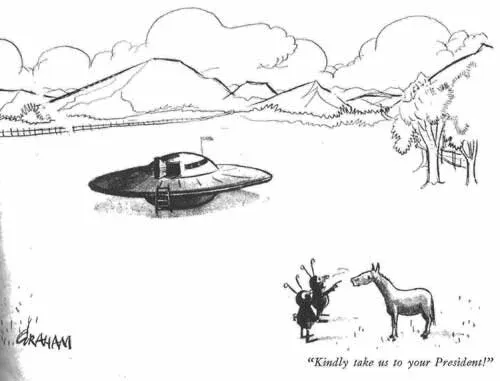
The current popularity of the phrase and its application to extraterrestrials and flying saucers dates to the 1950s, but the phrase itself is considerably older. The first known application of a variant of the phrase to first contact with extraterrestrials dates to 21 March 1953 and a cartoon by Alex Graham that appeared in the New Yorker (shown here). The cartoon depicts a flying saucer that has landed in a field and two aliens talking to a horse, saying, “Kindly take us to your President!”
We see the phrase in its familiar form in an Associated Press article from 21 August 1956 that reported on the Republican National Convention in San Francisco:
One delegate, intrigued by an outer-space type of portable transmitter in the hands of a network reporter, walked up and demanded, “Take me to your leader.”
But the 10 October 1956 issue of Variety also reports on this incident, calling it “the old space-man gag,” indicating that the catchphrase was already well associated with UFOs.
And before the extraterrestrial invasion of our popular culture, the phrase appears quite often in adventure fiction dating back to the nineteenth century. For instance, there is this from Edward Mitford’s 1867 The Arab’s Pledge: A Tale of Marocco in 1830:
Yusuf had been a patient spectator of the scenes which had been enacted, but it now came to his turn, and one of the robbers approached to strip him.
“Friend,” said he, “offer me no violence. I am under the protection of your Sheik Sidi Hamed Ibn Ishem. My journey is to meet him. In his name, forbear.”
“Infidel dog!” said the robber, “this trick shall not save your gold; you would give a drop of blood for every copper rather than part with it. You know the reward of resistance;” and he seized the defenceless Jew.
“Stop,” said another. “we may repent, if the infidel speak truth. Jew,” said he to Yusuf, “you come alone; have you no token?”
“I have,” said he, “but it is as my life; take me to your leader.”
This 1867 example may have simply been a collocation of the words as opposed to being a catchphrase, but the subsequent instances in nineteenth- and early twentieth-century fiction clearly establish it as a set phrase. A witness to this ossification of the words is an incident reported in the San Francisco Chronicle of 17 June 1956. A trans-Pacific flight carrying, among others, comedian Red Skelton was forced to return to San Francisco because of engine trouble:
On arrival here [Skelton] emerged from the plane giving an Indian salute and exclaiming:
“How! You take me to your leader!”
So the association of extraterrestrial with take me to your leader is the result of a cultural shift from images of European colonial encounters with Indigenous people to those of aliens making first contact with humanity.
Sources:
Chandler, Bob. “Doug Edwards Does Some 10th Anni Reflections on TV Commentating.” Variety, 10 October 1956, 46/3. ProQuest Magazines.
“Clipper in Trouble, Skelton Gives Show.” San Francisco Chronicle (California), 17 June 1956, 6/8. Readex: America’s Historical Newspapers.
Graham, Alex. Cartoon. New Yorker, 21 Mar 1953, 43. Archives.newyorker.com.
Mitford, Edward L., The Arab’s Pledge: A Tale of Marocco in 1830, London: Hatchard and Co., 1867, 62–63. Archive.org.
Pett, Saul, Associated Press. “Convention TV Has Bad Times.” Atlanta Journal, 21 August 1956, 14/2. ProQuest Newspapers.
Shapiro, Fred, ed. The Yale Book of Quotations. Yale University Press. 2006, 320.
Image credit: Alex Graham, 1953. Fair use of a low-resolution copy of a copyrighted image to illustrate the topic under discussion.