sophisticated
23 March 2026
Sophisticated is an adjective, but the root of the word entered English as a verb meaning to adulterate a substance, that is to mix it with inferior substances. It is taken from the Medieval Latin sophisticare, which in turn comes from the Greek σοφιστής (sophistes), meaning one who accepts payment for instruction. These sophists, were different from the philosophers, who engaged in intellectual pursuits and education for higher purposes and not for money, hence the sophists were considered by some to be tainted or adulterated by base and material motivations. As a result, their teachings became associated, often unfairly, with specious and poor reasoning, or sophistry. The word was borrowed into English first as verb, to sophisticate, meaning to mix or adulterate with foreign substances.
The key to understanding the modern shift in meaning of sophisticated is the sense of altered from a natural state. Something that is cultured or refined is also altered from its natural state. Also, something that is mixed or made up of many substances is complex. The development of the current meanings is not surprising, but what is a bit of a shock is the rapidity with which they have taken over. The senses of adulterated and altered have all but completely vanished, and you have to turn academic literary criticism to find sophisticated used to mean altered during printing.
Our current senses of sophisticated, meaning either refined, cultured, highly developed or complicated, are surprisingly recent. The Oxford English Dictionary dates use of the adjective to mean meaning experienced or refined people to 1895, when it appears in Thomas Hardy’s novel Jude the Obscure:
Though so sophisticated in many things she was such a child in others that this satisfied her.
The sense applied to things that are complex or advanced is even more recent. From C. S. Lewis’s 1945 science fiction novel That Hideous Strength:
The man was so very allusive and used gesture so extensively that Mark’s less sophisticated modes of communication were almost useless.
The noun sophisticate, meaning a worldly, cultured person, is from 1923.
Other senses of the adjective are older, however. The sense of sophisticated meaning adulterated or mixed with a foreign substance dates to at least 1607, when it appears in Thomas Dekker’s play The Whore of Babylon:
The drinke euen in that golden cup, they sweare
Is wine sophisticated, that does runne
Low on the lees of error.
And when applied to literary works, sophisticated can mean having been altered during copying or printing.
It makes sense, then, that the adjective comes from the verb to sophisticate, meaning to mix with a foreign substance, which dates to before 1390 in Aaron Daniels’s Herbal in a passage about adulterating laudanum:
Whan thei wil sofisticaten it, thei medle þerwith getes croteles & oþere blake thinges.
(When they wish to sophisticate it, they meddle it with goat’s excrement and other black things.)
And we have this from before 1425 in the Egerton version of The Book of John Mandeville:
Neuerþeles it fallez oft tyme þat marchands sophisticatez peper, when it es alde, as Ysidoris tellez. For þai take alde peper and stepez it and strewez apon it spume of siluer or of leed and driez it agayne, and so by cause of þe weight it semes fresch and new.
(Nevertheless, it often happens that merchants sophisticate paper, when it is old, as Isidore tells us. For they take old paper and steep it and strew upon it litharge of silver or of lead and dry it again, and so because of the weight it seems fresh and new.)
So if you mix with the right circle of people, you too can become sophisticated.
Sources:
Dekker, Thomas. The Whore of Babylon. London: Eliot’s Court Press [?] for Nathaniel Butter, 1607, sig. H3v
Hardy, Thomas. Jude the Obscure. New York: A. L. Burt, 1913, 286. Archive.org.
Lewis, Charlton T. and Charles Short. A Latin Dictionary, 1879, s.v. sophisma, n. Brepolis: Database of Latin Dictionaries.
Lewis, C. S. That Hideous Strength. London: John Lane, 1945, 384. Archive.org.
Mandeville, John. Mandeville’s Travels: The Egerton Version. George F. Warner, ed. Westminster: Nichols & Sons, 1889, 84. Corpus of Middle English Prose and Verse.
Middle English Dictionary, 31 January 2026, s.v. sophisticaten, v.
Oxford English Dictionary Online, 1986, s.v. sophisticate, n.; 1913. sophisticate, v., sophisticate, adj., sophisticated, adj., sophistry, n.
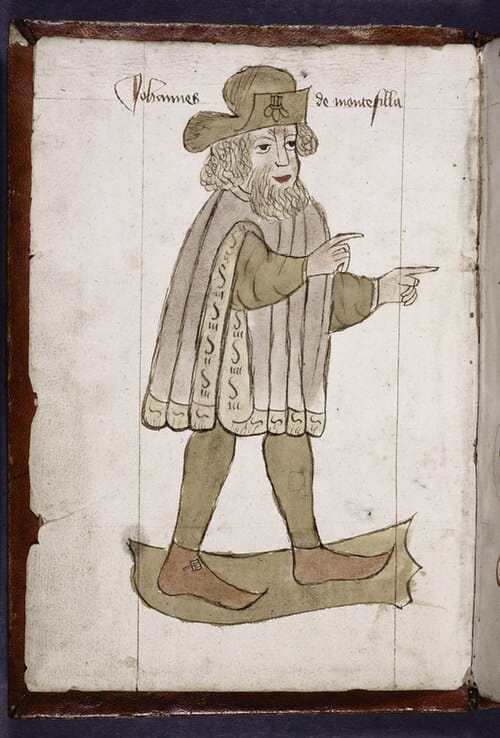
Image credit: Unknown artist, c. 1459. New York, NY Public Library, Spencer Collection MS 037. Wikimedia Commons. Public Domain Image.
