scrapple
5 January 2026
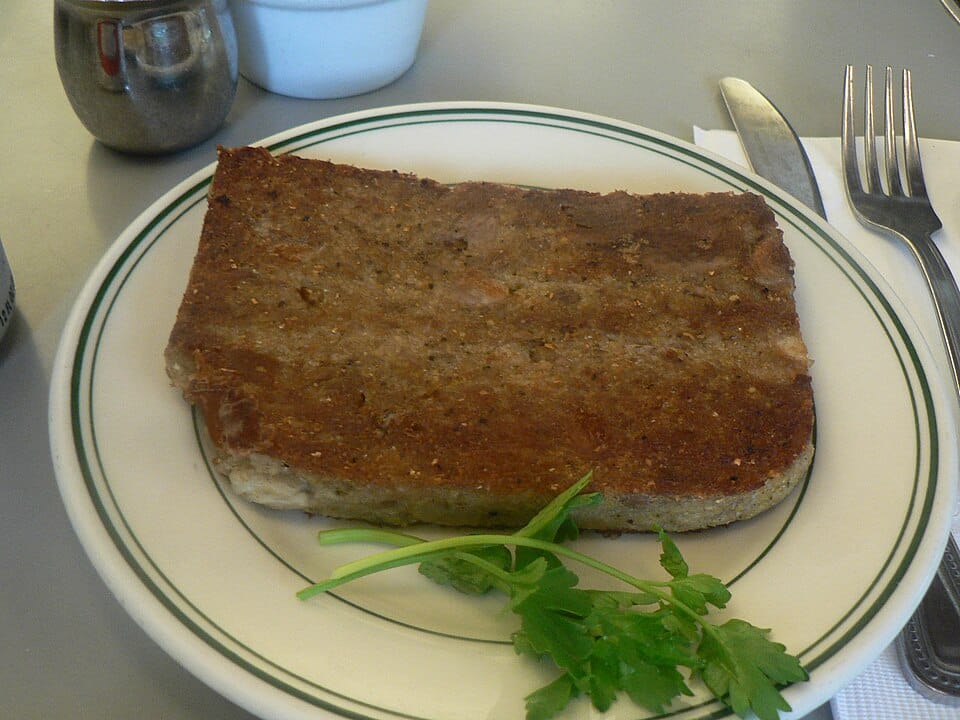
Scrapple is a mush of pork scraps—hence the name—cornmeal, and sometimes buckwheat flour. It is typically fried and served as a breakfast meat. It can be found in the Mid-Atlantic United States, from South Jersey to North Carolina. The Pennsylvania German name for it is Panhas.
The earliest reference to scrapple that I have found is in an 1841 list of products for sale in a Philadelphia market:
Blood Pudding. 7a 8
Souse Cheese, lb. 5a 12¼
Scrapple, per lb. 5a 6
And here is an 1853 recipe for preparing it that appeared in a Vermont, of all places, newspaper:
SCRAPPLE. This is generally made of the head, feet, and any pieces which may be left after having made sausage meat. Scrape and wash well all the pieces designed for the scrapple, put them in a pot with just enough water as will cover them. Add a little salt, and let them boil slowly till the flesh is perfectly soft, and the bones loose. Take all the meat out of the pot, pick out the bones, cut it up fine, and return it to the liquor in the pot. Season it with pepper, salt, and rubbed sage, to the taste. Set the pot over the fire, and just before it beings to boil, stir in gradually as much Indian meal as will make it as thick as mush. Let it boil a few minutes, take it off, and pour it in pans. When cold, cut it in slices, flour it, and fry it in hot lard, or sausage fat. Some prefer buckwheat meal; this is added in the same manner as the Indian. Indian meal is preferable, as it is not so solid as buckwheat. Sweet marjoram may be added with the sage, if preferred.
While scrapple is not to everyone’s taste, there are aficionados of the dish. One, a John Leadbeater, even composed a song about it and similar meat products that was published in 1850. It is to be sung to the tune of the Star-Spangled Banner:
THE MYSTERIOUS LOOM.
TUNE—Star Spangled Banner.
Oh say have you heard of the mysterious loom,
In which the famed, “Jarsey Sasuage” [sic] is wove,
Which is work’d in some dark greasy room,
The family heir-loom,—a token of love.
The “sausage meat” nice,
Is gone in a trice,
Producing a “link” that will hunger suffice,
Then here’s to that “loom,” whose work when begun,
Uses up the poor porkers, Father, Mother and Son.
Then here is the cheese, that is made of hogsheads,
And scrapple of jelly and fine Indian Meal,
A smile o’er the face of the weaver it sheds,
No pain for his victims he ever does feel.
Nor thinks of the slain,
Who his warp doth maintain,
He has but one object, a living to gain.
Then here's to that loom, whose work when begun,
Uses up the poor porkers, Father, Mother, and Son.
Sources:
Dictionary of American Regional English, 2013, s.v. scrapple, n., panhas, n.
Leadbeater, John. “The Mysterious Loom.” Literary Remains of John Leadbeater, Jr. Philadelphia: 1850, 93. HathiTrust Digital Library.
“Miscellany: Domestic Economy.” Vermont Chronicle (Windsor, Vermont), 20 December 1853, 4/2. Readex: America’s Historical Newspapers.
Oxford English Dictionary Online, 1911, s.v. scrapple, n.2.
“Retail Prices in Market—Oct 20, 1841.” Public Ledger (Philadelphia), 21 October 1841, 1/5. Readex: America’s Historical Newspapers.
Photo credit: Stu Spivack, 2006. Wikimedia Commons. Flickr. Licensed under the Creative Commons Attribution-Share Alike 2.0 Generic license.
