rob Peter to pay Paul
16 October 2026
To rob Peter to pay Paul is a proverbial phrase used to mean to right one wrong by committing another or to pay off one debt by incurring another. A modern example might be using one credit card to pay off another. The use of the names Peter and Paul in the phrase evokes the apostles, but it’s not a reference to any event in their lives. Rather, it’s just using the names as stand-ins for generic persons, as if to say to rob John to pay Jane.
We find this pairing of Peter and Paul as generic names in a late fourteenth century translation of Lanfranc of Milan’s Science of Cirurgie, a medical textbook. It appears in a section on poultices and ointments for reducing swelling:
In þis maner if þou leist coold þingis to a place, & ne hast not þi purpos þerof, þan pou schalt leeue þe coold medicyns, & make medicyns þat ben competent to þe same complexioun / for sum medicyne is for peter þat is not good for poul, for þe diuersite of complexioun. & al þis teching you miȝt fynde generalich in þe tretis of enpostyms. / ffor if peter be of complexioun hoot & moist, & poulis complexioun be coold & drie, oon repercussioun wole not serue hem boþe in oon point.
(In this manner, if you place cold things on a place, & you do not know the reason thereof, then you should leave the cold medicines & make medicines that are appropriate for that complexion; for some medicine that is for Peter is not good for Paul because of the diversity of complexion. & all this teaching you can generally find in the treatise on inflammations. For if Peter is of hot & moist complexion, & Paul’s complexion is cold and dry, one anti-inflammatory will not serve them both at the same point.)
And by the mid fifteenth century we see the proverbial phrase as we know it today. It appears in Jacob’s Well, a treatise on confession of sin:
Cesarius seyth þat a ryche man of fals getyn good schrofe hym on his dede-bedde, wyth full sorwe of herte, to an holy Abbott, & sayde, “Abbot, all my good I ȝeue þe & to þin hows, þat þou & þi bretheryn pray for me, & answere for my soule.” þe abbot seyde: “To robbe Petyr, & ȝeue it Poule, it were non almesse but gret synne.
(Cesarius says that a rich man of ill-gotten wealth confessed with great sorrow in his heart on his deathbed to a holy abbot, & said, “Abbot, all my wealth I give to you and your house, so that you & your brothers will pray for me and answer for my soul.” The abbot said, “to rob Peter & give it to Paul, would not be alms but a great sin.”)
Sources:
Brandies, Arthur, ed. Jacob’s Well, Part 1. Early English Text Society O.S. 115. London: Kegan Paul, Trench, Trübner, 1900, 138. HathiTrust Digital Library. Salisbury, Cathedral Library 103.
Lanfranc of Milan. Lanfrank’s “Science of Cirurgie,” Part 1—Text. Robert von Fleischhacker, ed. Early English Text Society O.S. 102. London: Kegan Paul, Trench, Trübner, 1894, 331. HathiTrust Digital Library. Oxford, Bodleian Library, Ashmole MS 1396.
Middle English Dictionary, 28 July 2026, s.v. Peter, n.
Oxford English Dictionary Online, December 2005, s.v. Peter, n. & int.
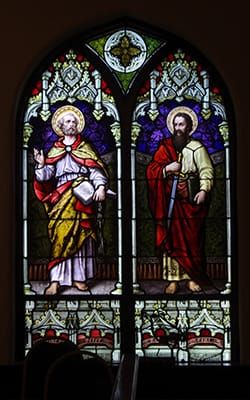
Photo credit: Nheyob, 2014. Wikimedia Commons. Licensed under the Creative Commons Attribution-Share Alike 4.0 International license.
_-_stained_glass,_St._Peter_and_St._Paul.jpg?ref=wordorigins-org.ghost.io)