redskin / red man
31 December 2025
Redskin, a disparaging term for a Native American, is over two and a half centuries old. It is first recorded in a transcript and translation of a speech given by Chief Maringouin, of the Illinois people, on 26 August 1769. It was interpreted by a Frenchman from the Illinois language and transcribed and translated into English by William Johnson:
I shall be pleased to have you come to speak to me yourself if you pity our women and our children; and, if any redskins do you harm, I shall be able to look out for you even at the peril of my life.
The French that redskin is translated from is peaux Rouges, and if the translation into French is accurate, the original Illinois word would probably have been *e•rante•wiroki•ta (person with red skin), but we don’t have a record of the original Illinois words.
The term red man is older, dating to 1740, when it appears in the journal of John Wesley, and the French homme rouge dates to at least 1725. And the English use of the adjective red to refer to Native Americans is older still, dating to an appearance in the journal of Colonel George Chicken on 31 October 1725:
They have heard the Talk of the White people for this many Years and that they have been down to the English Sevl times and heard the talk there and that they desire always to be at peace wth the White people and desire to have their own way and to take revenge of the red people and that it was their Young people that first broak out Warr with the White people.
Like many ethnic slurs, redskin and red man did not start out as derogatory, but they acquired the disparaging connotation over time. Tales that the term redskin refers to the practice of scalping or the use of red dye by native peoples are false.
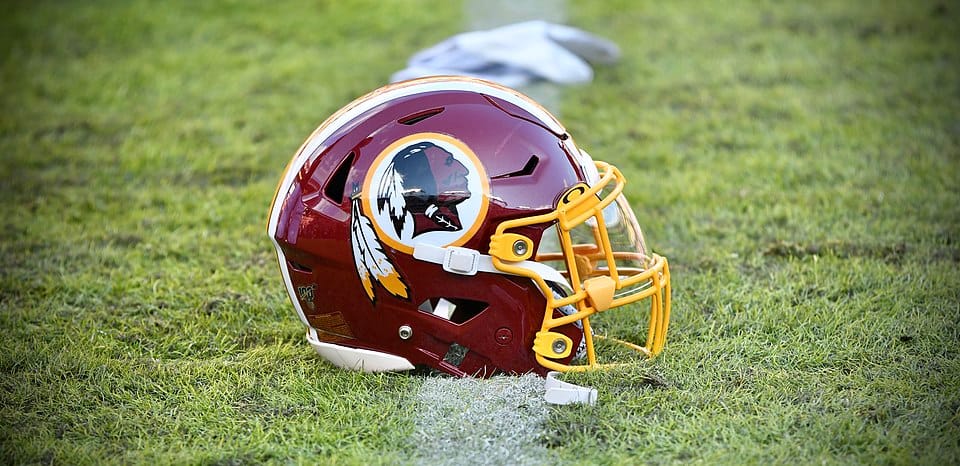
Until 2020, the Washington, DC National Football League team was known as the Redskins. The name was not originally intended to be disparaging and is part of the long and problematic tradition of using Native Americans as mascots of sports teams. Other examples in this genre include the NFL’s Kansas City Chiefs, and baseball’s Atlanta Braves and Cleveland Indians (which changed its name to the Guardians in 2021), not to mention my own high school teams, which were the Toms River South Indians. But while the Redskins name was never intended to be so, it is nevertheless considered offensive by many Native Americans. Following its dropping of the name, the Washington team was briefly known as simply the Washington Football Team before being dubbed the Commanders in 2022.
Sources:
Chicken, George. “Journal of Colonel George Chicken’s Mission from Charleston to the Creeks.” In Travels in the American Colonies, Newton D. Mereness, ed. New York: Macmillan, 1916, 169. HathiTrust Digital Library.
Johnson, William. The Papers of Sir William Johnson, v. 7, Albany: University of the State of New York, 1931, 133–38. HathiTrust Digital Library.
Nunberg, Geoffrey, “When Slang Becomes a Slur,” The Atlantic, 23 June 2014.
Oxford English Dictionary Online, September 2009, s.v. redskin, n., red man, n., red, adj. & n. (& adv.).
Photo credit: Joe Glorioso, 2019. Wikimedia Commons. Flickr. Licensed under the Creative Commons Attribution-Share Alike 2.0 Generic license.
