race / racism
17 December 2025
Race and racism permeate nearly every aspect of present-day American culture. Yet the concept of race as most people perceive it today is a relatively new one. While demonizing the “other” and the idea of grouping people by kinship dates to antiquity, grouping people by skin color only dates to the early modern era, and the systematic classification of people into defined races wasn’t reified until the eighteenth century, although it did not spring up de novo. Geraldine Heng, Cord Whitaker, and other scholars of race in the medieval period have shown that the seeds of our present-day concept of race date to medieval Europe. Likewise, the word race itself has its roots in medieval writing.
The common, present-day understanding of race is that it is a classification based largely but not exclusively on skin color, and that racism is an animus directed against people of a different race. This definition of racism focuses on the motivation of the racist individual. But scholars of critical race theory have expanded definitions of the words, using race to refer to any classification of people by what is perceived to be an essential difference between groups and the use of such difference to systematize power differentials between those groups. The essential difference can be skin color, but it can also be religion, national origin, sexual orientation, etc. This second definition ignores the motivation and focuses on the effect. Cord Whitaker, for example, writes:
Race sets one group of people identifiable by some distinctive trait and sets them beside another group with a different iteration of that trait—dark skin versus light skin, for an obvious example, or Catholicism versus Protestantism, for a less obvious though equally salient example—in order to make a point about hierarchy.
The specific traits that differentiate races can vary from place to place and era to era. Geraldine Heng writes:
In principle, race theory—whose brilliant practitioners are among the academy’s most formative and influential thinkers—understands, of course, that race has no singular or stable referent: that race is a structural relationship for the articulation and management of human differences, rather than a substantive content.
Critical race theorists define racism as any policy or institution that increases power differentials and inequalities between such races regardless of the motivations of the people advocating those policies. Therefore, even a so-called “color-blind” policy can be racist if it negatively affects people of color disproportionately. For example, a requirement to show government ID in order to vote, ostensibly enacted to combat perceived voter fraud, would be racist if whites are more likely to possess such IDs than are people of color.
Conversely, Ibram X. Kendi defines antiracism as:
a powerful collection of policies that lead to racial equity and justice and that are substantiated by ideas of racial equality.
So, a policy like affirmative action in the U.S. is antiracist because it reduces such power differentials, while policies that prevent “reverse racism” are actually racist because the seek to perpetuate existing, racially structured differentials in power.
As to where the word race comes from, that is only partially known; there is no Greek or clear Latin root to which it can be connected, but we can trace the word back to the late medieval period. Complicating things is the fact that late medieval uses of the word move in circles from language to language as texts are translated from one to another, so the etymological trail is rather muddled. But here is what we do know.
The earliest known appearance of the word is in the form raza in Italian from c. 1300, but this is in a translation from the French Faits des Romains in a discussion about Caesar’s horse:
l’uomo diceva che re Nicodeme di Bettinia li ‘l dono, e altri affermavano ch’elli fu nato in suo raza.
(The man said that King Nicodemus of Bettina gave him the gift, and others affirmed that he was born of his race.)
The original French, from c. 1213, uses the word haras:
Li un dien[t] que Nicomedes li dona, li autre afferment que il fu nez en son haras.
(One says that Nicodemus gave it to him; another affirms that it was born of his brood herd.)
In the Italian text raza (modern razza and modern Spanish raza) is translating the French haras, meaning a lineage of horses. (The word means stud-farm in modern French.) The English word haras, attested to before 1300, with the same meaning, also comes from the French.
The word race itself is first recorded in French in the 1481 poem “The Hunt” by Jacques de Brézé:
Contre eulx [les cerfs] avez bonne querelle,
Vostre race est leur ennemye!
(Against them [the deer] you [the hounds] have a good quarrel,
Your race is their enemy!)
So, the word originally applied to animals and was only later applied to humans, c. 1480 in the French Mystère du vieil Testament, where it is used to translate the Latin generatio (generation). In 1494 Simon de Phares in his Recueil des plus Célèbres astrologues (Collection of the Most Famous Astrologers) uses it to describe one of the astrologers, saying he is:
de la race entre les Juifs
(of a race of the Jews).
Here Simon is using race to refer to one of the tribes of Israel.
Where the Italian and French words come from is uncertain, but it’s most likely from the the Arabic faras, meaning horse.
As for English, the word race first appears in the early sixteenth century referring to a stud or breeding herd of horses. It could be a borrowing from the French or a parallel development within English from haras. By mid century, race was being applied to humans. In early English use, race refers to an extended family unit, people who share a common ancestral descent, making it a synonym of the older English word kin. The earliest use of race referring to people recorded by the Oxford English Dictionary is from Henry Howard’s, the earl of Surrey’s, translation of Virgil’s Aeneid. We don’t know exactly when Howard did his translation, but he ran afoul of Henry VIII and was beheaded in January 1547, so the translation obviously predates that:
I craue of God, and our streames to their fluddes,
Armes vnto armes, and offspring of eche race
With mortal warr eche other may fordoe.
(Henry VIII died nine days after Howard’s execution. Howard’s father, the duke of Norfolk, also under a death sentence, survived the king, and his death sentence was commuted. So, the poet suffered from bad timing.)
Howard uses race here to translate Virgil’s nepos, or descendent, so what he means by the word is clear when one examines the Latin original, but it’s not clear if one just looks at the English with a present-day eye. The next citation in the OED gives a clearer sense of the meaning being restricted to a specific family group. From John Ponet’s 1556 Shorte Treatise of Politike Power writing about the Roman emperor Caligula:
First by like that thempire [sic] should not goo out of his owne race, he coupleth not with one, but with all his susters, like bitche and dogge.
But the definition of race quickly expanded to refer to a larger tribe, nation, or people linked by common descent. From the 1572 letter by one I. B. discussing the state of Ireland:
The Englishe race ouerrunne and daily spoiled, seeing no punishment of malefactors did buy their owne peace, alied and fostred themselues with the Irishe, and the race so nourished in the bosome of the Irishe, perceiuing their immunitie from lawe and punishmente degenerated : choosing rather to maintain themselues in the Irish mans beastly libertie, tha[n] to submit themselues and to liue there alone, and not the Irish in the godly awe of the lawes of England.
By the seventeenth century, race was being used to refer to an even wider ethnic classification based largely on skin color, albeit an informal and unsystematic one. There is this description of the people of the city of Goave on Hispaniola (now in modern Haiti) in a 1684 translation of Alexandre Exquemelin’s De Americaensche Zee-Roovers (The Buccaneers of America):
These are for the most part a mungrel sort of people of several Bloods. Some of which are born of white European people and Negros, and these are called Mulatos. Others are born of Indians, and white people; and such are termed Mesticos. But others are begotten of Negros, and Indians, and these also have their peculiar Name, being called Alcatraces. Besides which sorts of people, there be several other species, and races, both here and in other places of the West Indies. Of whom this account may be given, that the Spaniards love better the Negro Women, in those Western parts, or the tawny Indian Females, than their own white European race.
But the use of race to refer to the systematic classification of people by their distinct physical characteristics doesn’t appear until the late eighteenth century and the advent of what we now call scientific racism. Oliver Goldsmith, in his 1774 A History of the Earth and Animated Nature, in which he divided humanity into six distinct races, appears to be the first to use race in this sense:
The second great variety, in the human species, seems to be that of the Tartar race […] The Tartar country, taken in general, comprehends the greatest part of Asia; and is, consequently, a general name given to a number of nations, of various forms and complexions.
But Goldsmith was not first to systematize the classification of humans into what we would now call races. That idea belongs to Carl Linnaeus, who a few decades earlier, in his 1758 Systema Naturae, divided humanity into four groups: Americanus, Europaeus, Asiaticus, and Afer (African). Unlike those who would follow him, Linnaeus does not explicitly assign a qualitative ranking to these groups, which he defines primarily by geography rather than skin color. Although he does give qualitative descriptions of the four groups which implicitly create a value ranking: Native American—regitur consuetudine (ruled by habit); European—regitur ritibus (ruled by custom); Asian—regitur opinionibus (ruled by belief); and African—regitur arbitrio (ruled by caprice).
It is Johann Friedrich Blumenbach’s De generis humani varietate nativa (On the Natural Variety of Mankind) that first explicitly articulated the modern concepts of race and racism. Blumenbach originally published the work in 1775, dividing humanity into Linnaeus’s four groups, but in the third edition of 1795 he added a fifth group, the Malay, which included Pacific Islanders and Australian Aborigines. (Also, this 1795 edition, also written in Latin, is the first to use the term Caucasian as a label for whites—based on Blumenbach’s notion that Eden and Adam and Eve, who in his schema were of course white, were located in the Caucasus region. Blumenbach believed the people of that region adhered most closely to his ideal of human beauty.) More crucially, he qualitatively ranked the five groups, with Caucasians at the top, and the others being increasingly degenerate forms of humanity in two lineages: Native American and then Asian, and Malay and then African. Blumenbach also founded the now discredited discipline of craniometry and based his classification system in large part on his studies of human skulls.
While neither Linnaeus nor Blumenbach, writing in Latin, used the word race, their ideas would form the foundation of present-day racism. And Blumenbach’s five categories survive in the present-day racial categories used by the U.S. Census, which try to align with the popular American idea of what constitutes race:
White—A person having origins in any of the original peoples of Europe, the Middle East, or North Africa.
Black or African American—A person having origins in any of the Black racial groups of Africa.
American Indian or Alaska Native—A person having origins in any of the original peoples of North and South America (including Central America) and who maintains tribal affiliation or community attachment.
Asian—A person having origins in any of the original peoples of the Far East, Southeast Asia, or the Indian subcontinent including, for example, Cambodia, China, India, Japan, Korea, Malaysia, Pakistan, the Philippine Islands, Thailand, and Vietnam.
Native Hawaiian or Other Pacific Islander—A person having origins in any of the original peoples of Hawaii, Guam, Samoa, or other Pacific Islands.
The Census Bureau qualifies its categories and their definitions:
The Census Bureau collects racial data in accordance with guidelines provided by the U.S. Office of Management and Budget (OMB), and these data are based on self-identification.
The racial categories included in the census questionnaire generally reflect a social definition of race recognized in this country, and not an attempt to define race biologically, anthropologically or genetically
Still, even using their own definitional criteria, there are problems with the Census Bureau’s categories. Hispanic/Latinx is not a racial category according to the Bureau—although many, if not most, Americans would classify it as such—with the Bureau saying, “people who identify their origin as Hispanic, Latino, or Spanish may be of any race.” Arabs, Iranians, and other peoples of the Middle East are classified as white by the Census Bureau, but few Americans would consider them as belonging to the same ethnic group as people from northern Europe. Likewise, Asian is a very broad category, and few would consider someone from China to be of the same ethnic group as someone from India. How Australian Aborigines should classify themselves under this system is unclear—there probably aren’t many Aborigines in the United States, but the country is a big one and there are undoubtedly some who reside here. And the caveat of “who maintains tribal affiliation or community attachment” for American Indians creates problems. What about the case where one sibling maintains such an affiliation and the other doesn’t? Are they of different races? Since the Census gathers such data based on self-identification, as a practical matter the Bureau records whatever race people say they are, but these issues just go to show the difficulties in trying to pin down a socially constructed system of categorization.
While our modern definition of race dates to the eighteenth century, the word racism is much newer—although racist practices date back to antiquity. The modern word is preceded by the term racialism, which makes its appearance in the late nineteenth century. From the Michigan City Dispatch of 24 June 1880:
There is a certain innate sentiment which ranks in a cataloguing of the mental impulses with patriotism, which we might term racialism. On account of that inborn and inbread [sic] sentiment we all incline to consider the caucasian superior to the other races of the genus homo.
The term racialist makes its appearance a few decades later. From a 1908 journal article entitled The Racial Interpretation of History and Politics:
M. Finot is able to point out, not only discrepancies between the methods of different observers in respect of the same physical characteristic, but between the estimates formed by various recent and contemporary racialists of the importance of particular marks. Thus dolichocephaly and brachycephaly, which according to M. Vacher de Lapouge, will be the watchwords of the Armageddon of the twentieth century, are, according to Broca, Manouvrier and others, among the least important differences between human beings.
Both of these terms have faded from use, being replaced by racism and racist. The earliest use of racism in the OED is by Richard Henry Pratt, founder of the Carlisle Indian Industrial School at Carlisle, Pennsylvania, speaking at the 20th annual meeting of the of the Lake Mohonk Conference of Friends of Indian in 1902:
Segregating any class or race of people apart from the rest of the people kills the progress of the segregated people or makes their growth very slow. Association of races and classes is necessary in order to destroy racism and classism.
Pratt is more famous for his articulation of the mission of the Carlisle School he founded: “kill the Indian; save the man.” Pratt inveighed against racism, but ironically his methods of fighting racism through forced assimilation were racist to their core. Pratt’s racism is an example of the definition used by critical race theorists in that his motivations were based on a belief in equality between the races (at least between Native Americans and whites), but his policies of stripping Native Americans of their culture were genocidal.
The noun racist appears by 1919 in an article by Julio R Barcos in the December issue of the journal Inter-America:
Our poor “American” race is, as we all know, in the depths: hunger, anaemia, syphilis, alcohol, tuberculosis, are the hydra of a hundred heads that is devouring its best energies without this fact concerning or troubling, in the least, the consciences of any of our literary “racists,” including the great Rodó. […] Race prejudice is unworthy of thought of the spiritual height of Rodó’s. To uphold and to propagate the idea of the superiority of the Latin-American over the Anglo-American is to fall into theories like those of Gobineau, sent to be pigeonholed by anthropological science.
And there is this use of the word in Henri Lichtenberger’s 1923 Relations between France and Germany in a description of the Nazi party:
A campaign was even planned to expel from the Nationalist party the agitators of the extreme right known as “Germanists” or “racists,” a group (deutschvolkische) whose foremost leaders are Wulle, Henning and von Graefe, and whose secret inspirer is supposed to be Ludendorff.
So, while people have been stigmatizing and demonizing the “other” since time immemorial, the terms race and racism and the criteria (i.e., skin color) used to distinguish “us” from “them” are modern. And it’s important to recognize that there are two related, but distinct definitions of race and racism in use today, and when engaging with the subject, one must understand which of the definitions one’s interlocutor is using, the one defined by motivation or the one defined by effect.
Sources:
Anglo-Norman Dictionary, AND2 Phase 2, 2006–08, s.v. haras.
Barcos, Julio R. “Our Professors of Idealism in America.” Inter-America, 3.2, December 1919, 84–102 at 89/1. HathiTrust Digital Library.
Barrows, Isabel C., ed. Proceedings of the Twentieth Annual Meeting of the Lake Mohonk Conference of Friends of the Indian, 1902. New York: Lake Mohonk Conference, 1903.134. HathiTrust Digital Library.
Blumenbach, Johann Friedrich. De generis humani varietate nativa. Göttingen: Vandenhoek et Ruprecht, 1795, xxiii–xxvi. Archive.org.
Esquemelin, Alexandre O. Bucaniers of America. London: William Crooke, 1684, 28. ProQuest: Early English Books Online (EEBO).
Goldsmith, Oliver. An History of the Earth, and Animated Nature, vol. 2. London: J. Nourse, 1774, 219. Gale Primary Sources: Eighteenth Century Collections Online (ECCO).
Gould, Stephen Jay. “The Geometer of Race.” Discover, November 1994.
Heng, Geraldine. The Invention of Race in the European Middle Ages. Cambridge: Cambridge UP, 2018, 19.
Howard, Henry, Earl of Surrey. Certain Bokes of Virgiles Aeneis Turned into English Meter. London: Richard Tottel, 1557, sig. G1r, lines 841–43. ProQuest: Early English Books Online (EEBO).
I. B. Letter Sent by I.B. Gentleman Vnto His Very Frende Maystet R.C. Esquire. London: Henry Binneman for Anthony Kitson, 1572, B1r. ProQuest: Early English Books Online (EEBO).
Kendi, Ibram X., How to Be an Antiracist, New York: One World, 2019, 33.
Liberman, Anatoly, “The Oxford Etymologist Looks at Race, Class and Sex (but not Gender), or, Beating a Willing Horse,” OUPBlog, 22 April 2009.
Lichtenberger, Henri. Relations Between France and Germany. Washington, DC: Carnegie Endowment for International Peace, 1923, 53. HathiTrust Digital Library.
Linnaeus, Carl. Systema natura, vol. 1. Stockholm: Lars Salvius, 1758, 20–22. Archive.org.
Michigan City Dispatch (Indiana), 24 June 1880, 2/2. NewspaperArchive.com.
de Miramon, Charles. “Noble Dogs, Noble Blood: The Invention of the Concept of Race in the Late Middle Ages.” In The Origins of Racism in the West. Edited by Miriam Eliav-Feldon, Benjamin Isaac, and Joseph Ziegler. Cambridge UP, 2009, 200–16.
Oxford English Dictionary Online, 1989, s.v. haras, n.; June 2008, s.v. race, n.6, race, n.5, racism, n., racist, n., racialism, n., racialist, n.
Ponet, John. A Shorte Treatise of Politike Power. Strasbourg: Heirs of W. Köpfel, 1556, sig. B7r. ProQuest: Early English Books Online (EEBO).
Roberts, W. J. “The Racial Interpretation of History and Politics.” International Journal of Ethics, 18.4, July 1908, 475–92 at 484–85. HathiTrust Digital Library.
U.S. Census Bureau, “Race.” 20 December 2024.
Whitaker, Cord. Black Metaphors: How Modern Racism Emerged from Medieval Race-Thinking. Philadelphia: U of Pennsylvania Press, 2019, 50.
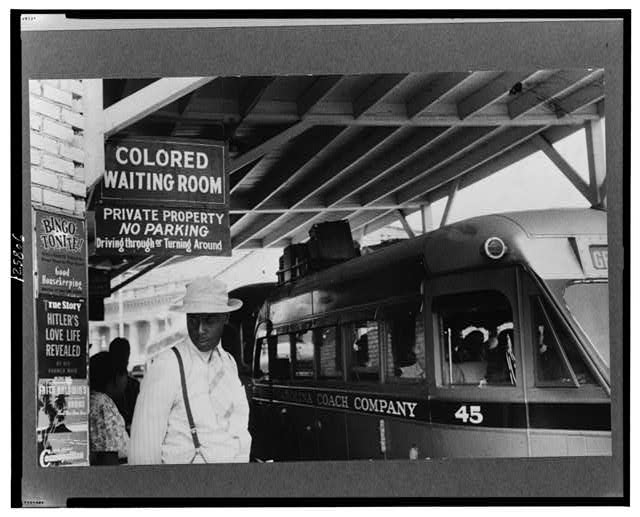
Photo credit: Jack Delano/US Farm Security Administration, 1940; Wikimedia Commons; Library of Congress; public domain photo.
