raccoon / trash panda

23 January 2026
Raccoons (Procyon lotor) are medium-sized (11–57 lbs / 5–26 kg), North American mammals with dexterous paws, a facial mask, and ringed tail. They are originally native to deciduous forests, but have adapted extremely well to urban areas, living in close proximity to humans, where they are often, despite their cuteness, considered a pest.
The word raccoon has a rather straightforward etymology. The word is from the Virginia Algonquian dialect word aroughcun or aroughcoune. Its first known use in English is in John Smith’s, 1608 True Relation of events in the early days of the Virginia colony. The word appears in a description of the native American chief Powhatan, the father of Pocahontas:
Arriuing at Weramocomoco their Emperour, proudly lying vppon a Bedstead a foote high vpon seune or twelue Mattes, richly hung with manie Chaynes of great Pearles about his necke, and couered with a great Couering of Rahaughcums.
Early spelling of the word varied considerably, with three main forms of the word being rahaugcum, arocoun, and raccoone. The spelling standardized around the last in the eighteenth century. Up until the twentieth century, spelling racoon with one <c> was common.
More recently, the slang name trash panda has been applied to the creatures, due to their propensity to raid trash bins for food and their resemblance to either the Asian red panda (Ailurus fulgens), which it resembles rather closely, or the giant panda, which it does not resemble other than the eye masks. (Pandas and raccoons are not related.) The slang term appears to have originated in Canada, or at least that’s where early uses predominate.
.jpg)

The earliest unambiguous use of trash panda that I’m aware of is a 24 February 2015 tweet that reads:
Orca=Sea Panda
Penguin=Ice Panda
Possum=Rat Panda
Badger=Striped Panda/Hufflepanda
Raccoon=Night Panda/Trash Panda
Skunk=Sulfur Panda
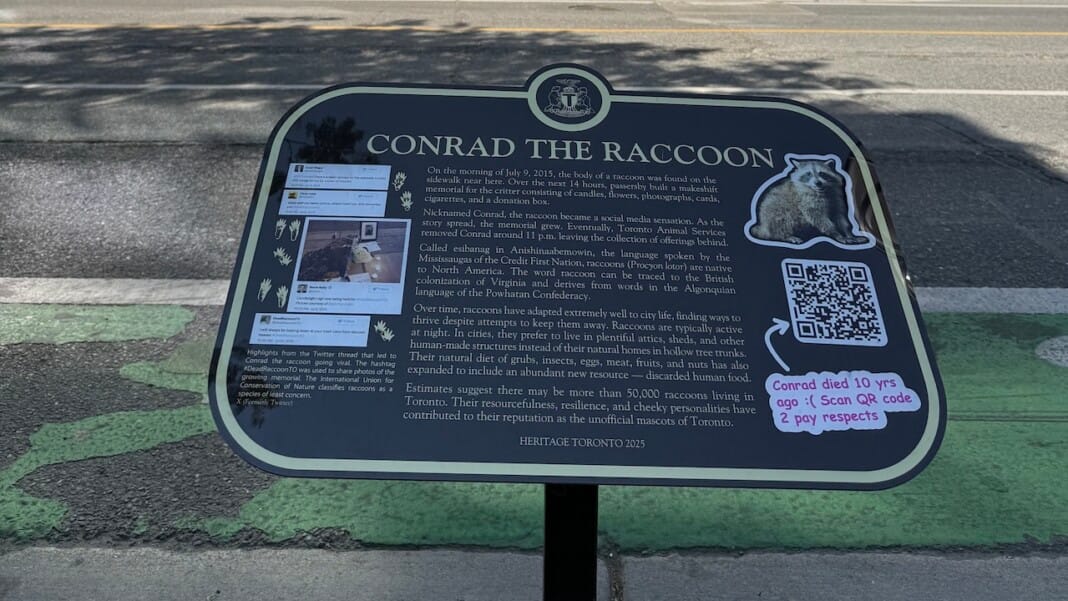
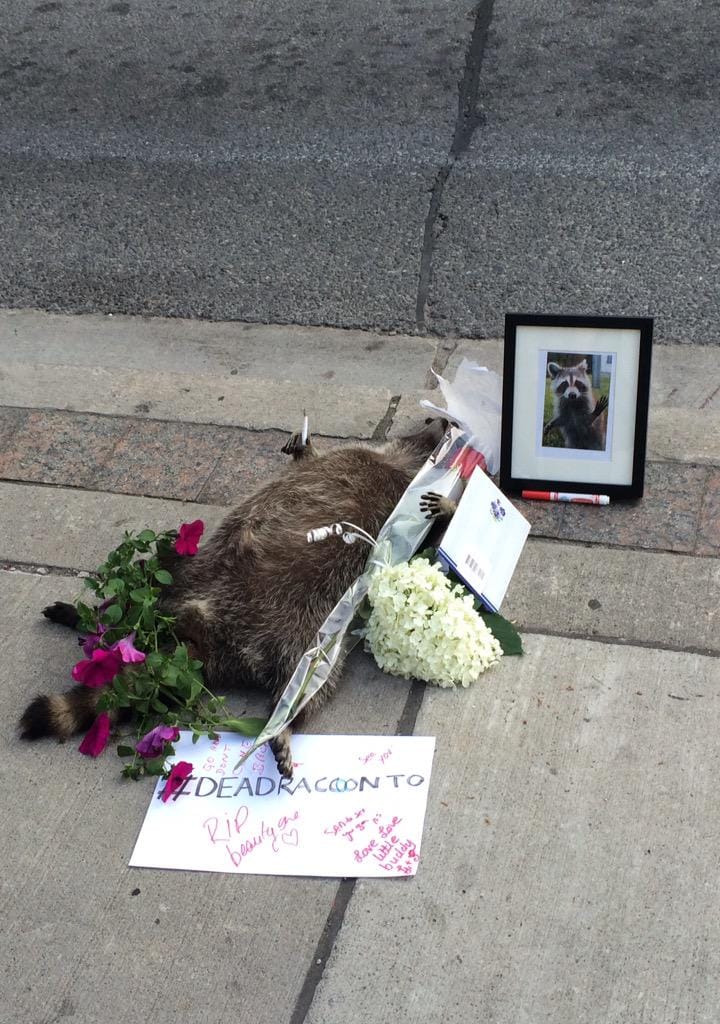
And use of trash panda exploded a few months later in relation to the 9 July 2015 demise of Conrad, a Toronto raccoon. (Raccoons are extremely common in that city.) Early that day, the body of a dead raccoon on the sidewalk along Yonge Street—a major downtown thoroughfare—was reported to animal control, which was slow in coming to pick it up. (The agency’s explanation for the tardiness was that they place a priority on trapped and distressed animals, which is only right.) In the meantime, residents created a memorial around the raccoon, whom they dubbed Conrad. Flowers, notes of condolences, candles, and a framed photo of a raccoon were arrayed around Conrad’s corpse. News of the memorial exploded on social media and on the local news. Later that evening, animal control finally arrived to dispose of poor Conrad’s mortal remains.
And trash panda got an entry in Urbandictionary on 2 August 2015:
trash panda
A raccoon
Those damn trash pandas keep tearing up my garbage bags.
There are some earlier, ambiguous uses of trash panda, which may or may not refer to the mammal. There are a few earlier tweets that have collocations of trash + panda but whose context cannot be determined, and a few Twitter users had the phrase in their handles. A musical group with the name Trash Panda and the Plywood Carousel Rejects was reported as performing in Saint John, New Brunswick in January 2007. And Michael Shilling’s 2009 novel Rock Bottom has the following lines:
Now the box was impaled on her heel. She shook her foot, but it wouldn’t come off, hanging there like a little baby trash panda.
There’s no further elaboration in the book as to what is meant, but my guess is that it is not a reference to a raccoon but rather to a piece of trash that is clinging like a baby panda does to its mother.
Sources:
@Pandabbadon. Twitter.com (now X.com), 24 February 2015.
Oxford English Dictionary Online, June 2008, s.v. raccoon, n.
Shilling, Michael. Rock Bottom. New York: Back Bay Books, 2009, 109. Archive.org.
Smith, John. A Trve Relation of Such Occurrences and Accidents of Noate as Hath Hapned in Virginia Since the First Planting of that Collony. London: John Tappe, 1608, sig. Cv. ProQuest: Early English Books Online (EEBO).
“Today and Tomorrow.” Telegraph-Journal (Saint John, New Brunswick), 30 January 2007, D2. ProQuest Newspapers.
Urbandictionary.com, 2 August 2015, s.v. trash panda.
Photo credits: Conrad, the raccoon, @ladydi1116, Twitter.com (now X.com), 9 July 2015, fair use of a copyrighted image to illustrate the topic under discussion; Memorial plaque, Streetsoftoronto.com, 2025, fair use of a copyrighted image to illustrate the topic under discussion.