poutine

4 February 2026
Poutine is a contender for the Canadian national dish, although whether or not it can unseat Kraft Dinner (i.e., Kraft macaroni and cheese) in overall popularity is questionable. But the origins of both the dish and its name are shrouded in mystery, and its pedigree is not that long.
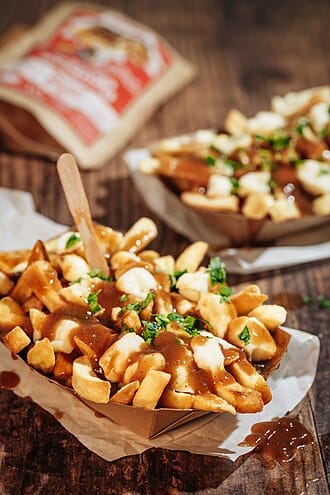
Poutine is a dish of French fries covered in gravy and cheese curds. Well-made poutine is both delicious and artery-hardening. Originating in Quebec, it is widely available across Canada, even being served in fast food restaurants like McDonalds and Burger King—although many would argue that what is served in these chain restaurants does not qualify as poutine.
While the dish most people today know as poutine dates only to the latter half of the twentieth century, The Canadian-French word poutine has been applied to a variety of dishes since the early nineteenth century. The word’s origin is a bit uncertain, but it is probably a dialectal variant of the French pouding or the English pudding. The word also has a slang sense in Canadian French that dates to at least the late 1950s meaning a complex affair or a mess, and this slang sense may have played a role in naming the dish.
There are various claims as to who first put cheese curds and gravy on French fries, but none have strong evidence to support them. Most commonly, it is asserted that Fernand Lachance, owner of Latin Qui Rit in Warwick, Quebec, was the culinary genius. He claims that in 1957 a customer asked him to mix cheese curds and fries, which he dubbed poutine because it created a mess. He says he started adding gravy in 1962 in order to keep the fries warm.
It's a neat story, and it very well may be true. But it seems more likely that the dish and the name is a variation on the older Acadian poutines rapées, a potato dumpling with a salt pork center.
But, according to the Oxford English Dictionary, the earliest attested use of poutine in Canadian French in reference to the modern dish is from 1978. The earliest English use of poutine in the sense of fries, cheese curds, and gravy that I have found is in the Montreal Gazette of 3 April 1980:
If you want to be truly chic in Sherbrooke, ask for a “poutine” which is French fries served with melted cheese and “beaucoup d’sauce.” The best places at the moment are La Wellington and Louis lunceonette [sic].
And there is this longer description in Manitoba’s Brandon Sun of 1 February 1982:
Although nutritionists may shudder at its starch, fat and salt content, a new fast-food snack is gaining on hot dogs, hamburgers and pizza in Quebec snack bars.
It’s called poutine and it combines french fried potatoes with curds of cheese and hot barbecue sauce.
[…]
Poutine, which has been popular for at least five years in southeastern Quebec, is responsible for almost doubling the sales of fresh curd or fromage en graine over the past two years.
[…]
Whoever originated the Quebec dish “borrowed” the name, said Harvey Godin, a government restaurant inspector.
“Don’t confuse it with poutines rapees which is an old Acadian dish,” he said. An Acadian from Rogersville, N.B., Godin has watched the new poutine grow in popularity during his travels as chief of the Industry department’s hotel services.
The original poutines rapees which he remembers eating as a child, are potato dumplings made with salt pork at the centre.
Sources:
Dictionary of Canadianisms on Historical Principles, second edition (DHCP-2), February 2017, s.v. poutine, n.
Dictionnaire historique du français québécois (DHFQ), 1998, s.v. poutine, n.
Oxford English Dictionary Online, December 2006, s.v. poutine, n.; September 2007, s.v. pudding, n.
“Poutine Popularity Rivals That of Burgers.” Brandon Sun (Manitoba), 1 February 1982, 12. NewspaperArchive.com.
Schnurmacher, Thomas. “Liz’s Mission Is a Big Secret.” Gazette (Montreal), 3 April 1980, 53/1. ProQuest Newspapers.
Photo credit: Berlinfoodeater, 2022. Wikimedia Commons. Licensed under the Creative Commons Attribution-Share Alike 4.0 International license.
