penguin
5 August 2026
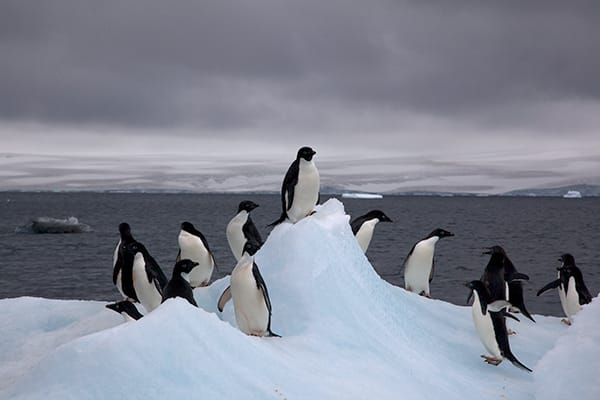
Penguins comprise a number of species of flightless sea birds of the family Spheniscidae, which, with one exception, inhabit the southern hemisphere. The exception is the Galapagos penguin, which dwells just north of the equator.
The name penguin seems to have been first applied to the great auk, a now extinct species of flightless sea bird that resembles, but is genetically unrelated to, the penguins we know today. Although the earliest use of the word in extant literature is a reference to penguins, not the great auk. This earliest known use is in an account of Francis Drake’s 1577–78 circumnavigation which refers to penguins living at the southern tip of South America. But great auks were a northern hemisphere bird, and it is likely the auks were called penguins prior to Drake’s voyage, with the name being applied to the southern birds by the men of the expedition.
The etymology of penguin is not known for certain. It is probably a borrowing from the Welsh pen gwyn (pen = head/headland + gwyn = white). Given that pen can also mean headland and that the great auk did not actually have a white head, it is possible that it is a place name (toponym) that transferred to the great auks living there. It is also possible that penguin is originally a Breton coinage, Breton also being a Celtic language that shares many cognates with Welsh. The word’s use in other European languages is a result of borrowing from English.
A less likely alternative is that it derives from the Latin pinguis, meaning fat. A spurious folk etymology has it coming from pin-wing, a supposed reference to the stunted wings of the flightless birds. This last is certainly incorrect.
The reference to penguins by members of Drake’s company appears in the notes of Francis Fletcher, Drake's chaplain on the voyage. The passage in question describes events of August 1578 when Drake and his expedition passed through the Strait of Magellan at the southern tip of South America. It’s unclear, though, exactly when it was penned, but it was before 1580 when the notes were first published:
In these Ilands we found great releife & Plenty of good victualls for Infinite were the Numbers of the foule, wch the Welch men name Pengwin. & Maglanus tearmed them Geese, This fowle cannot flye, hauing but stubb wings without feathers, couerd ouer wth a certaine downe as it were young Goslings of 2 monthes old, as are allso all their body besides in their head eyes & feet they be like a Duck but allmost as a goose.
(The Oxford English Dictionary dates this passage to 1577, but that is impossible as the events described happened in August 1578.)
Another early use of penguin is in a 1584 translation of Caradoc of Llancarfan’s twelfth-century history of Wales. The relevant passage is sixteenth-century commentary by the translators on the legend of Madoc that appears in Caradoc’s original Latin text. The legend has it that Madoc, a twelfth-century Welsh prince, sailed to the Americas and settled there with a number of countrymen. There is no evidence that the legend has any truth to it. The word here is probably being used to refer to the great auk, which despite not actually having a white head, was at least indigenous to the northern hemisphere:
The Brytish words and names of places, vsed in that countrie euen to this daie, doo argue the same: as when they talke togither, they vse this word Gwrando, which is, Hearken or listen. Also they haue a certeine bird with a white head, which they call Pengwin, that is, white head. But the Iland of Corroeso, the cape of Bryton, the riuer of Gwyndor, and the white rocke of Pengwyn, which be all Brytish or Welsh words, doo manifestlie shew that it was that countrie which Madoc and his people inhabited.
Despite it coming a few years after the first use of penguin to refer to the Antarctic species, the word’s appearance in this text is evidence that it was originally used to refer to the great auk.
Sources:
American Heritage Dictionary, fifth edition, 2022, s.v. penguin, n.
Caradoc of Llancarfan. The Historie of Cambria, now called Wales. David Powell and Humphrey Llwyd, trans. London: Rafe Newberie and Henrie Denham, 1584, 229. National Library of Wales.
Fletcher, Francis. “Francis Fletcher’s Notes” (August 1578?). The World Encompassed and Analogous Contemporary Documents Concerning Sir Francis Drake’s Circumnavigation of the World. N. M. Penzer, ed. London: Argonaut, 1926, 128. HathiTrust Digital Library.
Merriam-Webster.com, 1 July 2026, s.v. penguin, n.
Oxford English Dictionary Online, September 2005, s.v. penguin, n.
Photo credit: Jason Auch, 2008. Wikimedia Commons. Flickr. Licensed under the Creative Commons Attribution 2.0 Generic license.
