Oregon
20 March 2026
About the origin of the name Oregon, little can be said with certainty. It is of Native American origin and was first applied in English as the name of a river, but that’s about it.
The name first appears in a 1765 petition to English Privy Council by Robert Rogers, a colonial military officer. Rogers refers to the Ouragon River, saying it is an Indian name for a yet-to-be-seen-by-Europeans river (probably what would come to be known as the Columbia River):
The route Major Rogers proposes to take is from the Great Lakes towards the head of the Mississippi and from thence to the river called by the Indians Ouragon, which flows into a bay that projects north-eastwardly into the country from the Pacific Ocean, and there to explore the said bay and its outlets and also the western margin of the continent to such a northern latitude as shall be thought necessary.
Rogers’s use of the name indicates that the name could be from a pidgin of one of the Algonquin languages and English, wauregan, meaning beautiful. But alternatively, it could be from a Shoshonean word formed from ogwa (water) + pe-on’ (west).
The spelling Oregon appears in print in Jonathan Carver’s 1778 Travels through the Interior Part of North America:
The four great rivers that take their rise within a few leagues of each other, nearly about the center of this great continent; viz. The River Bourbon, which empties itself into Hudson’s Bay; the Waters of the Saint Lawrence; the Mississippi, and the River Oregon, or the River of the West, that falls into the Pacific Ocean at the straits of Annian.
And William Cullen Bryant uses the name in his 1817 poem Thanatopsis:
Take the wings
Of morning—and the Borean desert pierce—
Or lose thyself in the continuous woods
That veil Oregan, where he hears no sound,
Save his own dashings.
Bryant’s poem made the name famous and indirectly led to the naming of the territory and eventually the state.
An alternative, but now largely discounted, hypothesis for the origin appears in a 1944 article in American Speech where it is postulated that the name comes from Ouariconsint. The name appears on a French map from sometime before 1709 and the name is split into two lines, with -sint appearing below, giving the impression to a casual reader that the river’s name is Ouaricon. The river in question is the Wisconsin River. According to this hypothesis English explorers like Rogers confused the name with a river further to the west.
Sources:
Bryant, William Cullen. “Thanatopsis.” North-American Review and Miscellaneous Journal, 5.1, September 1817, 338–340 at 339. JSTOR.
Carver, Jonathan. Travels through the Interior Parts of North-America in the Years 1766, 1767, and 1768. London: 1778, ix. HathiTrust Digital Library.
Everett-Heath, John. Concise Oxford Dictionary of World Place Names, sixth ed. Oxford: Oxford UP, 2020, s.v. Oregon. Oxfordreference.com.
“North West Passage” (13 September 1765). Acts of the Privy Council of England, Colonial Series, Vol. 6. London: Stationary Office, 1912, 418. HathiTrust Digital Library.
Oxford English Dictionary Online, September 2004, s.v. Oregon, n.
Stewart, George R. “The Source of the Name ‘Oregon.’” American Speech, 19.2, April 1944, 115–17. JSTOR.
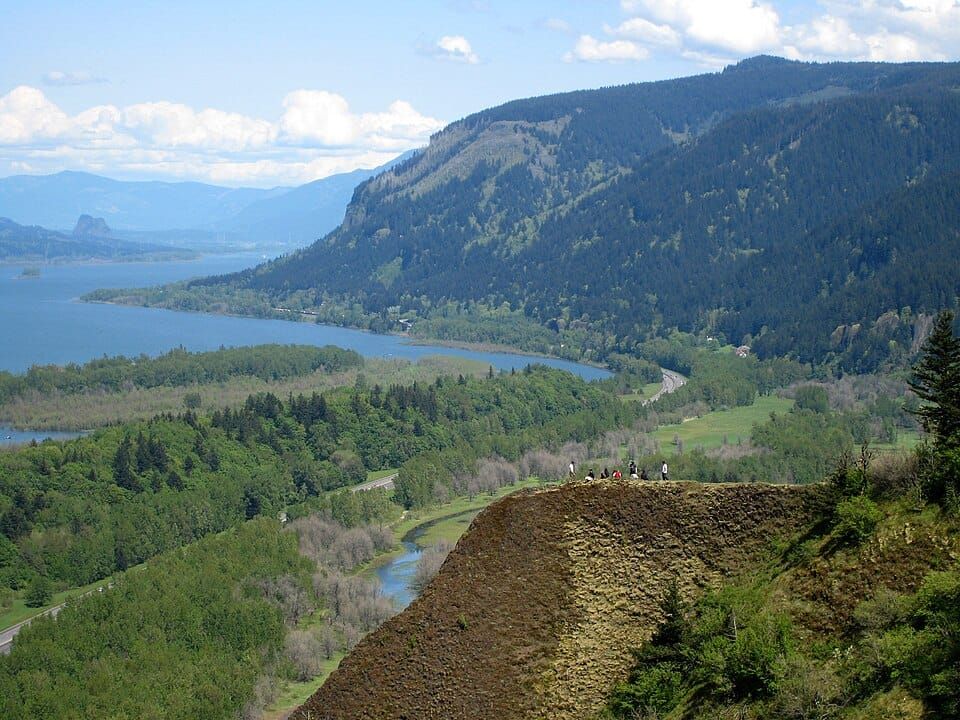
Photo credit: Hux, 2009. Wikimedia Commons. Public domain image.
