opera
2 November 2026
An opera is a musical drama consisting, usually, of vocal pieces accompanied by an orchestra. In classic opera, the script is entirely sung. This sense of the word is borrowed from Italian, where its use dates to 1639. The Italian word descends from the Latin opera, which is the plural of opus, meaning work or composition. So the Latin plural became singular in Italian before the word was borrowed into English.
This sense of opera first appears in English in the mid seventeenth century, and early use of the word is in reference to Italian operas. Here is an example from J. Raymond’s 1648 An Itinerary Conayning a Voyage Made through Italy:
A week after our arrive at Sienna, was an Opera represented on the new Theatre of Prince Matthaias, with severall changes of Sceanes, as a Garden, Sea, Pallace, and other Machines, at with the Italians are spoke to be excellent.
The first Italian-style opera written and performed in England was Thomas Clayton’s 1705 Arsinoe, Queen of Cyprus. The published libretto of that work is subtitled “An Opera after the Italian Manner,” and Clayton’s preface to the work opens with:
The Design of this Entertainment being to introduce the Italian manner of Musick on the English Stage, which has not been before attempted; I was oblig’d to have an Italian Opera translated: In which the Words, however mean in several Places, suited much better with that manner of Musick, than others more poetical would do.
Sources:
Clayton, Thomas. “Preface.” Arsinoe, Queen of Cyprus. An Opera after the Italian Manner: All Sung. London: Jacob Tonson, 1705. Gale Primary Sources: Eighteenth Century Collections Online (ECCO).
Oxford English Dictionary Online, June 2004, s.v. opera, n.1.
Raymond, J. An Itinerary Conayning a Voyage Made through Italy. London: Humphrey Moseley, 1648, 174. HathiTrust Digital Library.
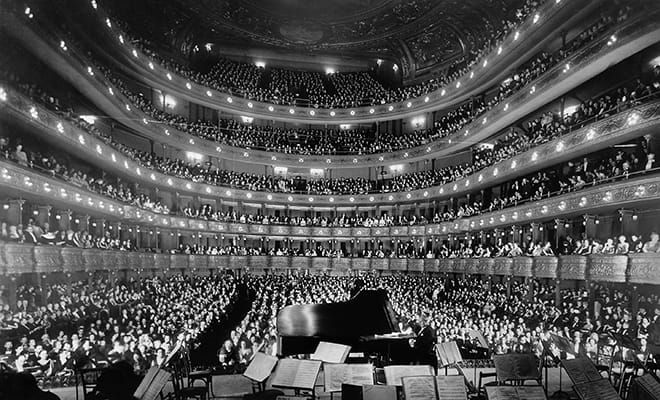
Photo credit: Unknown photographer/NARA, 1937. Wikimedia Commons. Public domain photo.
