nones (religious)
19 December 2025
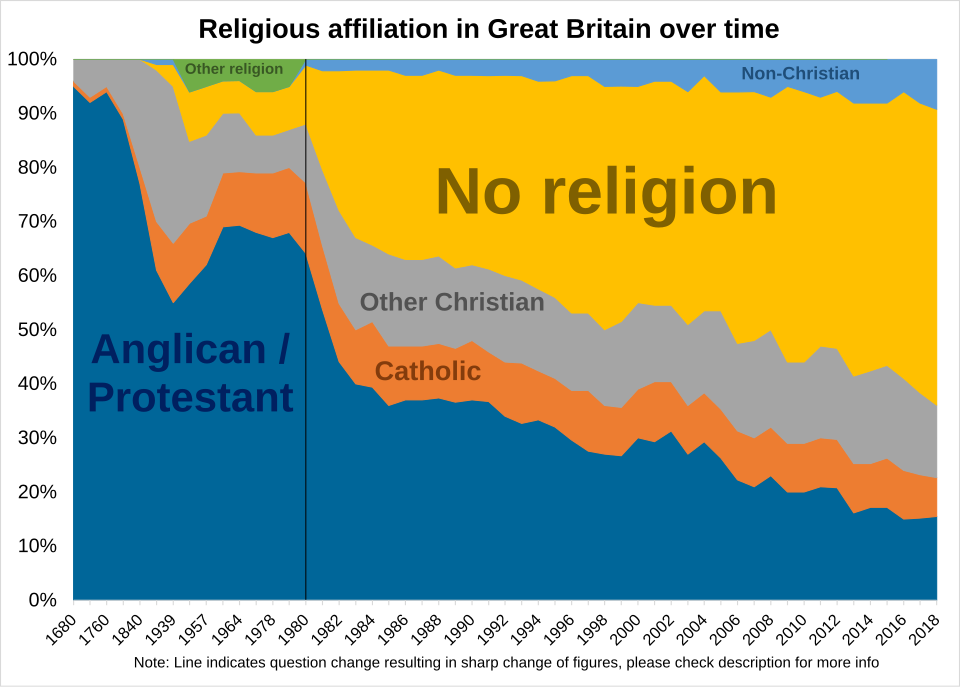
In recent years, there have been many news reports touting the fact that the fastest growing religious group in the United States is the nones. Who are the nones? And when did we start using the term?
The nones are people who are not affiliated with any organized religion. The group includes atheists and agnostics, but it also includes those who are “spiritual but not religious,” people who believe in some kind of divine being or spiritual existence but who don’t ascribe to an organized faith tradition. The term nones has become rather common in recent years, but it was coined over fifty years ago.
None dates to at least 1967 when it was used in a paper, The Religious “Nones”: A Neglected Category, by sociologist Glenn M. Vernon. The paper was circulated in mimeographed form and published the following year:
The language which any group uses inevitably betrays evaluation, even when only description is intended, and much more than referent identification may be implied by a particular label. This appears to be the case with the “none” label, as when it designates the last category, following “Catholic, Jew . . .,” in a list headed by “Religion.” It provides a negative definition, specifying what a phenomenon is not, rather than what it is. Intentionally or not, such a use implies that only those affiliated with a formal group are religious. In fact, the label “No religion” is used in the 1957 U. S. Census and by some researchers to identify those who do not belong to a formal church.
By way of contrast, the social scientist classifies as “independent” those who do not report affiliation with a particular political party. The use of the “independent” label suggests that the lack of political party affiliation does not mean that one is apolitical or has no political convictions. He is still viewed as a political person. Perhaps this is because the act of voting serves as the primary validation of political participation. There is no comparable religious phenomenon, no clearly recognized religious behavior other than membership, attendance, or other identification with a formal religious group. Thus, “none” is used in religious research, designating no religious affiliation, but also adding the gratuitous implication of a nonreligious person.
And Vernon attaches footnotes to these paragraphs that read:
Frequently included under this label are atheists, agnostics, those with “no preference,” those with no affiliation, and also members of small groups and others who, for one reason or another, do not fall within the classification scheme being used and who more properly belong in a residual or “other” category.
And:
At times other terms such as “free thinker” and “non-affiliated” have been used. Norman Thomas used the label “Independent Christian” in a classification of conscientious objectors in his book The Conscientious Objector in America.
The second of these papers is Vernon’s 1968 Marital Characteristics of Religious Independents, in which he writes:
When the sociologist of religion reports his research, he at times includes a somewhat residual category of “none” under which is frequently included such diverse individuals as atheists, agnostics, those with “no preference,” those with “no affiliation” as well as practicing and/or believing “nones”—those without affiliation who engage in ritual behavior and/or accept premises incorporated in the beliefs of the affiliated religionists. These are the “religious nones” to which previous attention has been called.
Despite the wording of this second paper, I’ve found no evidence in the sources he cites of anyone else using the term nones. As this paper was actually published before the first, the “previous attention” seems to be a reference to the mimeographed version of his first paper. The word none had been used elsewhere in surveys as a possible response when asking the question of religious affiliation prior to Vernon’s two articles, but they did not use it as a noun labeling a category of religious (non-)affiliation. While this is hardly ironclad evidence that he coined the term, it seems probable that he did.
None of the above has anything to do with the Christian liturgical term none (or nones), referring to the ninth hour of the day or the prayers that were to be offered at that hour, which has an entirely different origin. The liturgical term is borrowed from the Latin nona and the French none. This none roughly corresponds to three p.m., the ninth hour of daylight. This use in English-language discourse dates to the early sixteenth century and, of course, much earlier in Anglo-Latin.
Sources:
I’d like to thank Garson O’Toole of the Quote Investigator website and Peter Reitan for assistance in my research on this term.
Latham, Ronald E., David R. Howlett, and Richard K. Ashdowne, eds. Dictionary of Medieval Latin from British Sources, Oxford: Oxford UP: 2013, s.v. nonus, n. Brepols: Database of Latin Dictionaries.
Oxford English Dictionary Online, December 2003, s.v. none, n. and nones, n.3.
Vernon, Glenn M. “Marital Characteristics of Religious Independents.” Review of Religious Research, 9.3, Spring 1968, 162–70 at 162/1. JSTOR.
———. “The Religious ‘Nones’: A Neglected Category.” Journal for the Scientific Study of Religion, 7.2, Autumn 1968, 219–29 at 219–20. JSTOR.
Image credit: Tweedle, 2023. Wikimedia Commons. Licensed under the Creative Commons Attribution-Share Alike 4.0 International license.
