marmalade

16 September 2026
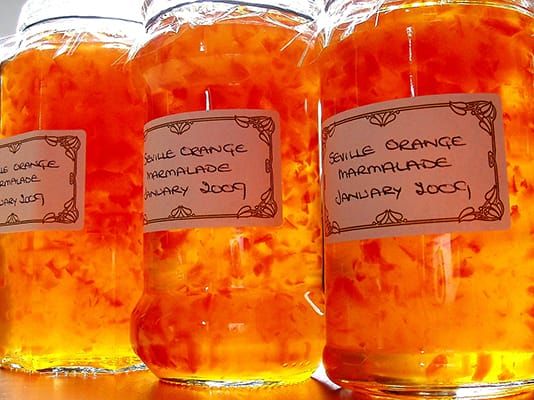
Marmalade is a jelly with pieces of fruit and rind suspended within it. It is now most commonly made primarily with oranges, but marmalade can be made with a variety of fruits; for instance, the original marmalade was made with quince. Appearances of marmalade are usually preceded by the name of the primary fruit, as in orange marmalade or apricot marmalade. But used on its own, marmalade now usually refers to orange marmalade.
The word was borrowed in the late fifteenth century from the Portuguese marmelada, a word for quince preserves, marmelo being the Portuguese for quince + -ade, being a drink or substance made from fruit. The Portuguese is from the post-classical Latin word for quince, malomellum, literally apple-honey. (Shifts from /l/ to /ɹ/, and vice versa, are common as both are alveolar approximants and easily mispronounced for one another.) The Hellenistic Greek μηλόμελι (milómeli) and classical Latin melimela referred to varieties of sweet apples. (The shift in the first vowel in the progression from classical to post-classical Latin is due to influence from the classical Latin malus, apple tree.) And the Ancient Greek μᾶλον or μῆλον (malon or milon) was the word for apple or similar fruit.
Originally, marmalade referred to a solid jelly cut into squares for eating. By the seventeenth century it had acquired the additional sense of jelly made from apples and citrus peel. Later it became the food we know today, preserves made by boiling fruit and then reboiling the liquid and fruit with sugar to create a mass with embedded rind.
The earliest known appearance of marmalade in English is in a 13 May 1480 letter written by a Richard Germyn:
Moreover, y late wrote you a letter and send him by oon John Symon, which gave you the orenges and marmelate at Exeter: which letter was delivered unto Lannos, skynner, in asmoche as ye be not at London.
It appears again in an inventory of provisions provided for the 1514 marriage of Mary, daughter of Henry VII of England, to Louis XII of France. Here we see the word in its original sense of a firm jelly for eating:
Item, a boxe of Codignac chare de qwynce marmelade.
And there is this in Thomas Elyot’s 1539 The Castel of Helth:
But yf he haue moche choler in his stomake or a heed full of vapours, it were moch better, that he dyd neyther drynke the one, nor the other, but rather eate a lyttell colyander sede prepared, or a pece of a quince rosted, or in marmelade, and after reste, to amende the lacke of nature with slepe, moderate exercise, and playsters prouyded for comfortynge of the stomake.
Sources:
Elyot, Thomas. The Castel of Helth. London: Thomas Berthelet, 1539, 46v–47r. ProQuest: Early English Books Online (EEBO).
Germyn, Richard. Letter to William Stoner (13 May 1480). The Stonor Letters and Papers, 1290–1483, vol. 2 of 2. Charles Lethbridge Kingsford, ed. Camden Third Series 30. London: Camden Society, 1919, 105. HathiTrust Digital Library.
Jerdan, William, ed. Rutland Papers. Camden Society. London: John Bowyer Nichols and Son, 1842, 27. HathiTrust Digital Library.
Oxford English Dictionary Online, December 2000, s.v. marmalade, n. & adj.
Photo Credit: Amanda Slater, 2009. Wikimedia Commons. Flickr. Licensed under the Creative Commons Attribution-Share Alike 2.0 Generic license.
.jpg?ref=wordorigins-org.ghost.io)