lorem ipsum
4 September 2026
Lorem ipsum dolor sit amet ... This seemingly pseudo-Latin, phrase is used in the typesetting industry as a place holder for text. It is intended to be a meaningless passage used to demonstrate what a printed page will look like without the reader being distracted by the content. Occasionally, one will see it make its way into print or onto a web page due to an editorial oversight.
There are many variations on the lorem ipsum text, but one common version reads:
Lorem ipsum dolor sit amet, consectetur adipisicing elit, sed do eiusmod tempor incididunt ut labore et dolore magna aliqua. Ut enim ad minim veniam, quis nostrud exercitation ullamco laboris nisi ut aliquip ex ea commodo consequat. Duis aute irure dolor in reprehenderit in voluptate velit esse cillum dolore eu fugiat nulla pariatur. Excepteur sint occaecat cupidatat non proident, sunt in culpa qui officia deserunt mollit anim id est laborum.
But what, if anything, does it mean? It is a modified extract from Cicero’s De finibus bonorum et malorum (The Extremes of Good and Evil) written in 45 B.C.E. Cicero’s actual words and a translation follow. Note that among other errors, the typesetter’s version begins not only in mid-sentence, but also in the middle of the word dolorem:
Neque porro quisquam est qui dolorem ipsum quia dolor sit amet, consectetur, adipisci velit, sed quia nonnumquam eiusmodi tempora incidunt ut labore et dolore magnam aliquam quaerat voluptatem. Ut enim ad minima veniam, quis nostrum exercitationem ullam corporis suscipit laboriosam, nisi ut aliquid ex ea commodi consequatur? Quis autem vel eum iure reprehenderit qui in ea voluptate velit esse quam nihil molestiae consequatur, vel illum qui dolorem eum fugiat quo voluptas nulla pariatur?
(Nor again is there anyone who loves or pursues or desires to obtain pain of itself, because it is pain, but because occasionally circumstances occur in which toil and pain can procure him some great pleasure. To take a trivial example, which of us ever undertakes laborious physical exercise, except to obtain some advantage from it? But who has any right to find fault with a man who chooses to enjoy a pleasure that has no annoying consequences, or one who avoids a pain that produces no resultant pleasure?)
Long thought to be nonsense Latin, the identification of Cicero’s speech as the source was made in 1987 by Richard McClintock, a Latin professor and publications director at Hampden-Sydney College in Virginia.
How long has this particular dummy text been around? It was created in 1966 by James Mosely of the St. Bride Printing Library for the Letraset company. Letraset produced transfer sheets of letters in various font sets that one could use to mockup page layouts. (My first job after leaving the army in 1989 was as an editor for a number of professional newsletters, and I used Letraset transfers to create the headlines on the camera-ready copies we sent to the printer.)
Some of the changes in lorem ipsum from Cicero’s original are random. Some, for instance, were introduced by typos when the makers of Pagemaker were typing the Letraset copy into the code for their digital product. But not all are random. The start of the text in the middle of the word dolorem, for example stems from the text having been taken from the 1914 Loeb Classical Library version of the text, which ends one page with do- and picks up on the next with lorem ipsum. (Some nineteenth century Latin dictionaries also split dolorem with a line break, but these only contain very short excerpts of only a few words, and and are not the source text for the typesetter’s version.) Other bits in various versions of the text are short phrases in Spanish and French that appear to have been added as plays on words.
In other cases, Mosley made changes to the Latin so that it would be more useful as English dummy text. letters and combinations of letters found in English but not in Latin, such y and ng, have been added, and letters more common in Latin, like q and m, have been removed to make the dummy text look more like English in form. And some entire words, like quia (because), have been consistently removed to make the text unintelligible to someone who knows Latin in order to preserve its utility as dummy text.
Extant evidence for the use of the lorem ipsum dummy text dates to 1966 when the Letraset company began using it in the sheets of body type that it sold. In the 1980s, electronic typesetting programs, such as Aldus Pagemaker, began including the text as default filler, and its usage exploded.
There are claims that the lorem ipsum text can be found in sixteenth-century printer’s samples, but these claims are unverified, and the technology of the day made the use of dummy text impractical. Setting a page using lead type is time consuming and labor intensive. Any need for dummy text simply does not justify the cost involved in setting the type. It wasn’t until the mid twentieth century that technology made the creation of dummy text practical.
For those interested in going more in depth on the history of lorem ipsum, I strongly recommend Emily Zhang's 30 May 2026 YouTube video on the topic by Emily Zhang. She is the one who first identified Mosley as the creator of the dummy text, and the video includes interviews with McClintock and Laura Perry, one of the creators of Aldus Pagemaker. It is well worth twenty-six minutes of your time, at least it is if you are a word or design nerd.
I originally penned this entry in 2021, and while I had correctly identified Cicero and Letraset as the origin of the dummy text, I did not have the full story until Zhang produced her video earlier this year.
Sources:
Adams, Cecil. “What Does the Filler Text ‘Lorem Ipsum’ Mean?” The Straight Dope, 16 February 2001.
Cicero. “De finibus bonorum et malorum.” On Ends. H. Rackham, trans. Loeb Classical Library 40. Cambridge: Harvard UP, 1914, 1.10, 35–37. Loeb Classical Library Online.
Cima, Rosie. “The History of Lorem Ipsum.” Priceonomics, 13 March 2015.
Zhang, Emily (Rabbit Hole). “The Lorem Ipsum Mystery.” YouTube.com, 30 May 2026. Video Notes.
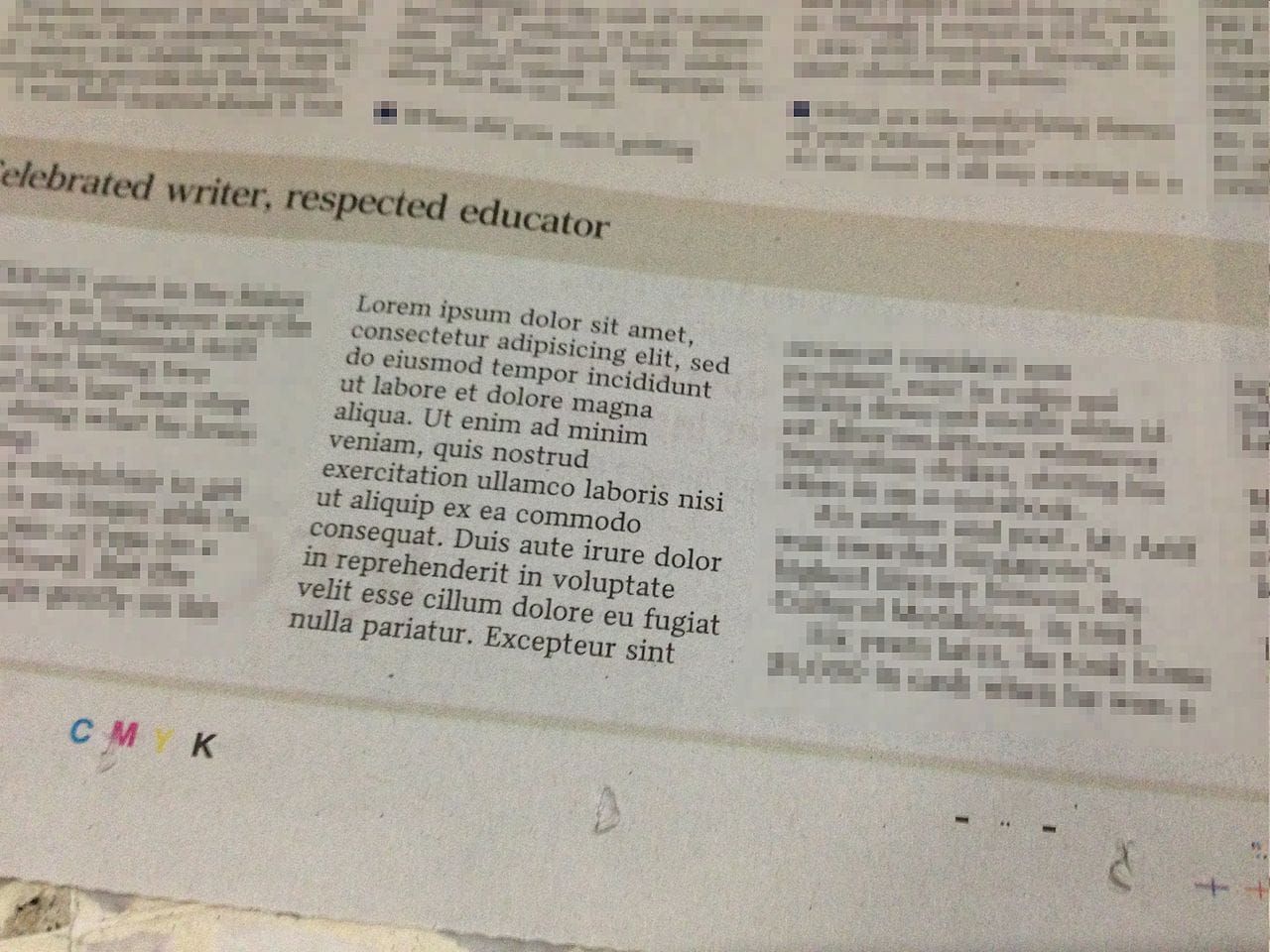
Photo credit: "Literary Icon in the Malay Community," Straits Times, 26 April 2014, D6. Unknown photographer, 2014. Licensed under the Creative Commons Attribution-Share Alike 3.0 Unported license.