lavender
22 May 2026
Lavender is a flower, a shade of purple, and a slang term associated with gay men. The slang sense is commonly seen in lavender marriage, a companionate, and often celebrity, marriage of convenience where one or both partners are gay. There is also the Lavender Scare, the label applied the U.S. government’s persecution of gays in government service in the mid twentieth century.
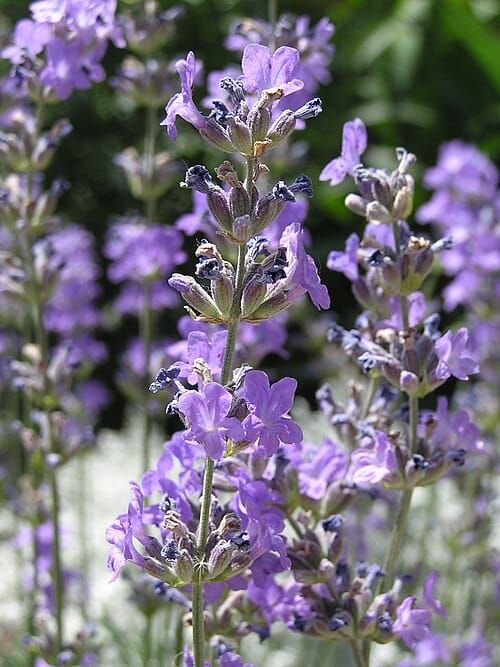
The flower, Lavandula angustfolia, gives rise to the name of the color, and English use of the name for the flower dates to the thirteenth century, with the oldest extant appearance being in the form lauendre in a gloss of the Latin lauendula.
Use of the word as a name for the color appears much later, in the nineteenth century. There is this 1840 article by John F. W. Herschel in the Philosophical Transactions of the Royal Society that uses the word as a name for the color, but which indicates the term, or at least the compounds lavender-gray and lavender-colored were in common use:
The fact to which I allude is that of the existence of luminous rays beyond the violet, but not affecting the eye with a sensation of violet, nor of any other of the recognised prismatic hues, but rather with that colour which is commonly termed lavender-grey.
And
The following experiment will show, that these rays when so concentrated as to possess an unequivocal illuminating power, still show no colour, but that sort of imperfect white which is best distinguished by the terms grey, ash-colour, lavender-colour, or such expressions. As orange, indigo, and violet, vegetable tints, are used for those of the prismatic hues, I may be allowed to express by the epithet lavender the rays which produce the tint in question, rather for the purpose of abbreviating the uncouth appellation of ultra-violet, and avoiding the ambiguity attaching to the term chemical rays (which exist in all regions of the spectrum) than for that of laying any undue stress on the observed fact.
When lavender became associated with homosexuality isn’t known for certain. It was clearly in place by 1919, but likely dates back further. The ballad Ninety-Ninth Hussars, published in the 1870 book Songs for the Army has these suggestive lyrics:
Sir Lavender Silk was a pretty young man,
[...]
His men, though respectful, had thoughts of their own
Which might have spoke out if they chose,
That Sir Lavender Silk had the aspect alone
Of a Lady dressed up in men’s clothes!
Lawrence Murphy’s 1988 book Perverts by Official Order: The Campaign Against Homosexuals by the United States Navy has the following use of dash of lavender from a 1919 investigation into homosexual activities among sailors at the Newport, Rhode Island naval base that gives a rather specific idea of what that phrase means:
Then came the ultimate question: “Are you the only straight one in this crowd?” “I am not,” replied [Fred Hoage], “saying that I am straight.” What he meant became clearer when he denied having participated in a sixty-nine party. “A straight person,” he went on, “must be straight and not reciprocate in any way.” Just what was he then? “As they say in sets I have known,” he confessed, “it is a dash of lavender.” Then you have reciprocated in these sexual acts?” queried the court. “Depending on what they were,” he answered, “I might have what they call, yanked someone off…”
Murphy’s book, while well researched, tells the tale in a narrative that does not reproduce an exact transcript of what was said or give a clear timeline of events. Without a visit to the National Archives to view the paper record of the proceedings, I cannot determine the exact date of these quotations, but the words dash of lavender were probably uttered sometime in March or April of 1919.
In the 1920s, pulp editor and sometime poet Harold Hersey penned a song titled The Lavender Cowboy. There are various versions of the lyrics, but the version that appears in his 1926 collection Singing Rawhide reads as follows:
He was only a lavender cowboy,
The hairs on his chest were two….
He wished to follow the heroes
Who fight as the he-men do.
Yet he was inwardly troubled
By a dream that gave no rest;
When he read of heroes in action,
He wanted more hair on his chest.
Herpicide, many hair-tonics
Were rubbed in morning and night….
Still, when he looked in the mirror
No new hair grew in sight.
He battled for “Red Nell’s” honor
Then cleaned out a hold-up next,
And died with his six-guns smoking….
But only two hairs on his chest.
Again, the Lavender Cowboy, at least in this version, is merely suggestive of homosexuality, but in 1927 we see lavender clearly being used with that connotation. The following poem appeared in the McGill Daily, the student newspaper of McGill University in Montreal on 16 February 1927:
QUESTION
Lesbians and lavender men
Do not attract each other;
Why is it?
I have asked the Students’ Council,
But they will not tell me—
Or they do not know
Why lavender men do not attract
Lesbians………….
—EUPHORIAN (TEXAS)
And there is Mae West’s 1928 play Pleasure Man that uses the word in the queer sense. The play had a single performance on Broadway before it was closed by police for obscene (read queer) content. Paradise Dupont is an effeminate character in the play whose appearance in the script reads as follows:
LEADER: “Yeah, we’ve always got to wait. You’d think they were Dukes or Earls or maybe Queens….
(Enter PARADISE DUPONT tripping lightly)
PARADISE: Whoops! I’ve been discovered, Royalty has arrived dearie.
And lavender appears later in the act in this exchange:
STEVE (To Paradise): Go ahead with your rehearsal, the boys won’t annoy you.
STANLEY: And don’t you annoy the boys, Violet.
PARADISE: Lavender, maybe but violet never.
Sources:
Herschel, John F. W. “On the Chemical Action of the Rays of the Solar Spectrum on Preparations of Silver and other Substances, both metallic and non-metallic, and on some Photo- graphic Processes.” Philosophical Transactions of the Royal Society, part 1, vol. 130. London: Richard and John Taylor, 1840,1–59 at 19, 20. HathiTrust Digital Library.
Hersey, Harold. “The Lavender Cowboy.” Singing Rawhide: A Book of Western Ballads. New York: George H. Doran, 1926, 13. HathiTrust Digital Archive.
Green’s Dictionary of Slang, accessed 21 April 2026, s.v. lavender, n., lavender, adj.
Middle English Dictionary, 31 January 2026, s.v. lavender(e, n.(2).
Mullins, Bill. “Antedating of ‘Lavender’ (Homosexual).” ADS-L, 24 October 2022.
Murphy, Lawrence R. Perverts by Official Order: The Campaign Against Homosexuals by the United States Navy. New York: Harrington Park Press, 1988, 54.
Oxford English Dictionary Online, 1997, s.v. lavender, n.2 & adj.
“Question.” McGill Daily (Montreal), 16 February 1927, 2/3. Archive.org.
West, Mae. Pleasure Man. Typescript, 1928. Archive.org.
Photo credit: Andrey Butko, 2010. Wikimedia Commons. Licensed under the Creative Commons Attribution-Share Alike 3.0 Unported license.
