laneway / laneway house

4 March 2026
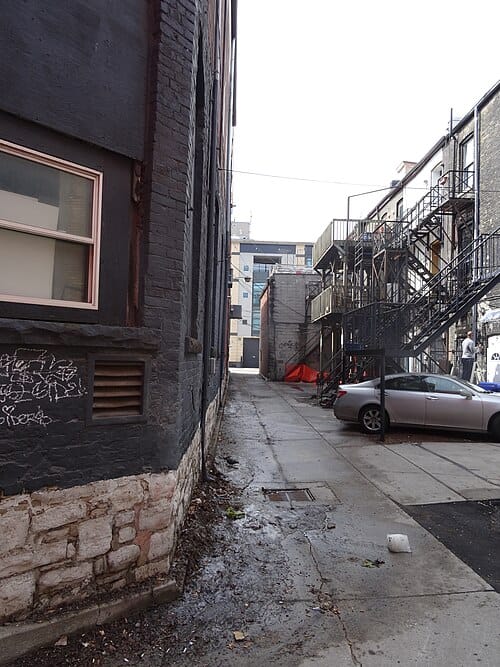
Literally, laneway (lane + way) is a redundant term, and one that is unfamiliar to most Americans. It is found in Canada, Ireland, Australia, New Zealand, South Africa, and the U.K. Originally simply meaning a road, the word in Canadian usage has narrowed to mean an urban back alley.
Today, laneway is chiefly found in Canada, but older instances of the term are found chiefly in Ireland. The oldest example I’ve been able to find, however, is in England’s Lancaster Gazette of 11 May 1822 in a notice of a property sale that describes the bounds of the property:
Also, all that other Close, Inclosure Piece or Parcel of Land or Ground […] called or commonly known by the name of Priest’s Meadow, […] bounded on or towards the East and West by lands belonging to the Reverend James Pedder, on or towards the North, by the said laneway or road, called Harbreck-lane, and on or towards the South, by by lands belonging to William Mashiter.
We see the distinctly Canadian sense of an urban back alley in the early twentieth century. From the Toronto Daily Star of 5 June 1911:
The light necessary to the tenants of the offices on the east side of the Traders Bank building is supplied from windows looking out over a narrow laneway and across the roof of the Nordheimer building.
And there is this from the 2 November 1923 issue of the same paper that makes the distinction between a laneway and a street clear:
Juryman: “Do you know if this is a laneway or a street?”
Mr Murphy: “It is a laneway, and has not been opened as a street. Application has been made.”
In the latter half of the twentieth century we get the Canadianism of laneway house or laneway dwelling, referring to a small house built on a laneway behind an existing house. The term is especially prevalent in Toronto and Vancouver. But there are some earlier uses of that phrase is a different sense.
There is this from Dublin’s Freeman’s Journal of 15 January 1883 that uses laneway house to refer to a drinking establishment. There are very instances of the phrase laneway house prior to the 1990s, so I don’t know if laneway house was an Irish term for a pub or bar, or if this was just a reference to a building alongside a road that happened to serve drinks:
Mr. Joseph Erskine objected to any extension of Mr. Mooney’s premises. It was in houses like his young men got charged with drink and afterwards adjourned to low beerhouses.
The Recorder—That is, to my mind, a most fanciful objection.
Mr. T W Russell said there was a small laneway house in St Peter’s parish, and if Mr. Mooney would add it to Poolbeg-st (laughter) the thing could, perhaps be managed. His lordship would remember that Galvin bought three laneway houses for one six-day licence, and Mr. Mooney ought to come up to the current rate.
Coming back to Canada, we see this 22 April 1977 classified ad in Toronto’s Globe and Mail, but it clearly refers to something not only rural but far more luxurious than what most Canadians today would consider a laneway house. Instead, this appears to be a return to the older sense of laneway = road with a house located at the end:
WOODBINE
PICTURE book reality. Passing the dammed pond you arrive at the end of the limestone laneway house, featuring many extras, including 3 fireplaces & family room. Offering cathedral ceiling, & car garage. This stylish property also offers 100 acres, barn & out buildings.
The Dictionary of Canadianisms on Historical Principles (DHCP-2) says that the concept of laneway houses, built to create more affordable housing and as an eco-friendly way to increase urban density, dates to 1989. But the earliest use of the term that I’m aware of is from the Globe and Mail of 23 August 1997:
BUILDING a house with the front door on the back lane may not be up everyone’s alley. But for those hardy souls who want to build affordable yet unique dwellings in Toronto’s saturated core, a coach house or laneway house may be the only practical option.
[…]
The idea of living on a laneway, or at the end of an alley behind a series of back yards, gives many people the willies, but both women easily dismiss such concerns. “People are much friendlier in the back yard that at the front face,” Finlayson says, adding that this actually adds to her sense of protection.
While Ironside’s house is located in a slightly rougher area, she waxes poetic over laneway culture. “The stigma is totally undeserved. The life of the laneway is about kids playing, people working, pedestrian and bicycle connections. It’s so quiet on my lane. You have no sense that you’re just one row of houses from Queen and Bathurst.”
Sources:
“$80,000 Is Paid by the Traders Bank.” Toronto Daily Star, 5 June 1911, 13/4. ProQuest Newspapers.
Classified Ad. Globe and Mail (Toronto, Ontario), 22 April 1977, BL17/3. ProQuest Historical Newspapers.
Dictionary of Canadianisms on Historical Principles, second edition, October 2016, s. v. laneway, n., laneway house, n.
Kapusta, Beth. “Life in the Back Lane.” Globe and Mail (Toronto, Ontario), 23 August 1997, C15. ProQuest Historical Newspapers.
“Licensing Sessions.” Freeman’s Journal (Dublin, Ireland), 15 January 1883. 7/6. Gale Primary Sources: British Library Newspapers.
“No One Was to Blame for Fatal Accident.” Toronto Daily Star, 2 November 1923, 6/4. ProQuest Newspapers.
“Notice is Hereby Given.” Lancaster Gazette (England), 11 May 1822, 2/5. Gale Primary Sources: British Library Newspapers.
Oxford English Dictionary Online, 1901, s.v. lane-way, n.
Photo credit: OldYorkGuy, 2015. Wikimedia Commons. Licensed under the Creative Commons Attribution-Share Alike 3.0 Unported license.
.JPG_-_panoramio.jpg?ref=wordorigins-org.ghost.io)