lam, on the

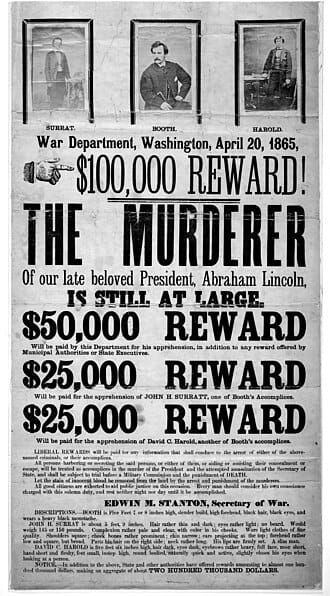
18 March 2026
To be on the lam means to be fleeing, especially from the law. Lam probably comes from an English dialectical verb meaning to thrash or to strike, and that verb may ultimately come from the Old Norse lemja, also meaning to beat or strike, but the connection is not certain. The shift in meaning to that of flight happens in American criminal slang of the late nineteenth century. This shift is undoubtedly influenced by the phrases to beat one’s way and to beat it. These phrases meaning to travel, especially without paying the fare, date to at least 1872, and somewhat later they come to mean to leave or go away, especially in haste
We see the English verb, in the form belamb, meaning to beat or strike, in Anthony Copley’s 1595 Wits Fittes and Fancies:
A Constable coming to arrest a shomaker within his house; the shoomakers wife so well bestirred her, that she brauely belamb’d the constable, whiles in the mean time her husband got away: The Constable then came vnto the Duke of Infantasgo & complained vnto him of the battery, and of the shoomakers vviues misusage; alledging that if so scandalous a fact were not very seuerely, & that eftsoones corrected, it would greatly redound to his L. disgrace: wherunto the Duke answered: Seeing as thou saist, the disgrace will be mine, I forgiue the shoomakers wife.
And the earliest reference to lam in American criminal slang that I’m aware of is in Allan Pinkerton's 1884 Thirty Years a Detective. He uses it in a passage about pickpockets:
The pickpockets have adopted certain words or signals, which are thoroughly understood by the craft, and these signals are given by the “tool” or “hook.” If he is rather slow about getting to the wallet or money, and he notices that the front men are getting somewhat uneasy, he calls out “stick!” This mean that in a few seconds he will be successful, and that they are to stay in their respective positions. After he has secured the wallet he will chirp like a bird, or will utter the word “lam!” This means to let the man go, and to get out of the way as soon as possible. This word is also used in case the money cannot be taken, and further attempts are useless.
And A. F. B. Crofton, in an article on criminal slang in the April 1897 issue of Appleton’s Popular Science Monthly defines do a lam as “to run.”
Finally in 1904 we see the phrasing on a lam in Number 1500’s Life in Sing Sing:
He plugged the main guy for keeps and I took it on a lam for mine.
Sources:
Copley, Anthony. “Of Noblemen and Ambassadors.” Wits Fittes and Fancies. London: Richard Jones, 1595, 18–19. ProQuest: Early English Books Online (EEBO).
Crofton, A. F. B. “The Language of Crime.” Appleton’s Popular Science Monthly. 50.4, April 1897, 831–35 at 832. Archive.org.
Green’s Dictionary of Slang, accessed 23 February 2026, s.v. lam, v.2, lam, n.
Lighter, J. E., ed. Historical Dictionary of American Slang, vol. 2, H–O. New York: Random House, 1997, s.v. lam, n., lam, v.
Number 1500. “Slang Among Convicts.” Life in Sing Sing. Indianapolis: Bobbs-Merrill, 1904, 263. HathiTrust Digital Library.
Oxford English Dictionary Online, 1976, s.v. lam, n.3; 1901, s.v. lam, v.; 1887, s.v. belam, v.; June 2025, s.v. beat, v.1.
Pinkerton, Allan. Thirty Years a Detective. New York: G. W. Carleton, 1884, 40–41. Archive.org.
Image credit: Alexander Gardner, 1865. Wikimedia Commons. Metropolitan Museum of Art, New York. Public Domain Image.
