kinetic

21 August 2026
Kinetic is an adjective that relates to motion; it’s a mid nineteenth-century borrowing from the Greek κῑνητικός (kinetikos). The noun kinetics, referring to the study of bodies in motion and the forces acting upon them, was formed from the adjective at about the same time. Both the adjective and the noun were originally used primarily in scientific writing.
But in the second half of the twentieth century a military sense of kinetic arose, used to refer to the application of deadly force on the battlefield. There is, however, at least one use of kinetic in a military context from World War I, but this is just a general sense of the word relating to motion; in the article it is contrasted with static. From Idaho’s Wallace Press Times of 25 November 1917:
But this ideal the allies have never been able to attain, for reasons which should have been apparent in advance. In their calculations the westerners appear to have assumed a parity between the static trench warfare in the west and kinetic maneuver warfare on other fronts.
The specialized military sense starts to develop in the latter half of the twentieth century. The phrase kinetic energy projectile was in place by 1976, meaning a solid shot, like a bullet. The phrase is a retronym formed with the advent of directed-energy weapons (e.g., lasers) and high-explosive shaped-charged munitions. From Kansas’s Chanute Tribune of 25 September 1976:
Brandon, an employee of the Ballistic Research Laoratories [sic], Aberdeen, Md., and four other men were recognized for their combined efforts in developing a new 60 millimeter kinetic energy projectile as part of the Army’s Medium-Caliber Anti-Armor Automatic Cannon Program.
And here is an example of kinetic energy round from Christian Science Monitor of 8 January 1982:
But the M-1 may not be as indestructible as the army likes to claim. Congressional testimony and unclassified army documents indicate that its Chobham armor is vulnerable to penetration by Soviet shells[.]
Some experts claim that although this revolutionary British armor provides good protection against high-explosive anti-tank rounds, it has no special capability against solid-shot, or kinetic energy, rounds that tanks use to destroy each other. The Army stoutly denies the claim[.]
In the coming years, this sense of kinetic generalized to refer to any violent engagement with the enemy, not just the particular class of munition. And by the end of the century, kinetic had moved into military slang with the verb phrase to go kinetic. From Syracuse, New York’s Post-Standard of 1 October 1997:
”Avoid going kinetic”
The next time the United States finds itself facing a Saddam Hussein or a terrorist druglord with nuclear weapons, says [Gen. Jack] Sheehan, “the whole object will be to avoid going kinetic.”
That’s “kinetic” as in kinetic energy warfare—whether it’s cavemen bashing each other with clubs or the bombs, missiles and artillery of more recent conflicts.
Instead of kinetic shooting, the action in recent war games at the U.S. Army War College here has been mostly electronic. The unscripted games, set 25 years in the future, are intended to allow senior leaders to explore new technologies and strategies, and to raise problems and issues that need to be addressed.
But the jargon use of kinetic by the military continued as well. In his annual address to the British military of February 2002, Admiral Michael Boyce, then the British Chief of Defence Staff (equivalent to the US Chairman of the Joint Chiefs of Staff) used both kinetic form of warfare and kinetic targeting:
Precision Guided Munitions (PGMs) allow the focused application of combat power. It has been interesting to watch their use in asymmetric war, and it is clear that the United States have learned from the less effective use of air power in Kosovo. At first it appeared that this essentially kinetic form of warfare was merely turning big rocks into smaller rocks. Moreover, there were all the normal targeting problems. but the volume of kinetic targeting against the Al Qa'ida/Taliban (effectively non-state actors) appears to have helped deliver strategic success in providing the Northern Alliance and opposition forces with the tactical mass required to overwhelm, or at least turn the Taliban.
And by early 2003, with the war in Iraq, the military sense of kinetic started to be noticed by the general public. We see it in a Guardian piece on military lingo published on 18 March 2003:
Kinetic targeting
Current preferred euphemism for dropping bombs. When aircraft drop leaflets on Iraq asking the military to surrender and radio stations broadcast anti-Saddam rhetoric, the generals describe it as soft targeting. When fighter jets and cruise missiles destroy targets on the ground, the military calls it “kinetic targeting.”
For the military, it is an unusually simple and vigorous description of the destruction they are about to deliver. It has also spawned a spin-off: the tens of thousands of US and British troops poised to attack Iraq are simply waiting for permission to “go kinetic.”
And by 2007 we see non-kinetic used to refer to military operations that do not require the use of deadly force. From an article in the journal Army Logistician late that year:
The procurement and distribution of humanitarian assistance items can have an effect on mission accomplishment that is as significant as the support of kinetic operations. During a non-kinetic event, such as a medical civil action project, the FLE [forward logistics element] can prepare supplies and strategic loads to be pushed forward to villages using host nation trucks or Afghan National Army (ANA) vehicles.
The wars in Iraq and Afghanistan brought this military use of kinetic to the attention of the general public, and kinetic event was chosen as the “most euphemistic” word of the year for 2010 by the American Dialect Society.
Sources:
American Dialect Society. “‘App’ 2010 Word of the Year” (press release), 7 January 2011.
Boyce, Admiral Michael. “UK Strategic Choices Following the Strategic Defence Review & 11th September. Annual Chief of Defence Staff Lecture.” Royal United Services Institute for Defence Studies (RUSI) Journal, 147.1, February 2002, 5/1. ProQuest Trade Journals.
“Cooperation for Defense by Allies is Mandatory to Relieve Perilous Position of Italy in German Drive.” Wallace Press Times (Kellogg, Idaho), 25 November 1917, 8/1. Newspapers.com.
Friedman, Nancy. “kinetic.” ADS-L, 8 May 2026.
Manganaro, Christopher G. “Doing More with Less: Special Forces in Afghanistan.” Army Logistician, 39.6, November/December 2007, 26–30. ProQuest Trade Journals.
McCarthy, Rory and Duncan Campbell. “The Language of War.” Guardian (London), 18 March 2003, 7/7–8. ProQuest Newspapers.
Mullins, Bill. “kinetic.” ADS-L, 8 May 2026.
Oxford English Dictionary Online, 1901, s.v. kinetic, adj. & n., kinetics, n.
“U.S. Army Recognized Former Resident for Energy Projectile.” Chanute Tribune (Kansas), 25 September 1976, 7/5. NewspaperArchive.com.
Webbe, Stephen. “M-1 Tank: Prone to Fires in the Crew’s Compartment?” Christian Science Monitor (Boston), 8 January 1982. ProQuest Newspapers.
Whitman, Neal. “‘Kinetic’ Connections.” Visual Thesaurus, 4 May 2011 and again here.
Wood, David. “Future War: No Shots Fired.” Post-Standard (Syracuse, New York), 1 October 1997, A-13/2/. Newspapers.com.
Zimmer, Ben and Charles E. Carson. “Among the New Words.” American Speech, 86.2, Summer 2011, 192–214 at 203–04. DOI: 10.1215/00031283-1337010.
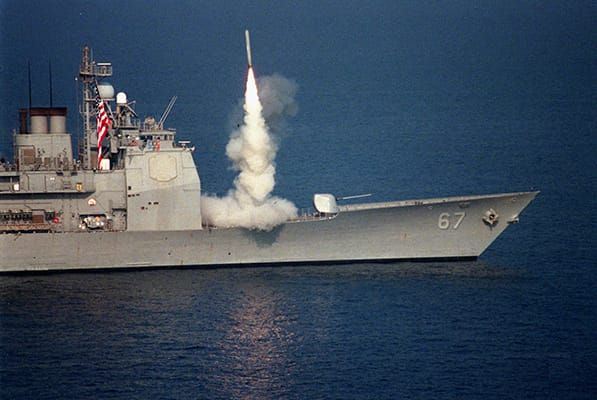
Photo credit: US Navy, 1996. Wikimedia Commons. Public domain image.
