intifada
10 April 2026
The word intifada enters English from the Arabic انتفاضة, meaning uprising or revolt. In Arabic, it has widespread use referring to any number of insurrections or civil resistance movements across the Arab world. In English, however, it is usually found in the context of Palestinian insurrections against Israeli occupation. And, with a capital letter, Intifada is used to refer specifically to two Palestinian insurrections against Israeli occupation, the First Intifada (1987–93) and the Second Intifada (2000–05).
The earliest use of the word in English that I have found is in a January 1985 article in Current History that uses Intifada as the name of an alliance of Palestinian political groups arrayed against Yassir Arafat’s leadership of the Palestinian Liberation Organization (PLO):
Not taking part in these talks were the Fatah rebels of Abu Musa (known now as the Intifada, or “upheaval”) and other groups controlled by Syria—the Saiga guerrilla organization, the Popular Front—General Command (PFGC) of Ahmad Jibril, and the small Palestine Popular Struggle Front (PPSF); together, these groups were known as the National Alliance. It was the groups of the National Alliance that had taken up arms against Arafat’s loyal units in Lebanon; the groups in the Democratic Alliance, however, had remained neutral, even though they shared many rebel complaints about Arafat’s policies and leadership.
And in the sense of uprising or insurrection, it appears later that year in the pages of the Los Angeles Times, referring to Palestinian resistance to the government of Lebanon. From the 11 September 1985 issue:
Along with Gemayel’s declining popularity, the last six months have seen one intifada—Arabic for uprising—after another, and they have brought about the most fundamental realignment of power in the Christian community since Lebanon obtained its independence from France in 1946.
Sources:
Hudson, Michael C. “The Palestinians after Lebanon.” Current History, 84.498, January 1985. 16–20, 38–39 at 19. ProQuest Magazines. DOI: 10.1525/curh.1985.84.498.16.
Oxford English Dictionary Online, March 2023, s.v. intifada, n.
Wallace, Charles P. “Gemayel a Leader Deserted by Followers.” Los Angeles Times, 22 September 1985, 1/5. ProQuest Historical Newspapers.
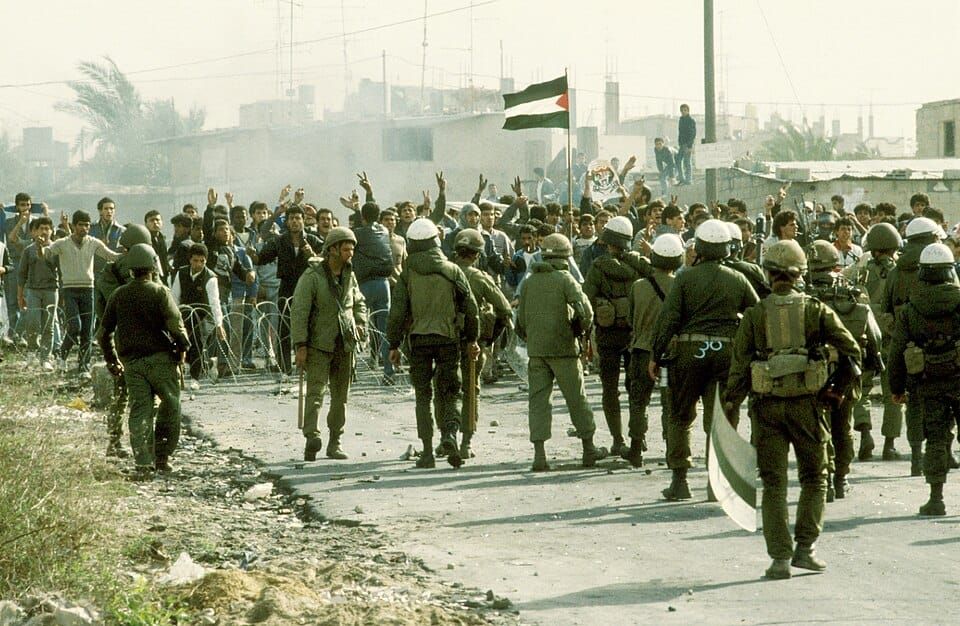
Photo Credit: Eli Sharir, 1987. Wikimedia Commons. Efi Sharir / Dan Hadani collection / National Library of Israel / The Pritzker Family National Photography Collection. Licensed under the Creative Commons Attribution 4.0 International license.
.jpg?ref=wordorigins-org.ghost.io)