impeach / impeachment

12 December 2025
The verb to impeach has a straightforward and unsurprising etymology, but the noun impeachment has an unusual twist.
The English verb to impeach is a late fourteenth century borrowing from the Anglo-Norman empescher. This French verb comes from the medieval Latin impedicare, meaning to entangle or hinder, and impetere, meaning to attack, with a secondary meaning of to initiate legal charges against someone.
Note that the Latin root is ped-, meaning foot, which is etymologically related to the English word fetter. But fetter comes down to us today via a different path, from the Old English feter. The difference between ped- and fet- is explained by Grimm’s law: the Proto-Indo-European /p/ changes to /f/ and the /d/ to /t/ in the Germanic languages, while they remain the same in Latin and the Romance languages. The root ped-, of course, means foot, and to fetter is to tie one’s feet. The verb to impede uses the same underlying metaphor, although that verb is an early modern borrowing from the Latin impedire.
And the original meanings in English were the same as the French. We see both senses in Wycliffite tract, The Grete Sentence of Curs Expounded, c. 1383 in passages that address the privilege of sanctuary, in which those accused of crimes could avoid secular punishment by residing in a church. In this first passage, the verb has a primary sense of to hinder or impede, but it is being used in a legal context:
Also grete houses of religion, as Westmynstre, Beverle, and oþere, chalengen, usen, and meyntenen þis privylegie, þat whatevere þef or felon come to þis holy hous of religion, he schal dwelle þere alle his lif, and no man enpeche hym, þouȝ he owe pore men moche good and have ynouȝ to paye it.
(Also, great houses of religion, such as Westminster, Beverley, and others, claim, use, and maintain this privilege, so that whatever thief or felon comes to this holy house of religion, he shall dwell there all his life, and no man impeach him, though he owes poor men much wealth and has enough to pay for it.)
And that same Wycliffite text uses the verb in the sense of accusing someone of a crime:
Also, þei chalengen fraunchise and privylegie in many grete chirches, þat wickid men, opyn þeves, mansleeris, þat han borwed here neiȝboris goodis and ben in power to paie and make restitucion, þere schullen dwelle in seyntewarie, and no man empeche hem bi processe of lawe, ne ooþ sworn on Goddis body and used.
(Also, they challenge the freedom and privilege in many great churches, that wicked men, known thieves, manslaughterers, that have taken their neighbor’s goods and are able to pay and make restitution, should dwell there in sanctuary, and no one impeach them by process of law, nor by an oath sworn and spoken on God’s body.)
Another sense of impeach that is often used in legal circles is to challenge, discredit, or disparage, as in to impeach a witness. This sense dates to at least 1600 when it appears in Shakespeare’s A Midsummer Night’s Dream, 2.1, in which Demetrius says to Helena:
You doe impeach your modestie too much,
To leaue the Citty, and commit your selfe
Into the hands of one that loues you not,
To trust the opportunity of night,
And the ill counsell of a desert place,
With the rich worth of your virginity.
The noun impeachment follows a similar development of its senses, but it has a twist in its etymology. The Old French empeschment was borrowed back into Latin during the medieval era, where it appears as impechementum. This is an instance of Latin borrowing a word from a later language. Most French words stem from Latin, but you don’t often see it work in the other direction.
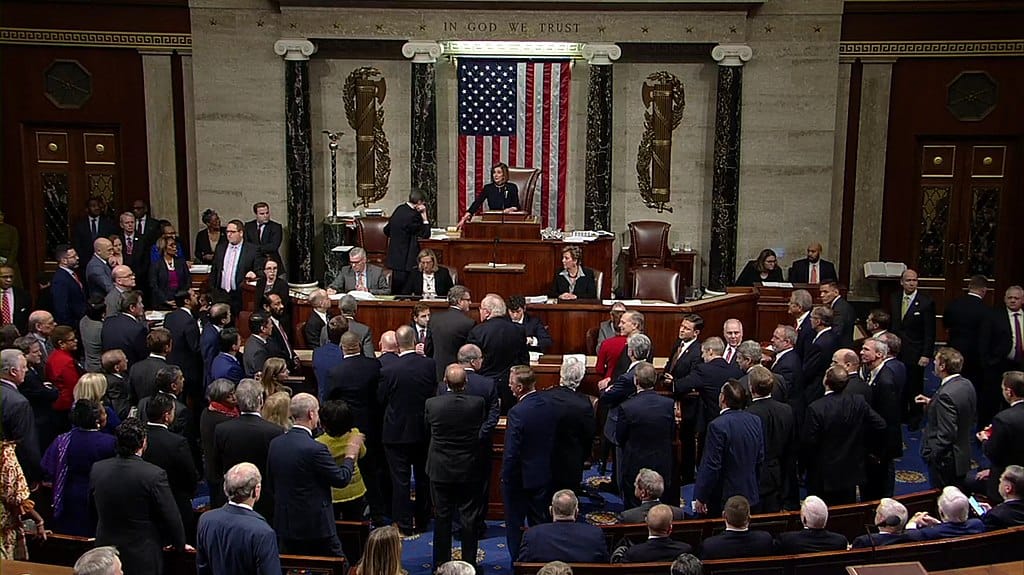
Impeach and impeachment have a distinct sense in American political usage, where it is a political process, rather than one of criminal justice. In the United States, the House of Representatives has the sole power of impeachment of federal officials, that is the bringing of charges against an official, and the Senate is the tribunal that adjudicates the charges and, if found guilty, removes the official from office. Three presidents (Andrew Johnson, 1868; Bill Clinton, 1998; and Donald Trump, in 2019 and again in 2021) have been impeached and one (Richard Nixon, 1974) resigned before the House could impeach him. None were convicted by the Senate Fifteen federal judges have also been impeached, eight of whom were convicted by the Senate and removed from office with one resigning before the Senate could convict, the most recent conviction being in 2010.
One final note, many people use impeach to mean remove an official from office. Technically, impeachment is just the bringing of charges by the House; removal requires a trial before the Senate. This sense of impeach meaning to remove from office isn’t in any of the standard dictionaries and is incorrect from a legal perspective, but linguistically it is a correct usage because so many people use it in that sense.
Sources:
American Heritage Dictionary, fifth edition, s.v. impeach.
Anglo-Norman Dictionary, AND2 Phase 1, 2000–06, s.v. empescher, v.
Dictionary of Medieval Latin from British Sources, Oxford: Oxford UP, 2013, s.v. impedicare, v., impetere, v. Brepols: Database of Latin Dictionaries.
“The Grete Sentence of Curs Expounded.” In Thomas Arnold, ed. Select English Works of John Wyclif, vol. 3 of 3. Oxford: Clarendon Press, 1871, 294 and 316–17. HathiTrust Digital Library.
Merriam-Webster.com, 5 November 2025, s.v., impeach, v.
Middle English Dictionary, 8 October 2025, s.v. empechen, v., apechen, v.
Oxford English Dictionary Online, 1889, s.v. impeach, v., impeach, n., impeachment, n., impede, v.; 1895, s.v. fetter, n., fetter, v.1
Shakespeare, William. A Midsommer Nights Dreame. In Mr. William Shakespeares Comedies, Histories, & Tragedies (First Folio). London: Isaac Jaggard and Edward Blount, 1623, 149/2. Folger Shakespeare Library.