hurricane

6 March 2026
Hurricane comes to us from the Taino language of the Caribbean via Spanish. The Taino word is hurákan. It makes its first English language appearance in Richard Eden’s 1555 translation of Gonzalo Fernández de Oviedo y Valdés’s 1535 summary of La historia general de las Indias. Eden included portions of Oviedo’s work, and the works of other authors, in his translation of Peter Martyr d’Anghiera’s Decadas del nuevo mundo:
Lykewyse when the deuyll greatly intendeth to feare theym, he threteneth to sende them great tempestes which they caule Furacanas or Haurachanas, and are so vehement that they ouerthrowe many howses and great trees.
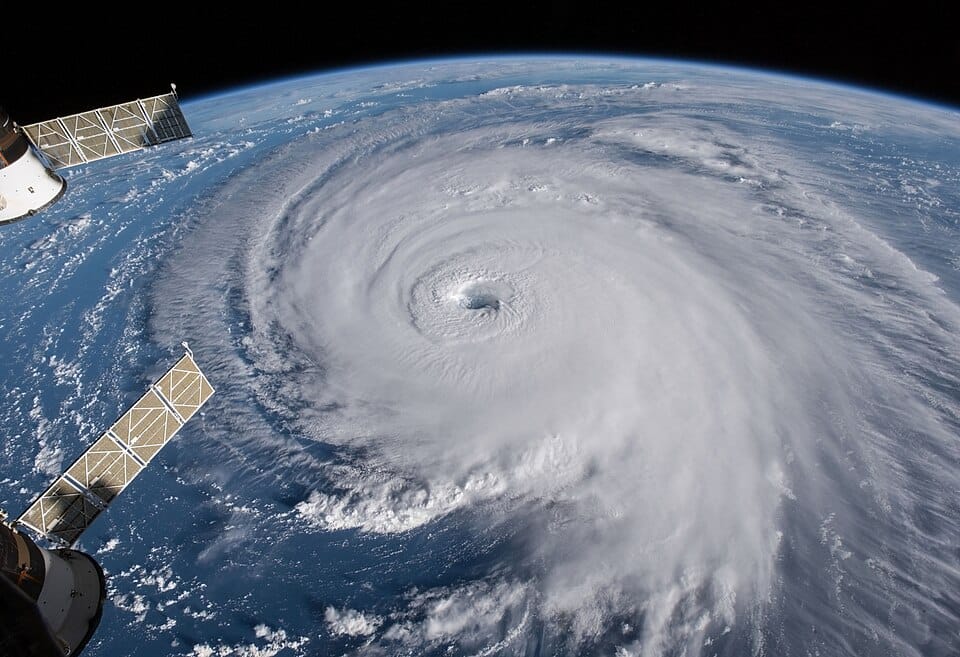
Today, the official definition of a hurricane is a western-hemisphere tropical cyclone (i.e., forms over tropical or sub-tropical waters) with sustained winds of 64 knots (74 mph, 119 kph). Those with lower sustained winds are dubbed tropical storms. The Saffir-Simpson Hurricane Wind Scale classifies hurricanes into five categories of increasing severity based on windspeed, category five being the worst, with sustained winds in excess of 137 knots (157 mph, 252 kph).
Before 1953, the names of individual hurricanes and tropical storms were arbitrary and unofficial. For instance an 1842 storm ripped the mast off the boat Antje and became known as Antje’s Hurricane. Saint’s names for storms that hit on the particular saint’s feast day were also common but could be confusing if storms hit on the same day in multiple years. Beginning in 1953, names for North Atlantic storms were assigned by the U. S. National Weather Service, now NOAA’s National Hurricane Center. These names were originally all female ones, but in 1979 male names started to be alternated with female ones. Names for cyclones in other regions are assigned by various nations’ meteorological bureaus, and all of these names are coordinated by the World Meteorological Organization. When a storm is particularly devastating, the name is retired from the list and replaced. Recent retirees include Katrina (USA, 2005), Haiyan (Philippines, 2013), and Sandy (USA, 2012).
Sources:
American Heritage Dictionary, fifth edition, 2017, s.v. hurricane, n.
Anghiera, Pietro Martire d'. The Decades of the Newe Worlde or West India. Richard Eden, trans. London: William Powell, 1555, 183. ProQuest: Early English Books Online (EEBO).
Oxford English Dictionary Online, 1899, s.v. hurricane, n.
“Tropical Cyclone Naming,” World Meteorological Organization, 24 November 2023.
Image credit: NASA/Goddard Space Flight Center, 2018. Wikimedia Commons. Public domain image.
_(cropped).jpg?ref=wordorigins-org.ghost.io)