hokey / hokey pokey
2 September 2026
The Hokey Pokey is a dance, and hokey pokey is also part of an old street vendors' cry indicating ice cream is for sale. It can refer to inferior or knock-off products. When standing alone, the first element in the phrase, hokey is an adjective meaning banal or melodramatic, and this sense is commonly used in theatrical slang. All these terms and senses of hokey stem from hokum, which in turn is a blend of hocus / hoax and bunkum. And ultimately these all come from hocus-pocus, which also supplies the inspiration for the second half of the phrase, pokey.
But hokey has an older sense that is unrelated to these others. It was part of a minced oath, a euphemistic substitute for another word, perhaps hell. We see the oath by the hokey in a 1789 Irish song poking fun at the English parliament:
I’m de boy, your souls! dat docked de money-bills, and put de free trade in your fists, sould Poyning’s to Mr. Foot of de corner, and bid de English Parliament kiss our a—es. Den your sould to de gallows! when I fobb’d my mocus’s, well becomes me, by de hokey, I falls a ballyragging F—d, spits in de Volunteers countenance, and corks de newspapers gobs, your souls, Huzza for de sweet Liberty!
Use of by the hokey or by hokey continues into the mid twentieth century, and in later use it is often rendered as by the hokey fiddle. James Joyce records this form of the oath in the Circe episode of his 1922 Ulysses:
I’m suffering the agony of the damned. By the hoky fiddle, thanks be to Jesus those funny little chaps are not unanimous. If they were they’d walk me off the face of the bloody globe.
Theatrical use of hokey to refer to melodramatic or banal performances dates to the early twentieth century. Variety of 28 June 1929 has this:
This mixed couple have the makings of a good hokey act when it gets a bit more even and more attention paid to the cueing on chatter stuff. The girl is a looker with personality and a click delivery, while the man also makes a personable appearance that will get over better through checkmaking some of his uncalled for mugging.
And Walter Winchell used the word to pan a performance by Carole Lombard in his On Broadway column of 10 November 1938:
Carole Lombard did a very hokey melodrama Monday night—pretty dull stuff…Not even thinking of Carole’s pretty face could help you forget its monotony.
The reduplicative hokey-pokey has been used to mean deception or fakery and to denote products of inferior quality or cheap knock-offs since the mid nineteenth century. James Halliwell’s 1846 Dictionary of Archaic and Provincial Words records hoky-poky as a northern English dialect form of hocus-pocus. And nineteenth-century street ice-cream vendors often used the cry hokey-pokey penny a lump to advertise their wares. Such street vendors were known for selling lower-quality products.
We see hokey-pokey and a reference to the ice cream vendors’ cry used to refer to inferior foodstuffs in an 1874 report by Georgia’s Commissioner of Agriculture:
There still remain in the State a few “junkers” who are constantly on the lookout for salvage, rejected and cast off food products which are sold for junk and peddled about to unsuspecting buyers at reduced prices. We are making one less of these people as often as we are able to catch them. The street ice cream cone “hokey-pokey” nuisance is fast passing out from the street corner and the newsboy’s alley and the traveling weinerworst [sic] peddler has retired to the “crack” in the wall.
And again Joyce in the Lotus Eaters episode of Ulysses used the vendors’ cry in reference to the Eucharist:
Yes, bread of angels it’s called. There’s a big idea behind it, kind of kingdom of God is within you feel. First communicants. Hokypoky penny a lump. Then feel all like one family party, same in the theatre, all in the same swim.
In New Zealand hokey-pokey is a type of honeycomb toffee, and there and also in Australia it is a flavor of ice cream containing bits of the toffee.
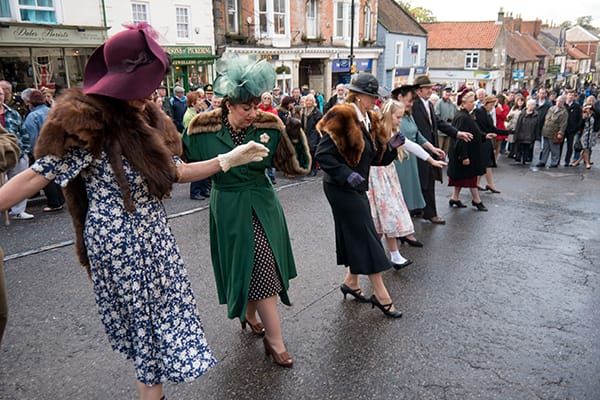
The song known as the Hokey Pokey or Hokey Cokey is a participatory dance that dates to the early nineteenth century. The name is more recent, however, and comes from an arrangement of the song by British bandleader Al Tabor in 1940. Tabor supposedly took the name from the cry of ice cream vendors, changing the pokey to cokey because he thought it sounded better. The dance is known as the Hokey Pokey in the United States.
Sources:
“De M——R——S Done Over; or, All de Boys in a String.” Both Sides of the Gutter, or, the Humours of the Regency, third edition. William Carey, ed. Dublin: P. Byrne, 1789, 89. Archive.org.
First Annual Report of the Commissioner of Agriculture, Being for the Year 1874. Savannah: J. H. Estill, 1875, 52–53. Google Books.
Green’s Dictionary of Slang, accessed 11 August 2026, s.v. hokey, n.1, hokey, adj. hokey-pokey, n.1, hokey-pokey, n.3.
Halliwell, James Orchard. Dictionary of Archaic and Provincial Words, vol. 1 of 2. London: John Russell Smith, 1846, s.v. hoky-poky, 455/1. Archive.org.
Joyce, James. Ulysses (1922). Hans Walter Gabler, ed. New York: Vintage, 1986, 5 (Lotus Eaters):360–63 and 15 (Circe): 2679–81.
“New Acts this Week.” Variety, 87/11, 29 June 1927, 31/1. ProQuest Magazines.
Oxford English Dictionary Online, 1899, s.v. hokey | hoaky, n., hokey-pokey, n.; 1976, s.v. hokey, adj.
Winchell, Walter. “On Broadway” (syndicated column). Houston Post (Texas), 10 November 1938, 11/2. Readex: America’s Historical Newspapers. (Green’s has 7 November date for this column, but I cannot find a paper that publishes it prior to the 10th. And 7 November was a Monday, which makes that date a reference to Lombard’s performance rather than Winchell’s column.)