hobbit
10 December 2025
In a hole in the ground there lived a hobbit.
So begins J. R. R. Tolkien’s 1937 novel The Hobbit. A hobbit, as anyone who doesn’t live in a hole in the ground knows, is a small humanoid creature with hairy feet and a fondness for pipe-weed. The two most famous hobbits, Bilbo and Frodo Baggins, are the protagonists of that novel and of Tolkien’s later The Lord of the Rings. But contrary to what most people believe, Tolkien may not have coined the term hobbit.
There is an earlier example of hobbit from the folklore of the north of England, where it is a name for a type of spirit or mythical creature. The word is recorded in the Denham Tracts, a series of privately published compilations of folklore by Michael Denham, produced between 1846–59. In the closing years of the nineteenth century, the tracts were edited and republished by the Folklore Society. Denham gives no description of what a hobbit is, only the name in a long list of such names:
…boggleboes, bogies, redmen, portunes, grants, hobbits, hobgoblins, brown-men…
The question is whether or not Tolkien was familiar with the Denham Tracts and whether he, perhaps unconsciously, was influenced by the name appearing on this list, or if he coined the word independently. We have no evidence that Tolkien read the Denham Tracts, although he certainly had access to them, and they are the type of thing he, with his interest in creating a mythic corpus for English culture, might have read. Tolkien did not borrow any other of the names in this list, so that indicates that if he was familiar with the list, any borrowing of hobbit was probably unconscious on his part.
The conventional wisdom is that Tolkien’s use of hobbit is a combination of hob- + [rab]bit. Hob is most likely a nickname for Robert and appears in a number of names of spirits and creatures, such as hobgoblin and hob-thrush. A form of Robert also appears in the name Robin Goodfellow, a name known to us today chiefly from Shakespeare’s A Midsummer Night’s Dream, but which was used generally as a name for a sprite or fairy.
For his part, Tolkien never claimed to have coined the word. The closest he came was in a 1968 BBC interview in which he said that during a long and boring stint of grading student papers, c. 1930, he came across an exam book where a student had left one page blank. On it he scribbled the iconic line, “In a hole in the ground there lived a hobbit.” He also, in Appendix F to The Lord of the Rings, gives a fictional etymology for hobbit:
Hobbit was the name usually applied by the Shire-folk to all their kind. Men called them Halflings and the Elves Periannath. The origin of the word hobbit was by most forgotten. It seems however to have been at first a name given to the Harfoots by the Fallohides and Stoors, and to be worn-down form of a word preserved more fully in Rohan: holbytla “hole-builder.”
In the Lord of the Rings, Tolkien’s language of Rohan is not one that he invented. Rather, all the examples of that language are taken directly from Old English. In this case, the word is said to derive from the Old English words hol (“hole”) and bytla (“builder”). Later in the appendix, Tolkien extends this fictional etymology:
Hobbit is an invention. In the Westron the word used, when this people was referred to at all, was banakil “halfling.” But at this date the folk of the Shire and of Bree used the word kuduk, which was not found elsewhere. Meriadoc, however, actually records that the King of Rohan used the word kûd-dûkan “hole-dweller.” Since, as has been noted, the Hobbits had once spoken a language closely related to that of the Rohirrim, it seems likely that kuduk was a worn-down form of kûd-dûkan. The latter I have translated, for reasons explained, by holbytla; and hobbit provides a word that might well be a worn-down form of holbytla, if the name had occurred in our own ancient language.
Of course, we should not confuse this fictional etymology with the real one. But Tolkien’s fictional creation did inspire the naming of a real-world hobbit.
In 2003, the remains of what appears to be a diminutive species of hominin were found on the Indonesian island of Flores. Officially dubbed Homo floresiensis, by 2004 they had become known popularly as hobbits because of their size. There is this description of the discovery and naming from a 27 October 2004 National Public Radio (NPR) report in which one particular individual has been given the name Hobbit:
PETER BROWN (Anthropologist): If a Neanderthal walked down the street wearing, you know, standard human clothes, you wouldn't be all that surprised, particularly if they're wearing a hat. But there's no way one of these small critters could walk down a street and you wouldn't be surprised. They're extremely different.
CHRISTOPHER JOYCE (Reporter): Yet still part of a human tribe, the scientists argue. They made tools and hunted dwarf elephants, but were physically unlike modern pygmies. The scientists call this species Homo floresiensis, and the first skeleton they found Hobbit.
And there is this from the Canadian CTV News, also from 27 October 2004, that uses hobbit as another name for Homo floresiensis:
JOHN VENNAVALLY-RAO (Reporter): In J. R. R. Tolkien’s “Lord of the Rings,” he imagined a species of tiny people called hobbits just half the size of a human. But it may have been a case of art imitating life. In this cave on a remote island, scientists have unearthed the ancient bones of a real lost tribe of little people.
RICHARD ROBERTS (University of Wollongong Australia): Here's one of the arm bones of a hobbit. As you can see, it's half the size of my arm and everything else was half size on the hobbit. Half our height. And until this discovery, last year, no one had imagined that humans could be that small in the recent past.
There is debate in the scientific community whether the remains are a sample of Homo erectus affected by insular dwarfism or if they are a distinct species of earlier hominin, such as Homo habilis, that migrated to the island from Africa. Homo floresiensis is thought to have lived on the island from about one million to 50,000 years ago.
While Tolkien may not have coined the word hobbit, he certainly did invent the concept of hobbits as we know them, and we should justly thank him for that inspired leap of imagination.
Sources:
All Things Considered, 27 October 2004. National Public Radio (NPR). ProQuest.
BBC Archive. “1968: Tolkien on Lord of the Rings.” YouTube.
“Bones of New Human Dwarf Species Found,” CTV News (Scarborough, Ontario), 17 October 2004. ProQuest.
Denham, Michael A. “Folklore, or Manners and Customs, of the North of England.” In The Denham Tracts, vol. 2. Hardy, James, ed. The Folklore Society. London: David Nutt, 1895, 79. HathiTrust Digital Library.
Dictionary of Old English: A to Le, 2024, s.v. hol, n., bylda, bylta, n.
Oxford English Dictionary Online, September 2025, s. v. hobbit, n., hob, n.1, hob-thrush, n.
Tolkien, J. R. R. The Hobbit (1937), revised edition. New York: Ballantine, 1982, 1.
———. “Appendix F.” The Return of the King (1955). New York: Ballantine, 1965, 456, 465.
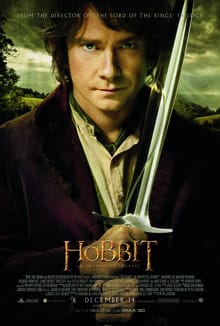
Image credit: Warner Bros., 2012. Wikipedia. Fair use of a low-resolution copy of a copyrighted image to illustrate the topic under discussion.
