gnarly
7 October 2026
The history of gnarly is one of changing forms within English. The adjective gnarly appears in the mid nineteenth century with a sense of covered with protuberances, knotted, twisted. It was formed from the older gnarled, which dates to the early seventeenth century and which also came in the forms knurled or nurled. These adjectives come from the noun knurl or nurl, meaning a protuberance, knob, nodule, etc. This noun, in turn, developed from knur or knurr, which dates to the early fifteenth century, and which means a growth or swelling in flesh or on the trunk of a tree. Beyond this the chain becomes murky, but the word is almost certainly an inheritance from Proto-Germanic as cognates appear in many Germanic languages.
Gnarly and its predecessors all carried literal meanings, or at least figurative ones that did not stray far from the literal meaning of a bumpy or knobbed. That would change in the late 1960s when gnarly was adopted by California surfing culture.
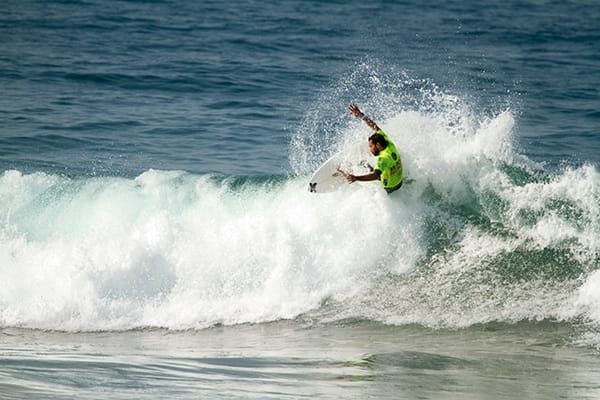
By 1968, gnarly had become surfing slang for a rough wave, one characterized by a surface that wasn’t smooth and hence was difficult to surf. The earliest use of this slang sense of gnarly in print that I’m aware of was by Dewey Schurman, the surfing columnist for the Santa-Barbara News-Press on 24 August 1968:
A small, rocky point marks the southern end of the best surfing area, a point with the friendly name of Tarantula. The waves there are even less friendly. On big south swells, Tarantula often shows a big, gnarly left wall. Almost any hollow left tube nowadays is described as “just like the Banzai pipeline.”
Schurman, who would later become the city editor of the News-Press, used gnarly in a number of subsequent columns. Bonnie Taylor-Blake, who discovered Schurman’s use of the word, also found 1968 references to a Southern California rock band (one speculates that it was a surf rock band) named the Gnarly Beasts, sometimes rendered as Gnarley or Knarly.
From this surfing sense, gnarly would acquire extended, and often contradictory, senses. It could mean risky or dangerous, as attested in a 21 September 1978 glossary of skateboard slang in the Los Angeles Times:
GNARLY: Crazy, like Rad; used for outstanding daring feats or outstanding wipe-outs.
Skateboarding culture overlaps with surfing culture, but that same year gnarly would start to be used outside of those milieux when Stephen King’s novel The Stand used the word twice:
“Hang loose” meant don’t get upset. “Rad” and “gnarly” were ways of saying a thing was good.
And:
“Hey, boy,” The Kid said flatly. Then one of his doll’s eyes closed in a solemn wink. “Don’t tell me—I’ll tell you. How’s that beer? Pretty fuckin gnarly, ain’t it? Hits the spot after ridin that kiddy-bike, don’t it?”
“It sure does,” Trashcan Man said, and took another big swallow of warm Coors. He was insane, but not yet insane enough to disagree with The Kid while he was driving. Nowhere near.
And it could also mean something unpleasant, as in this passage from Joseph Wambaugh’s 1981 novel Glitter Dome in which a woman who is offered a part in a porn film uses gnarly to describe her past work as a sex worker:
I mean, I was getting antsy around here in the house all the time, with her working so much and all. I wanted my own money and it seemed better than going back to those gnarly massages. Eight thousand for three days?
Gnarly reached a wider audience with the 1982 film Fast Times at Ridgemont High, where, in a memorable scene, the surfer character Jeff Spicoli, played by Sean Penn, utters, “Oh, gnarly!” while witnessing an autopsy.
Sources:
Crowe, Cameron. Fast Times at Ridgemont High (film). Amy Heckerling, dir. Universal Pictures, 1982.
Green’s Dictionary of Slang, accessed 12 September 2026, s.v. gnarly, adj.
King, Stephen. The Stand (1978). New York: Anchor Books, 1990, 662 and 728. Archive.org.
Middle English Dictionary, 28 July 2026, s.v. knur, n. (stub entry).
Oxford English Dictionary Online, 1900 (2003 addition), s.v. gnarly, adj., gnarled, adj.; 1901, s.v. knurled, adj., knurl, n., knur | knurr, n.
Schurman, Dewey. “How to Avoid the Malibu Crush.” Santa Barbara News-Press (California), 24 August 1968, C-3/1–2. Newspapers.com.
“‘Taking a Burger’ Isn’t Meal to Skateboarders in the Know.” Los Angeles Times, 21 September 1978, G16/1. ProQuest Historical Newspapers.
Taylor-Blake, Bonnie. “Gnarly (surfer slang; slight antedating, 1968),” ADS-L, 19 August 2026.
Wambaugh, Joseph. The Glitter Dome. New York: William Morrow, 1981, 249. Archive.org.
Image credit: Faypearse, 2014. Wikimedia Commons. Licensed under the Creative Commons Attribution-Share Alike 4.0 International license.
