French toast
13 April 2026
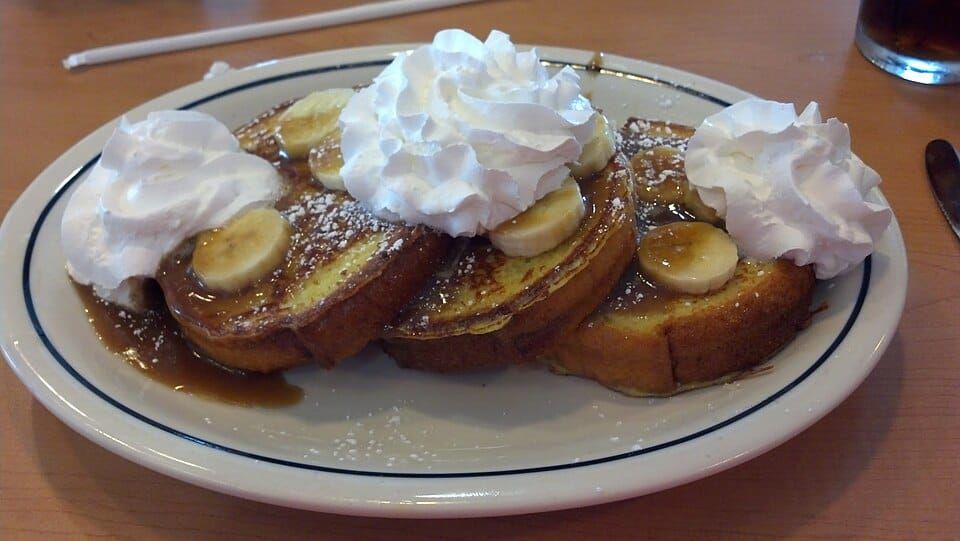
French toast is a dish, typically served at breakfast or brunch, of slices of bread soaked in beaten eggs and then fried. It is usually served with syrup. Why it is French is a bit of mystery. The earliest use of the present-day form of the dish that I have found ascribes it to an anonymous French cook, but the name is more likely simply from a general ascription of things culinary to the French.
But before we get to the dish as we know it today, I have found three early uses of the term French toast to refer to a different method of preparing and serving toasted bread. In these cases, the French is a reference to using French bread. Whether this is a baguette or another type of bread, I do not know. The first of these uses is from Robert May’s 1660 The Accomplisht Cook:
French Toasts.
Cut French Bread, and toast it in pretty thick toasts on a clean gridiron, and serve them steeped in claret, sack, or any wine, with sugar and juyce of orange.
A century later, Thomas Houdlston publishes a verbatim recipe in his c. 1760 A New Method of Cookery. And J. Skeat, in their 1769 The Art of Cookery and Pastery Made Easy and Familiar, includes “French Toast” as a side dish on a suggested menu for a cold supper. Exactly what this dish consists of cannot be determined, but it seems likely to be this same type of wine-soaked toast.
These early uses are probably unrelated to the dish we know today, which seems to have been independently created and coined in the mid nineteenth century. We have this recipe that appears in the magazine Southern Planter in August 1844:
FRENCH TOAST
From a French gentleman, of this city, we obtained the following recipe:—Take a loaf of light baker’s bread and cut it into thin slices—mix three eggs—three table-spoonfuls of sugar, and a tea-cup of milk, taking care to beat the eggs until they are very light. Soak the bread in this custard. Have some lard boiling hot, enough to cover the bread, and fry it until it is brown—then serve it up hot.
This is a very convenient and very pleasant dessert. The children, who are very fond of it, have dignified it with the name of French toast.
Sources:
“French Toast.” Southern Planter, August 1844, 192/2. ProQuest Magazine.
Houdlston, Thomas. A New Method of Cookery. Dumfries, Scotland: c. 1760, 57. Gale Primary Sources: Eighteenth Century Collections Online (ECCO).
May, Robert. The Accomplisht Cook, or the Art and Mystery of Cookery. London: R.W. for Nathaniel Brooke, 1660, 162. ProQuest: Early English Books Online.
Oxford English Dictionary Online, September 2009, s.v. French toast, n.
Skeat, J. The Art of Cookery and Pastery Made Easy and Familiar. London: 1769.
Photo credit: tengrrl, 2013. Wikimedia Commons. Flickr. Licensed under the Creative Commons Attribution-Share Alike 2.0 Generic license.
