enthusiasm / enthuse
16 January 2026
The meanings of words change over time. Sometimes words become more specialized; the Old English deor was used to refer to any kind of wild beast, but by the end of the thirteenth century had started to be used specifically to refer to the creature we now call a deer. Other words become more general over time; one such is enthusiasm.
Enthusiasm comes into English from Greek ἐνθουσιασμός and the Latin enthusiasmus, where it refers to the state of being possessed by a god. It was a religious term for a state of divine ecstasy or frenzy. This Latin and Greek meaning was the sense of the word when it was first used in English, but the earliest uses in English are in reference to heretical Christian sects who were thought to be falsely inspired by supposed divine influences. Here is one such use, in the form enthusiast, in a 1536 translation of Philip Melanchthon:
And it is profitable also as much as may be, to garnishe the ministration of the worde with al maner prayse agaynst mad men, whiche dreame that the holy ghoste is gyuen nat by the worde, but for certaine preparatio[n]s of theyr owne, if they syt ydle holdynge theyr tonges in darke places, lokyng after illumination / lyke as they dyd in olde tyme whiche were called enthusiastes whiche fayned them selues to be inflate and inspired by the diuine influence and power, and as these Anabaptistes do at this day.
Toward the end of the century, enthusiasm was being used in reference to being filled with a different kind of spirit. From a 1593 translation of François Rabelais’s Orthœpia Gallica:
In vvine is truth, that is to say, In vvine is truth.
Harke my friend, I vvill tell thee a thing in thine eare, tell no body if thou loue me, it shall rest secret betweene vs two: it is, that I find the vvine better and more pleasant to my tast then I vvas vvoont: more then I vvas wont I feare the meeting of a bad cup of vvine, and to tell you the plaine truth, the odour of vvine how much more it is delicious, smirking and surpassing, by so much more celestiall and delicate is it then oile, That is spoken like a man of learning. I vvill tell other stories. Tarry a little that I deduce a dram out of this bottell: Lo here my very and sole Helicon. See here my Fountaine Caballine. This is mine onely Enthusiasmos.
And by the beginning of the seventeenth century the word was being used to refer to poetic inspiration, being metaphorically possessed by one’s muse. From a 1605 translation of Du Bartas’s Divine Weeks and Works we see the French equivalent left untranslated:
For yet (besides my vaines and bones bereft
Of blood and marrow, through thy secret theft)
I feele the vertue of my spirit decayd,
Th’Enthousiasmos of my Muse allaid.
And on the title page of Thomas Dekker’s 1620 Dekker His Dreame we see enthusiasm used in a non-translation context:
Dekker his Dreame.
In which, beeing rapt with a Poeticall Enthusiasme, the great Volumes of Heauen and Hell to Him were opened, in which he read many Wonderfull Things.
And by the early eighteenth century we see enthusiasm being used in the sense we’re most familiar with today, that of a passion or intensity of feeling for some cause, principle, or activity. Here we see it in a 16 March 1717 letter by English bishop White Kennett on the subject of a planned invasion of England by Sweden which never happened:
And yet amidst these divisions at home we are daily threatened with invasion from abroad, though certainly we are so well prepared against it, that the King of Sweden, who was so desperate to project it, must have much more enthusiasm in him to put it in execution.
And in the early nineteenth century we start to see the backformation to enthuse. It is originally an Americanism, but its earliest recorded use is by the Scottish botanist David Douglas in a 9 July 1827 letter about the results of his trip to the Pacific Northwest. Douglas was a Scot, but he had spent several years in North America and picked up some of the idioms spoken there:
In Botany my expectations have not been realized, but at the same time, being in possession of several not included in the American Flora, many interesting and but partially known species, with some additional knowledge as to the geographical range of plants, an enquiry of the greatest importance, I have no reason to regret the journey At all events, my humble exertions will I trust convey and enthuse, and draw attention to the beautifully varied verdure of N. W. America.
While originally an Americanism, enthuse can now be found on both sides of the Atlantic. It is found primarily in an informal register, and there are many who criticize its use. But it quite clearly a well-established word, and while perhaps it is best to avoid its use in formal writing, in less formal contexts it is perfectly fine.
That’s quite a journey in a mere four centuries, from religious ecstasy and boozing it up to acquiring a sometimes-derided backformation.
Sources:
Du Bartas, Guillaume de Salluste. Bartas His Deuine Weekes & Workes. Joshua Sylvester, trans. H. Lownes, 1605, 341. ProQuest: Early English Books Online (EEBO).
Dekker, Thomas. Dekker His Dreame. London: Nicholas Okes, 1620, title page. ProQuest: Early English Books Online.
Douglas, David. Letter, 9 July 1827. In Athelstan George Harvey. Douglas of the Fir: A Biography of David Douglas Botanist. Cambridge: Harvard UP, 1947, 148. Cornell University Library: Core Historical Literature of Agriculture.
Kennett, White. Letter to Dr. Blackwell, 16 March 1716/17. In Henry Ellis, ed. Original Letters Illustrative of English History, second series, vol. 4. London: Harding and Lepard, 1827, 306. HathiTrust Digital Library.
Melanchthon, Philip. “The Apologie or Defense of the Confessyon of the Prynces of Germany.” Richard Taverner, trans. In The Confessyon of the Fayth of the Germaynes. London: Robert Redman, 1536, sig. N6v. ProQuest: Early English Books Online (EEBO).
Merriam-Webster.com, 27 November 2025, s.v. enthuse, v.
Oxford English Dictionary Online, September 2018, s.v. enthusiasm, n., enthuse, v., enthusiast, n.
Rabelais, François. Orthœpia Gallica. Eliots Fruits for the French. John Eliot, trans. London: Richard Field for John Wolfe, 1593, 41. ProQuest: Early English Books Online (EEBO).
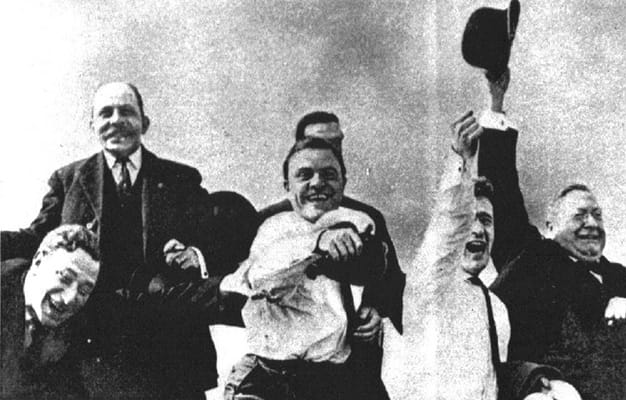
Photo credit: Unknown photograph, c. 1912. Wikimedia Commons. Public domain image.
