camp
24 August 2026
Camp has a general meaning of temporary dwelling place, originally used in military contexts. But it also has a slang sense, originating in gay slang, of flamboyance or exaggeration, or as an adjective meaning affected or effeminate.
The word was borrowed into Old English from the Latin campus, meaning a field, especially one used for mustering and training troops. In Old English it also acquired the sense of a battlefield, and the Old English verb campian meant to fight. But these forms dropped out of use following the Norman Conquest, when the noun was replaced by the Old French form chaump (strangely, English did not adopt the Norman dialectal form of the word, which was also camp). The English spelling of camp was reborrowed from modern French in the early sixteenth century.
We see the word being used in the Old English translation of Bede’s Ecclesiastical History of the English People, in this case in the sense of a fight or strife:
Martyralogium be symbeldægum haligra martyra, on þære ealle þa þe ic gemetan mihte, nales þæt an hwilce dæge ac eac swilce hwilce cyne compes, oþþe under hwilcum deman hie middangeard oferswiðden, ic geornlice awrat.
(I carefully wrote a martyrology all that I could find about the festivals of the holy martyrs, not only through what kind of camp [i.e., strife, battle] and by means of which judge [i.e., Christ] they overcame the world.)
Bede’s original Latin uses certaminis, the genitive singular of certamen, meaning strife, contest, battle.
With the reborrowing from modern French, both the noun and verb began to also be used in non-military contexts, such as hunting and fishing camps or in the context of traveling or nomadic groups. We can see this form and sense in a 1560 translation of Exodus 16:13:
And so at eue[n] the quailes came and couered the campe: & in the morning ye dewe laye rounde aboute the hoste.
A translation printed in London two years earlier used tentes rather than campe.
The sense of camp meaning a place of recreational activity for children, as in summer camp, developed in North America in the late nineteenth century as part of the physical culture movement. Here’s an early example of the usage from Rhode Island’s Newport Daily News of 20 March 1876:
The advantages of camp life, especially for boys who are in many cases too much confined in the house or the school room, are not easy to over-estimate. Dr. J. T. Rothrock of Wilkesbarre, Penn., purposes to establish during the four warmest months of the year a camp for boys among the mountains. Studies will not be neglected, while the boys will have opportunities to hunt, fish, and reap all the benefits of life in the open air, at the same time being protected from inclement weather and under the care of a physician.
The origin of the gay slang use of camp, referring to affected or effeminate mannerisms, comes into the language via a different path and isn't known for certain. But it is probably from the colloquial French se camper, meaning to assume a provocative posture, to strike a pose. The term appears in French in the late seventeenth century and is adopted by the nascent gay culture in the mid nineteenth century. Less likely alternatives include formation in English from the military association, either from an affected swagger or from the activities of camp followers and from the Scots camp meaning lively, playful.
We can see this sense of camp in the adjective campish that appears in a November 1868 letter from Frederick Park, a noted cross-dresser, to Lord Arthur Clinton, a Liberal politician and godson of Prime Minister William Gladstone, who was partnered with Ernest Boulton, a cross-dresser who appeared on stage with Park:
[My] campish undertakings are not at present meeting with the success they deserve.
In 1870 Park and Boulton were charged with incitement to commit unnatural offenses. Clinton died the day after receiving a subpoena to testify in their trial. The cause of his death was officially given as scarlet fever, but it is widely thought that he took his own life. (Speculation at the time also had him faking his death and fleeing to live abroad.) Both Park and Boulton were eventually acquitted.
We also see camp being used in relation to the arrest of several men for vagrancy in an article in Liverpool’s Evening Express of 23 October 1874:
The ticket found on one of the prisoners was handed up to the bench, and read as follows:—“Her Majesty, Queen of Camp, will hold a grand levee and grand ball masque on Wednesday, October 21st, 1874. Dancing to commence at ten o’clock; tickets, 1s. 6d. each. Ices, refreshments, &c., will be provided.”
The article also contains a noteworthy use of gay, ostensibly in the sense of bright and lively, but clearly in a homosexual context:
The whole of the prisoners were dressed in a gay manner. Mack wore a light muslin dress, with muslin bodice, ear-rings, and white gloves; Hallas had on a black lace shawl, and Fox was similarly attired. Their hair (or wigs) were dressed after the latest fashion for ladies. They also wore dancing boots.
Sources:
Bede. The Ecclesiastical History of the English People. Bertram Colgrave and R. A. B. Mynors, eds. Oxford: Clarendon Press, 1969, 570.
———. Ecclesiastical History of the English People, part 1.2. Thomas Miller, ed. Early English Text Society O.S. 96. London: Oxford UP, 1891, 5.22, 484. Archive.org.
Dictionary of Old English: A to Le, 2024, s.v. camp1, n., campian, v.
Exodus 16:13. The Bible and Holy Scriptures Conteyned in the Olde and Newe Testament. Geneva: Rouland Hall, 1560. ProQuest: Early English Books Online.
Exodus 16:13. The Holie Bible. Conteyning the Olde Testament and the Newe. London: Richarde Iugge, 1558. ProQuest: Early English Books Online.
Green’s Dictionary of Slang, accessed 6 August 2026, s.v. camp, adj., camp, n.2.
“Manchester Masqueraders in Trouble.” Evening Express (Liverpool, England), 23 October 1874, 2/2. British Newspaper Archive.
Middle English Dictionary, 28 July 2026, s.v. chaump(e, n.
“North Mountain School of Physical Culture.” Newport Daily News (Rhode Island), 20 March 1876, 2/4. NewspaperArchive.com.
Oxford English Dictionary Online, 1888, s.v. camp, n.1, camp, n.2, camp, v.1, camp, v.2; December 2019, s.v. camp, adj. & n.5.
Park, Frederick. Letter to Lord Arthur Clinton, November 1868. Quoted in Jonathan Ned Katz’s Love Stories: Sex between Men before Homosexuality. Chicago: Univ. of Chicago Press, 2001, 193. Archive.org.
Scottish National Dictionary, 1941, s.v. camp, n.1, v., adj. Dictionaries of the Scots Language | Dictionars o the Scots Leid.
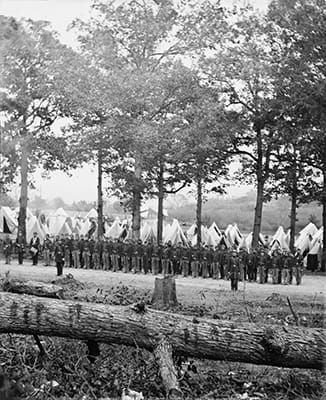
Photo credit: Unknown photographer, c. 1861. Wikimedia Commons. Library of Congress. Public domain image.
