breaking bad
26 December
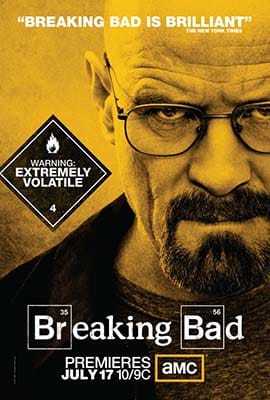
The popular US television show Breaking Bad (2008–13) is about a high-school chemistry teacher in Albuquerque who, after being diagnosed with lung cancer and with the assistance of an ex-student turned failed drug dealer, begins to cook and sell crystal meth. While the show has been popular with both audiences and critics, the title has baffled many. What does breaking bad mean? Where does the phrase come from?
The answers to these questions are not surprising but digging the answer out of reference books is somewhat difficult, because for most of its life to break bad was not a catchphrase, but simply a normal verb phrase, consisting of a verb coupled with a variety of adjectives. One could break bad, but one could also break good, or break lucky, or break better, etc. It wasn’t until the 1960s that to break bad developed into a fixed phrase, with a sense of to become angry or belligerent, in Black slang. And in the series, White's turn to criminality and violence indicates that the title stems from this Black slang usage.
The use of break in various contexts of something emerging or becoming apparent dates to the seventeenth century. Today we often speak of breaking news, and this phrasing dates to Thomas Middleton’s c. 1615 play The Witch which contains the line “What news breakes there?”
The use of break in cricket to mean a ball that changes its trajectory dates to the late nineteenth century. We have this example from a 6 October 1884 article describing an interview with famed cricketer W. G. Grace:
He says that a fast bowler can “break” both ways, but admits this cannot be done with precision.
And it appears in American baseball slang by the end of the century when it is used by The Chicago Daily News on 8 October 1899:
Katoll is spoken of as the possessor of a sizzling curve that comes up with a phenomenal burst of speed and breaks lightning fast.
And break wrong starts being used in a more general sense by baseballers not long after. From the Detroit Free Press of 9 June 1901:
The unexpectedly poor showing of the Tigers in the series with the eastern teams on the home grounds should not make the followers of the team lose faith in their favorites. The team was laboring under many disadvantages and everything seemed to break wrong for them.
And this the following week in the Rockford, Illinois Morning Star of 15 June 1901:
But for eight innings everything seemed to break wrong for the locals.
Shortly after this, various forms of break good/right/lucky start appearing. Such examples of the verb to break paired with various adjectives can be found right up to the present day. But the use of break bad as a fixed phrase isn’t recorded until the 1960s, when it starts appearing in African-American slang with the sense of to become aggressive or angry. Claude Brown’s 1965 novel Manchild in the Promised Land has:
Down home, when they went to town, all the n[——]rs would just break bad, so it seemed. Everybody just seemed to let out all their hostility on everybody else.
The earlier uses of break bad are primarily in the sense of things taking an unfortunate turn, of bad luck, with criminality, anger, and violence becoming attached to the phrase when it becomes a fixed locution in Black slang.
Sources:
Brown, Claude. Manchild in the Promised Land. New York: Macmillan, 1965, 302. Archive.org.
Dickson, Paul. The Dickson Baseball Dictionary, third edition. New York: W. W. Norton, 2009, s.v. break, break ball, 134.
Green’s Dictionary of Slang, accessed 22 November 2025, s.v. break, v.2.
“Kiernan’s Krew Beaten in Tenth.” Morning Star (Rockford, Illinois), 15 June 1901, 4/3. Readex: America’s Historical Newspapers.
“An Interview with Dr. W. G. Grace.” Huddersfield Daily Chronicle (West Yorkshire), 6 October 1884, 4/2. Gale Primary Sources: British Library Newspapers.
Middleton, Thomas. The Witch. London: J. Nichol, 5.3, 106. Gale Primary Sources: Eighteenth Century Collections Online (ECCO). The play existed only in manuscript form for over 150 years before it was published in 1778. The manuscript is Oxford, Bodleian Library, MS Malone 12.
Oxford English Dictionary Online, March 2024, s.v. break, v.
“Whirl of the Sporting World.” Detroit Free Press (Michigan), 9 June 1901, 10. ProQuest Newspapers.
Image credit: Sony Pictures Television/AMC, 2011. Fair use of a low-resolution copy of a copyrighted work to illustrate the topic under discussion.