boycott
13 March 2026
To boycott someone or something is to refuse to buy goods or otherwise engage in commerce with them. Boycotts are usually undertaken as a form of economic, political, or social protest.
Boycott is an eponym, a word that comes from a person’s name. The namesake is Captain Charles Boycott, who managed the Irish estates of the Earl of Erne, an absentee landlord in County Mayo, Ireland. In September 1880, Erne’s tenants and laborers were demanding reduced rents, and Boycott evicted them. In response, the Irish Land League, under the leadership of Charles Parnell, organized the tenants and neighbors to resist the evictions, refuse to rent a farm from which someone had been evicted, refuse to work on the estate Boycott managed, and even to refuse to deliver the mail to Boycott. Boycott managed to get the autumn crop harvested, but at a loss, and by the end of the year he had resigned his post and returned to England.
News of the actions at Boycott’s farm was reported in newspapers throughout Ireland and Britain on 25 September 1880. But at this point the land agent’s name was not yet being used as either a verb or a noun. Here is what London’s Daily News said on that date:
Thursday was the last day for serving the processes, and on Sub-Inspector M‘Cardle making his appearance a crowd proceeded to the house of the agent, Captain Boycott, and drove off every labourer and tenant on the estate. It was resolved that the agent should be deprived of any help whatever from the tenantry.
But on 1 November 1880, the verb to boycott appears in newspapers throughout Ireland and Britain. Here is a passage from Dublin’s Freeman’s Journal of that date:
Mr. John Lavelle proposed—
That we hereby pledge ourselves to take no land from which a tenant has been evicted.
He advised the people to “Boycott” any man who took a farm from which another was evicted.
And by December 1880, the noun boycott and the adjectival use of the past participle boycotted are in place. The Times of London on 9 December uses both:
The magistrates feel a difficulty about treating the Land League meetings as unlawful assemblies, and this makes the law in a great measure inoperative. They also do not feel warranted in regarding the threat of “Boycott” as one that comes within the Act, as it does not refer to violence. This appears to be unreasonable, as Boycotting is a most effectual means of intimidation.
[…]
A butcher who was charged with buying the sheep of a “Boycotted” farmer came forward and stated that for all he possessed he would not break the rules of the League. He had erred through the inadvertence and he promised not to offend again.
The rapidity with which the word boycott caught on is astounding. It even managed to make its way into French by the end of the year. Also surprising is that the term has lasted. Most such eponyms rapidly fade as the events that inspired them recede into memory. For example, how many people still use to bork, meaning to defame someone in order to prevent them from attaining public office, a word inspired by the treatment political opponents gave U.S. Supreme Court nominee Robert Bork in 1987. Boycott has not only survived, but most people who use the word don’t even know who Charles Boycott was.
Sources:
“Ireland.” Daily News (London), 25 September 1880, 6/5. Gale Primary Sources: British Library Newspapers.
“Ireland” (8 December). Times (London), 9 December 1880, 10/2. Gale Primary Sources: Times Digital Archive.
“The Land Question.” Freeman’s Journal (Dublin), 1 November 1880, 6/8. Gale Primary Sources: British Library Newspapers.
Oxford English Dictionary Online, December 2008, s.v. boycott, v., boycott, n.
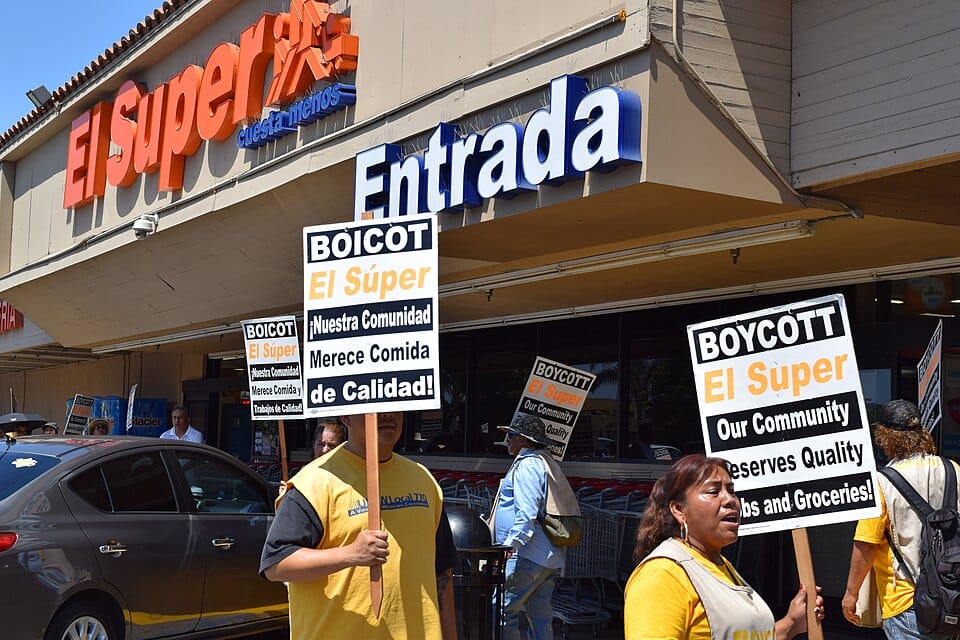
Photo credit: United Food and Commercial Workers (UFCW), 8 July 2017. Flickr.com. Wikimedia Commons. Licensed under the Creative Commons Attribution 2.0 Generic license.
.jpg?ref=wordorigins-org.ghost.io)